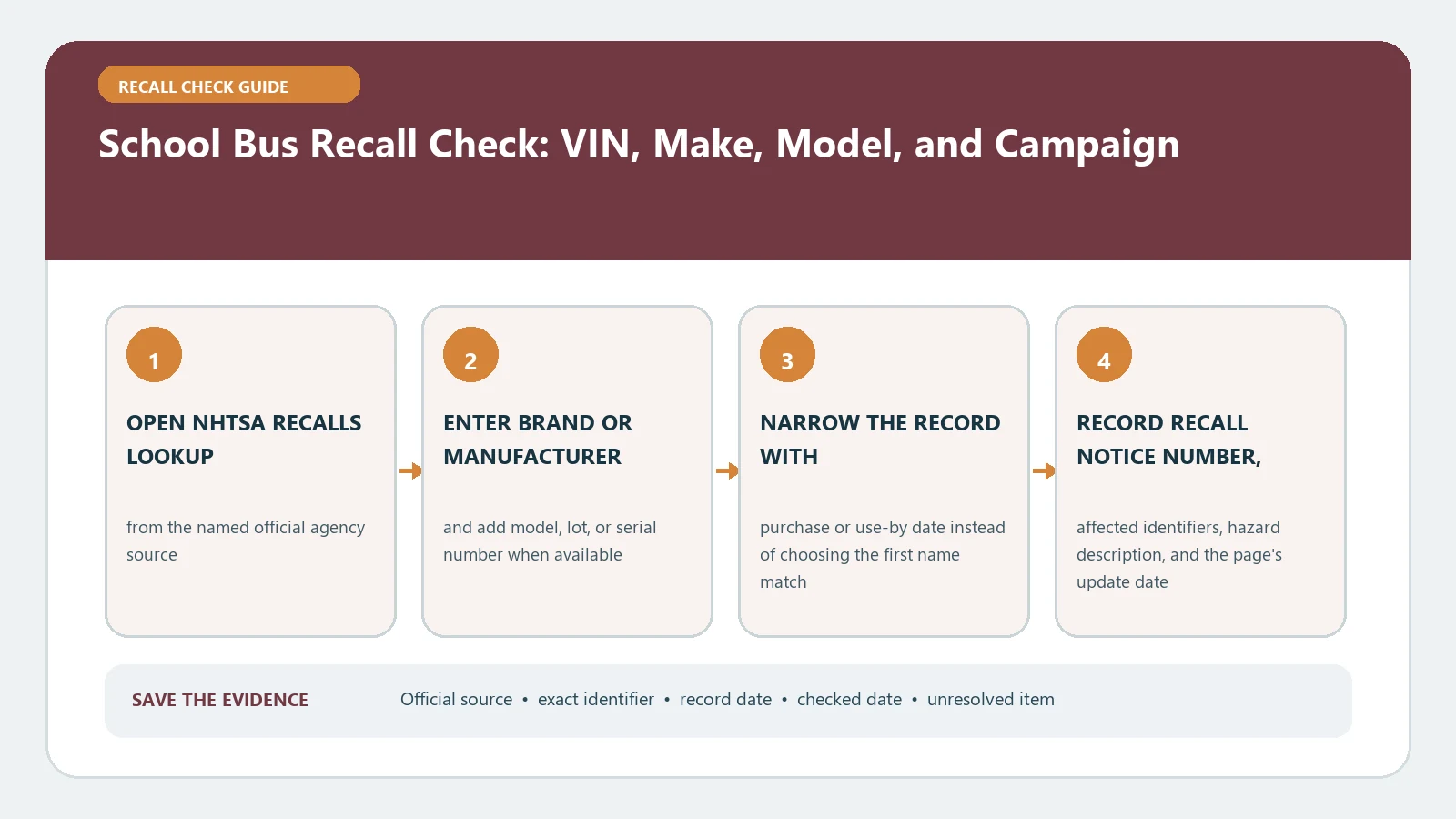
Check a school bus for recalls with its full 17-character VIN, then verify the make, model year, campaign, affected component, and current remedy. A fleet name or bus number is not a federal identifier. Keep body-maker and chassis information alongside the VIN because the vehicle may combine systems from more than one manufacturer.
Last checked August 26, 2026. New VINs can be added to a campaign, open status can change after service, and fleet equipment may be replaced. Recheck NHTSA and the manufacturer before assigning the bus to service after an alert or repair.
Tie the fleet number to the legal vehicle identity
Start with the certification label and the VIN visible on the bus. Compare it with registration, title, and fleet asset records. Record the chassis maker, body maker, model year, gross vehicle weight rating, seating configuration, and fleet number without merging them. A district may call a bus unit 42 for years even after paperwork, plates, or route assignments change.
| Fleet evidence | Field to preserve | Recall use |
|---|---|---|
| Federal certification and VIN label | Complete VIN, manufacturer, manufacture date, GVWR | Individual federal lookup and identity check |
| Body-builder plate | Body make, model, serial, completion date | Body-system and final-stage campaign search |
| Fleet record | Unit number, route, depot, current status | Locates and controls the physical bus |
| Equipment labels | Lift, restraint, seat, tire, door, camera, or accessory details | Tests separately identified equipment populations |
Photograph the plates in context so another employee can find them again. Preserve zeroes and suffixes. If a label is damaged, do not reconstruct the VIN from the fleet number or from a similar bus. Resolve it through the title file, state vehicle record, manufacturer, or an existing maintenance document.
Export the fleet roster before a batch check and keep it unchanged for that review. Record buses that are spare, leased, sold, out for body work, or parked at another depot. A VIN omitted because the physical bus was temporarily unavailable remains an open inventory task, not a clean fleet result.
Run the federal lookup one bus at a time
Use the NHTSA recall lookup for each VIN. NHTSA describes VIN and supported plate searches as the way to learn whether a particular vehicle needs repair for a recall. A year, make, and model search is broader and can surface recalls, investigations, complaints, and manufacturer communications; it should be a second pass rather than the fleet’s only check.
- Enter the VIN copied from the bus and verify the displayed identity.
- Open every unrepaired campaign and record the NHTSA ID.
- Copy the affected component, consequence, remedy, and manufacturer contact.
- Assign an operational owner and a maintenance work order for each campaign.
- Repeat the lookup after the manufacturer reports repair completion.
For a rejected or questionable VIN, the NHTSA VIN recall guide provides a transcription and decoder sequence. Do not cycle through guessed characters to obtain a plausible bus result.
Search chassis, body, and equipment names separately
A campaign can originate with the chassis maker, final-stage school-bus manufacturer, or an equipment supplier. Search the broader NHTSA vehicle and equipment records using both manufacturer names, the model year, and the component type. NHTSA’s recall resources page explains that manufacturer communications are also searchable for vehicles and equipment. A service bulletin is not automatically a safety recall, so label each record accurately.
Inspect current equipment identity when the campaign concerns tires, seats, wheelchair lifts, restraint systems, warning lights, doors, stop arms, or other replaceable parts. Maintenance may have moved an affected component onto a different bus or installed a replacement that falls outside the original build sheet. The physical label and installation record decide which fleet asset needs action.
When equipment moves between buses, record removal and installation dates plus both fleet numbers. Search the equipment model even if the donor bus was sold. This prevents a closed vehicle file from concealing a lift, seat, tire, or restraint that remains active elsewhere in the fleet.
Keep the recall decision separate from daily safety checks
The NHTSA school bus safety page describes federal vehicle safety standards and school-bus design features. State rules, district inspections, driver pre-trip checks, and maintenance programs address additional operational duties. A federal recall result answers whether a safety campaign appears for the searched vehicle or equipment; it does not replace those other checks.
Likewise, passing an inspection does not prove that a newly announced recall is closed. If a campaign affects braking, steering, fire risk, seating, doors, warning systems, or another operationally significant component, route the notice to the person authorized to decide whether the bus can remain in service. This guide cannot make that dispatch decision.
Resolve a missing campaign or conflicting service answer
NHTSA states that a VIN search can omit already repaired recalls, some recent campaigns whose VIN population is still being assembled, certain older recalls, actions from some small manufacturers, non-safety customer-service campaigns, and international recalls. A zero-unrepaired result therefore does not prove that the bus has no defect, no completed history, or no body or equipment notice.
If a manufacturer letter names the fleet but the VIN page is empty, retain the letter, confirm its campaign number, and ask the manufacturer which VIN, body serial, or equipment range controls. When a dealer says work is complete but the federal record remains open, request the repair order and completion-report date. Preserve both records until the discrepancy is explained.
Manage the remedy as a fleet control
One campaign can affect several buses, but each VIN needs its own row. Track notice received, bus located, operating decision, appointment, parts status, repair order, completion date, and post-repair lookup. Keep replacement-component serials and identify any equipment removed from one bus and stored or installed elsewhere. The remedy completion guide helps distinguish a scheduled repair from a closed action.
The final fleet record should show affected, excluded by a specific campaign field, repaired with evidence, or unresolved. It should also name the official URL and August 26, 2026 check date. That record supports maintenance accountability; it does not certify the present condition of the entire bus or guarantee compliance with state and local pupil-transportation rules.