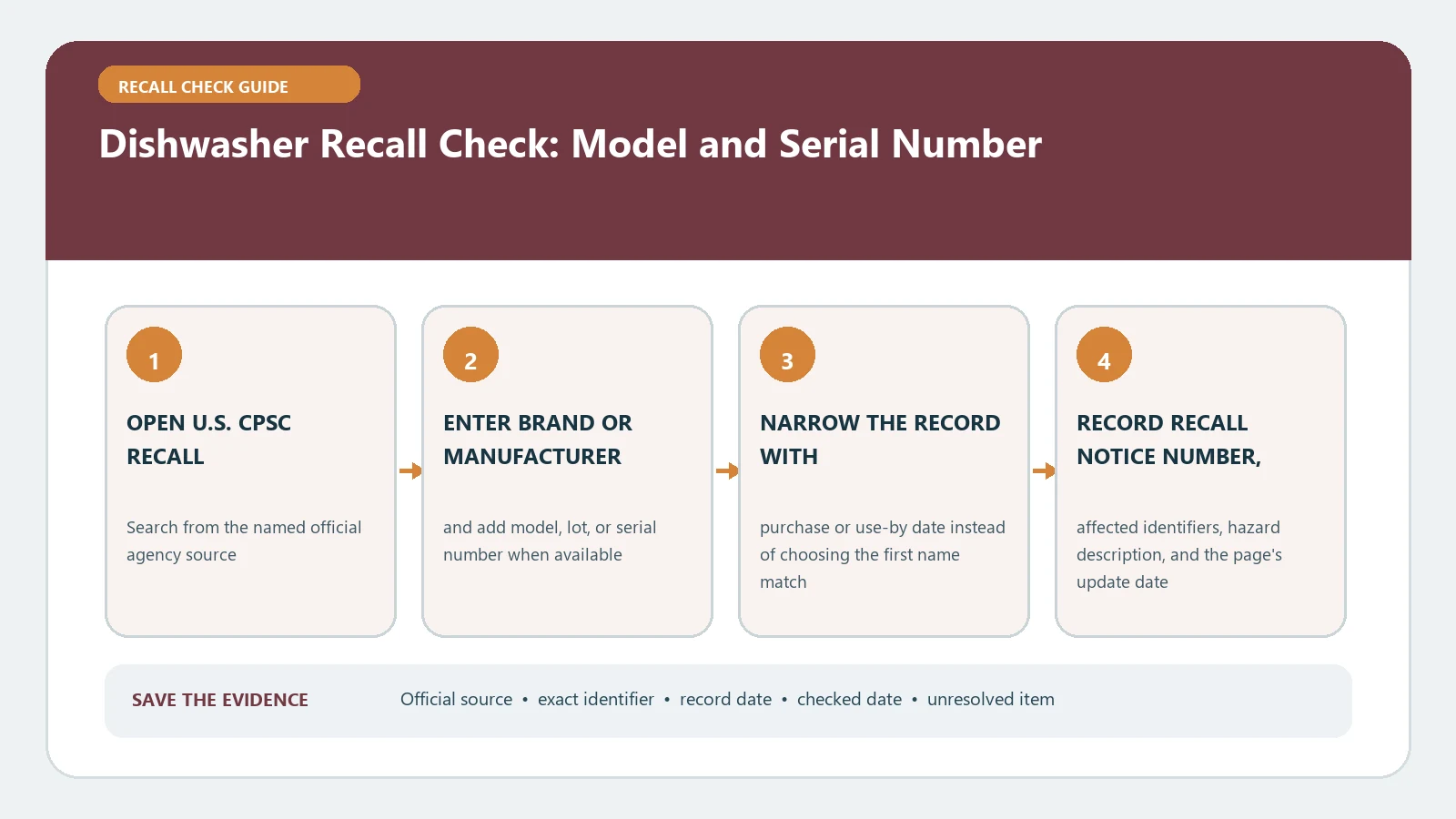
Check a dishwasher recall from the identification plate inside the door opening, not from the logo or kitchen appearance. Compare the complete model and serial with the ranges in the CPSC notice, confirm any manufacture or sale-date conditions, and follow the remedy for that precise unit. Similar dishwashers can share a door and control panel while falling into different production populations.
Reviewed August 26, 2026. Revisit the live dishwasher and general CPSC notices before service because contact routes and remedy availability may change after the initial announcement.
Open the door and capture the entire identification plate
Switch off the machine and wait until it is cool and dry enough to inspect safely. Typical labels sit on the left or right edge of the tub, door jamb, or inside of the door. Photograph the plate straight on and from an angle that exposes faint printing. Do not remove the label or dismantle the control panel.
| Dishwasher field | Record exactly | Common mistake |
|---|---|---|
| Model | Letters, digits, suffix, color or installation code | Stopping at the shared family prefix |
| Serial | Full value, including leading zeroes and letters | Using an order number instead |
| Manufacture evidence | Date code or date if the notice names it | Substituting the purchase date |
| Configuration | Built-in or portable, width, finish, handle or panel style | Letting appearance override identifiers |
| Service history | Prior repair, replaced control, dealer invoice | Assuming service completed a recall |
If the dishwasher came with a home purchase, also photograph any installer or service label, but keep it separate from the manufacturer plate. A property inspection report may call the appliance by brand and age without recording the model or serial needed for a recall decision.
A notice table can require two exact range matches
The CPSC dishwasher recall collection includes an ASKO notice that lists model rows and serial-number ranges and states where those identifiers appear. This demonstrates the correct test: the model must be one of the listed values and the serial must fall within the row’s stated interval.
Use the current CPSC recall search to find every plausible campaign, not only the category example. Search the full model, a shortened family stem, the manufacturer, and dishwasher. Private-label or acquired brands can make the recalling firm different from the name printed on the front.
- Locate the exact model row in the affected-products section.
- Compare the full serial with both endpoints and any prefix rule.
- Apply manufacture, distribution, color, or configuration limits only as written.
- Save the hazard, consumer action, remedy, and recall date.
Model-family resemblance cannot replace the suffix
Manufacturers use suffixes for market, finish, panel, voltage, or installation variations. If a recall table contains the complete model, do not assume every model beginning with the same characters is included. Conversely, never reject a listed model because a custom cabinet panel makes the exterior look different.
Serial intervals also require literal comparison. Preserve letter blocks and fixed-length sections before comparing numeric portions. If the serial format differs from the notice, ask the manufacturer whether the label is a production serial, service serial, or control-board code. Record the answer rather than converting it privately.
Built-in kitchens add a second identity trap. A cabinet panel can conceal the original finish and the retailer invoice can use a package or installation SKU rather than the appliance model. Open the door and rely on the tub or jamb plate. If the notice lists a model followed by a serial interval, make a two-column comparison and retain a photograph showing both values on the same label. For rental property, record the unit address, appliance location, landlord or manager, and service history only as custody information. Those facts help locate the dishwasher later but do not widen recall scope. If a technician previously replaced a door, control, pump, or wiring harness, ask whether the original identification plate remained with the chassis and whether the work order referenced a CPSC campaign.
For a model with several labels, treat the manufacturer chassis plate as primary unless the notice directs owners to another component code. A certification mark, energy label, or installer sticker can look official while answering a different question. Photograph all of them, but identify which value the recall table actually requests.
If the plate is missing, painted over, or unreadable
Check the other door edge, tub lip, manual packet, delivery invoice, warranty registration, installer photograph, and past service order. A replacement control panel can display a part number that is not the dishwasher model. Ask authorized service to document the expected plate location without dismantling an unsafe machine.
A home purchase date, estimated appliance age, or retailer SKU cannot substitute for a serial when the notice uses a serial range. Leave the result unresolved. The appliance recall guide offers a wider label-recovery workflow, while the refrigerator check should be used only for that separate appliance.
Leaks, overheating, or electrical damage require their own response
Follow the current notice’s stop-use direction for a matched dishwasher. If there is smoke, burning odor, sparking, heat damage, or active leaking near electricity, prioritize personal safety and appropriate emergency or utility response. Do not run a diagnostic cycle merely to reproduce the problem for a photograph.
Visible failure is not required for a recall match, and visible damage does not by itself prove the machine belongs to a recall. Keep condition photographs, incident details, and recall identifiers in separate records. A CPSC incident report can describe a product problem but does not activate a manufacturer repair.
Record what the technician actually completed
For repair, save the recall number, unit model and serial, service authorization, appointment, replaced part, technician record, and completion date. A generic maintenance visit or control-board replacement does not establish recall completion unless the record ties it to the campaign. For refund or replacement, retain intake and disposition evidence required by the program.
A no-match search does not certify installation, wiring, present condition, or freedom from an unannounced defect. Finish as affected, excluded, or unresolved. State the exact matching or mismatching field, preserve the live notice URL, and date the decision. That record is what a future owner or service provider can reproduce.