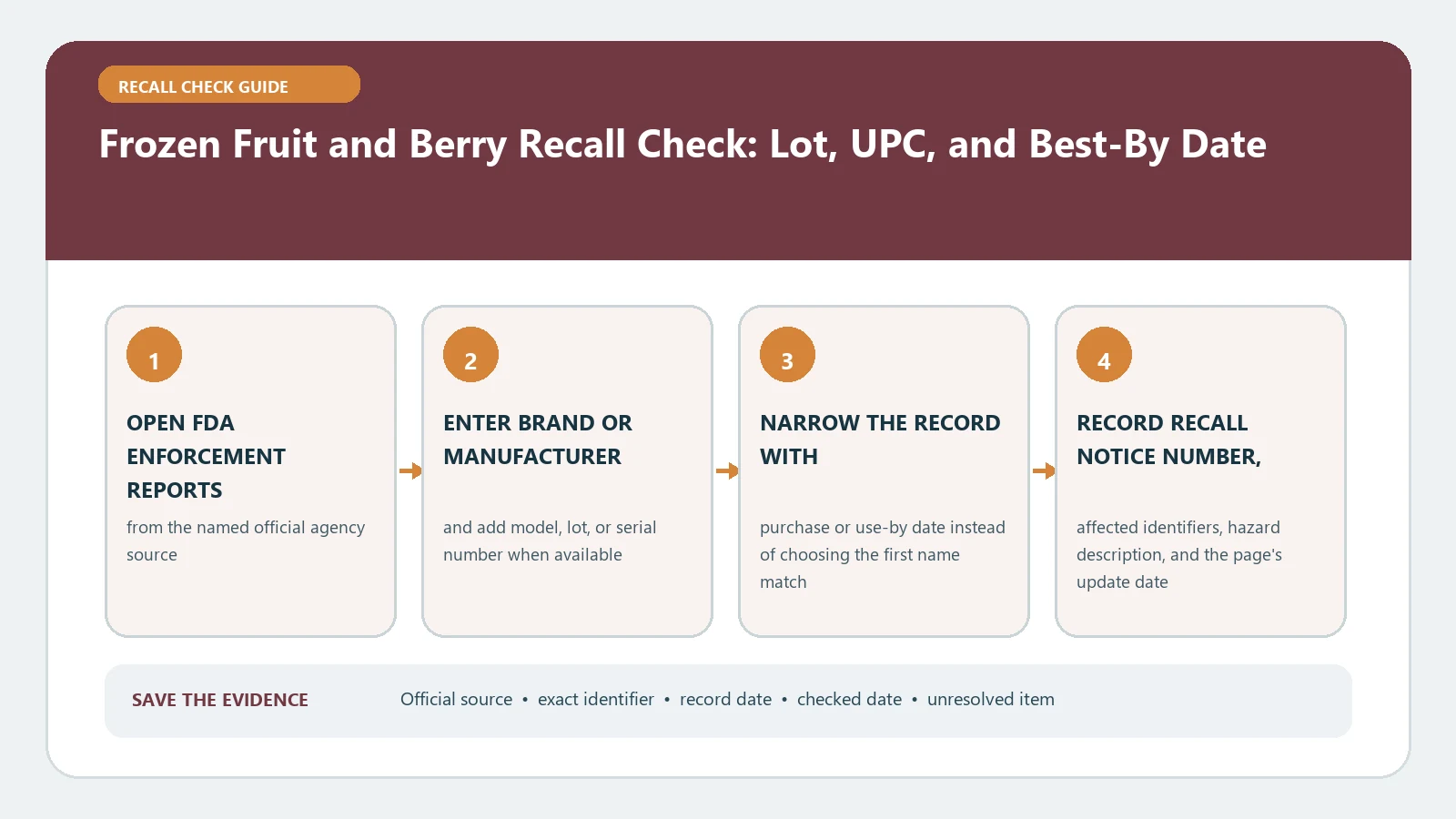
Keep a frozen-fruit package out of use until its brand, fruit or blend name, package size, UPC, lot code, and best-by date have been compared with the complete official recall notice. A matching berry type or store name is not enough. Frozen products can remain in a household for months, so the decisive evidence is usually on the original bag rather than in a recent shopping list.
Reviewed August 26, 2026. FDA announcements and distribution details can be revised, expanded, or archived. Check the live record again before returning or discarding the package.
Photograph the unopened evidence while it is still frozen
Place the bag in a separate freezer bin or clean secondary bag without opening it. Photograph the front, back, barcode, ink-stamped code, and any sticker added by the retailer. Do not scrape frost with a sharp tool or thaw the food merely to read a faint code. A phone photograph taken at an angle often reveals an embossed or dot-matrix line more clearly.
| Package detail | Where it may appear | Decision it supports |
|---|---|---|
| Brand and exact variety | Front panel and ingredient description | Separates a named blend from other fruit sold by the same company |
| Net weight | Lower front corner | Distinguishes package configurations in the notice |
| UPC | Digits below the barcode | Matches the retail unit, not the shipping case |
| Lot or production code | Seal, back panel, or stamped edge | Connects the bag to a manufacturing run |
| Best-by date | Near the lot code | Tests the notice’s affected date window |
| Purchase location | Receipt or account history | Checks the states, stores, or channels listed for distribution |
Choose the FDA record that can answer the missing piece
Begin with FDA’s Recalls, Market Withdrawals, and Safety Alerts and search the brand, distributor, supplier, or exact fruit blend. That public list presents company announcements and selected warnings, but FDA states that not every recall receives a press release or remains on the page indefinitely.
Use FDA’s food recall guidance to understand what a complete announcement normally supplies: product description, packaging, UPC, lot or date codes, images, distribution, and the recalling firm’s instruction. If a news item lacks those fields, do not complete the comparison from the headline. Follow the announcement to its full product table or FDA record.
Store brands may hide the supplier name you need
A frozen-fruit processor can pack the same affected material under several retail labels. The notice may lead with the supplier while a bag displays a supermarket brand. Read the distributor statement and ingredient panel, then search both names. Product photographs in the notice help with packaging recognition, but the printed identifiers still control the final match.
Capture the notice revision date as well as the original announcement date. A company may expand the brand list, add a package size, or clarify distribution after the first release. Compare the current affected-product table with the saved version before closing a private-label bag as excluded. When a retailer owns the label, ask its recall desk to trace the UPC, purchase store, and transaction date back to the named supplier.
Do not collapse a blend into its most visible ingredient. A recall for one berry used in a mixed-fruit product may identify the blend by its finished-product UPC and date code. Likewise, a notice for a named blend does not automatically cover every bag of the same individual fruit. Record the label exactly and let the affected-product table define the boundary.
Require the notice and the freezer bag to agree
- Confirm that the product description names the same fruit, blend, and brand or private label.
- Match the package weight and UPC, including leading zeroes when the notice displays them.
- Compare the lot code and best-by date character for character; do not treat one matching field as sufficient when both are specified.
- Check distribution states, retail chains, online channels, and sale dates without using them to override a package mismatch.
- Read the recall reason and consumer action together, then save the exact announcement used for the decision.
The result should be one of three states. Affected means every required identifier falls inside the notice. Excluded means a decisive package field falls outside it. Unresolved means the package or record lacks enough information. That third state should stay out of use while you ask the recalling firm or retailer to identify the lot.
When the bag is missing, rebuild the trail without inventing a code
Fruit transferred to an unmarked container cannot be matched to a lot merely because the purchase date or store looks right. Look for a receipt, loyalty-account entry, delivery invoice, freezer photograph, or another unopened bag from the same purchase. Ask the retailer whether its record identifies a UPC or fulfillment batch. If none of that recovers the affected fields, describe the item as unidentified rather than assigning the notice’s lot to it.
For a broader FDA package workflow, use the FDA food recall check. When the notice cites Listeria, Salmonella, or an undeclared allergen, the hazard-specific food recall guide explains why the affected population and cleaning direction must come from that record rather than from a generic freezer routine.
Separate exposure handling from the refund task
Follow the notice’s instruction about return, disposal, and cleaning. Do not donate the food or pass it to another household. If anyone may have eaten the product and has health concerns, preserve the package details and contact a health professional; a store refund cannot answer an exposure question. Keep photographs before surrendering the bag if doing so does not conflict with the notice.
Check every freezer used by the household, including garage units, vacation-property freezers, and portions divided into secondary containers. Record each package as affected, excluded, or unresolved, then attach return receipts or disposal notes. The recall remedy guide can help organize a delayed consumer response. This guide routes and interprets official records; it does not determine whether an unidentifiable bag belongs to a recalled lot.
An FDA search result does not prove that a frozen product is unaffected. FDA explains that its public company-announcement page does not contain every recall and that older announcements move outside the current display window. A defensible exclusion needs a specific mismatch in the live notice or a traceability answer from the recalling firm or retailer. If neither exists, retain the photographs and leave the package unresolved rather than converting silence into a safety conclusion.