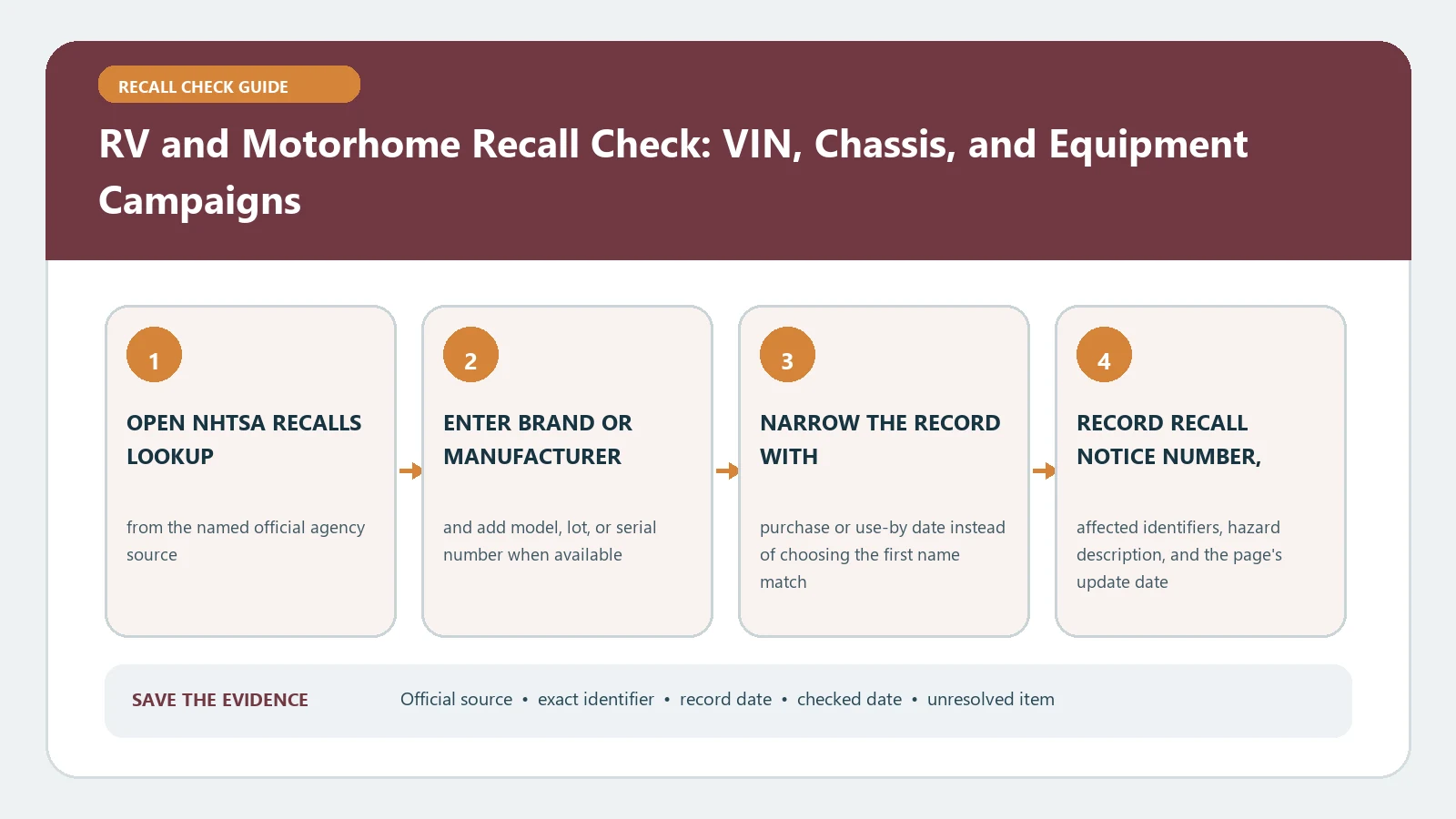
An RV or motorhome recall check needs more than one identity: the complete vehicle VIN, the chassis maker, the final-stage or coach manufacturer, and the installed equipment. Run the VIN through NHTSA, then search the coach and each safety-relevant component by its own make and model so a chassis result does not hide an appliance or equipment campaign.
Reviewed August 26, 2026. VIN populations, manufacturer communications, parts availability, and remedy status can change. Repeat the live checks before buying a used RV, beginning a trip, or treating an old service invoice as proof of completion.
Map the motorhome as a stack of manufacturers
A motorhome can begin as a chassis or incomplete vehicle and receive its body, living systems, and equipment later. The badge on the front may identify the chassis while the model name on the side identifies the coach builder. Generator, refrigerator, range, awning, step, tire, seat, hitch, and electrical components can carry labels from still other manufacturers. Put those identities in separate rows before searching.
| RV layer | Identifiers to record | Likely search question |
|---|---|---|
| Vehicle and chassis | 17-character VIN, chassis make, model year, GVWR | Does this vehicle have an unrepaired NHTSA campaign? |
| Coach or final-stage build | RV make, model, floor plan, coach serial, build date | Does the completed motorhome enter a coach-maker population? |
| Road equipment | Tire, axle, hitch, seat, belt, or lighting identifiers | Is separately identified motor-vehicle equipment affected? |
| Living equipment | Appliance model and serial, generator model, battery or charger | Does another regulator or manufacturer notice apply? |
Photograph the federal certification labels, chassis plate, coach data sheet, and each component rating plate. Keep the purchase file and build sheet, but do not replace a physical serial with a floor-plan name. Owners often swap tires, batteries, generators, or appliances, so the equipment installed today may differ from the original build list.
For a travel trailer or fifth wheel, the tow vehicle and trailer have separate identities and recall histories. Use the trailer VIN recall guide for the trailer branch, then check the tow vehicle independently. A campaign on one does not classify the other or any detachable equipment carried between them.
Confirm the VIN before opening the recall result
Enter the full VIN in the NHTSA recall lookup. Compare it with a second vehicle record before submitting. The federal page uses VIN or supported license-plate searches for individual unrepaired campaigns, while year, make, and model searches produce broader records that can include investigations, complaints, and manufacturer communications.
If the displayed identity looks wrong, use the NHTSA VIN Decoder to review manufacturer-reported fields. A decoder result helps reveal a transcription problem, model-year conflict, or unexpected incomplete-vehicle identity. It is not a recall search and will not identify the coach serial, current installed equipment, or whether repair work was performed.
- Save the VIN result with the lookup date and vehicle identity shown.
- Open every campaign and copy both federal and manufacturer numbers.
- Identify whether the affected component belongs to chassis, coach, or equipment.
- Compare the campaign population with the actual build and replacement history.
- Assign the remedy to the service network responsible for that layer.
Search beyond the VIN for coach and equipment campaigns
Use NHTSA’s broader make, model, model-year, and equipment searches after the VIN check. The agency’s investigations and recalls resources explains that consumers can search recalls by VIN, vehicle identity, equipment type, date, or NHTSA ID, and can also review manufacturer communications. This second pass can expose a general campaign or bulletin that the individual VIN surface does not display as an open recall.
Then search the motorhome maker’s recall page with the coach serial and the equipment makers with their own labels. A refrigerator, portable appliance, battery, or household-type product may belong to a consumer-product notice rather than the vehicle database. The appliance recall guide provides a model-and-serial workflow for that branch. Keep an equipment result separate from the chassis campaign even when both require work at the same dealer.
Assign each campaign to the part it actually names
Read the component, defect summary, consequence, affected population, and remedy together. A chassis brake campaign may apply regardless of the living-area configuration. A coach-body notice may be restricted by floor plan, build date, or final-stage serial. An equipment campaign may depend on a component model that was installed only in some units or later replaced.
Create one evidence card per campaign. Include the identifier that triggered the match, the component location, federal or company number, current instruction, contact, and status. Never use the completion of a chassis repair to close a coach-body record, and never assume a coach model match proves the current refrigerator or generator is original.
If the RV search returns no result or a mismatch
A zero-unrepaired VIN message has stated limits. NHTSA notes that it does not show completed recalls, some recently announced populations still being identified, certain older campaigns, some small-manufacturer actions, non-safety customer-service programs, or international recalls. Specialty and final-stage manufacture make those limits particularly important for an RV. Zero does not mean every coach system is safe or that no earlier work occurred.
When the coach builder or dealer says a campaign applies but the VIN lookup does not, ask for the campaign number and affected-vehicle basis. Compare the VIN, coach serial, build date, and component label rather than arguing from brand alone. Search the manufacturer communication and retain its date. If a label is missing, recover the build sheet, warranty registration, original invoice, service history, or pre-purchase inspection photographs.
Route service to the correct network
A chassis dealer may not perform coach or appliance work, while an RV service center may need authorization or parts from several firms. Give the service provider the exact campaign and identifier, ask who supplies the remedy, and record transfers between networks. The recall remedy guide helps distinguish an appointment or claim from completed work.
Close the RV only when every row has a defensible state: affected and open, scheduled, completed with a work order, excluded by a named condition, or unresolved. Store replacement-component serials with the old ones. The resulting file shows what was checked across chassis, coach, and equipment; it does not certify the motorhome’s overall condition or replace a mechanical inspection.