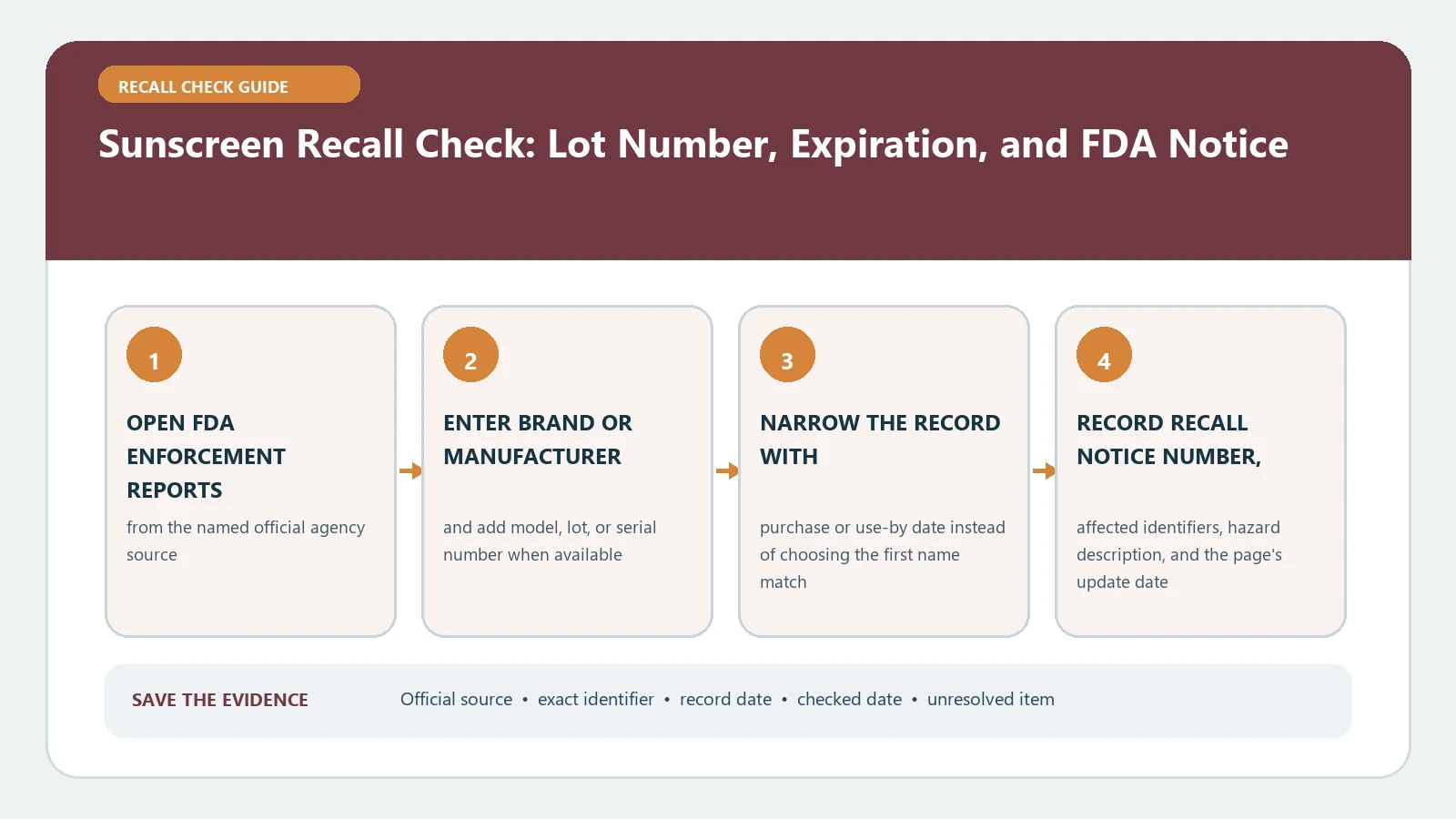
Identify a sunscreen recall with the product name, dosage form, package size, NDC when present, lot number, and expiration date on the container. Then compare that combination with FDA’s drug-recall announcement and follow the instruction for the affected lot. A brand match alone cannot classify every lotion, spray, stick, or tube sold under the same name.
FDA routes checked August 26, 2026. Drug-recall entries, terminated status, and company remedy information may change. Read the current announcement again before shipping, returning, or discarding a product.
The Drug Facts container is the working record
Keep the sunscreen in its original container and photograph all sides. Capture the front name and SPF, Drug Facts panel, active ingredients, manufacturer or distributor, net contents, NDC, lot, expiration, and barcode. For a carton-and-bottle product, inspect both because the lot may appear on one and the NDC on the other. Note whether it is a lotion, cream, spray, stick, oil, gel, or another dosage form.
| Label field | Why FDA recall matching uses it | Near match that can mislead |
|---|---|---|
| Product and dosage form | Distinguishes formulations sharing a brand and SPF | A lotion compared with an aerosol spray |
| NDC | Identifies the labeled drug package when the notice lists it | A UPC from a retailer page |
| Lot | Connects the container to an affected production batch | A purchase order number |
| Expiration | Tests the date range specified in the announcement | The date the bottle was opened |
| Package size | Separates retail presentations and multipacks | A photograph with no readable volume |
Search FDA as a drug, not as a cosmetic
Open FDA’s Drug Recalls page and search the product, recalling company, and labeler. The current table includes drug recall announcements and a terminated-recall field. Also review FDA’s broader recall and safety-alert list, which can expose a company announcement by brand or product description.
FDA’s consumer explanation of drug recalls directs people to compare the lot on their label with the lot in the notification. It also explains that a company generally initiates the action while FDA oversees the recall strategy. That division matters when the FDA page describes the event but the manufacturer page administers the refund or replacement.
Read one affected lot row from left to right
- Confirm the same brand, full product name, SPF, and dosage form.
- Match the NDC or other package identifier when the notice supplies one.
- Compare the lot exactly, preserving letters, leading zeroes, and punctuation.
- Test the expiration date and container size against the same product row.
- Check distribution or sale channels as supporting scope, not as a replacement for the lot.
- Save the recall reason, company contact, and consumer action attached to that row.
Do not mix a lot from one formulation with an expiration date from another. If the notice lists all lots, all sizes, or a broader population, record that explicit boundary. If the only overlap is the brand or SPF, the result is not an affected-lot match.
An NDC can appear as ten digits in FDA material and as an eleven-digit billing format elsewhere. Do not add, remove, or reposition a zero until the labeler or the recall record explains the format. Record the exact printed sequence first. If the notice identifies only one package configuration, use the dosage form and net contents to prevent a reformatted number from pulling a different bottle into the case.
A terminated recall still has meaning for a bottle at home
FDA defines a terminated recall as one for which reasonable efforts have been made to remove or correct the product and proper disposition has occurred according to the strategy. That status describes the agency’s administration of the event. It does not change the printed lot on a container bought earlier. Use the original notification to decide whether the bottle fits the affected group, then ask the company for the currently available consumer route.
A market withdrawal, safety alert, or quality notice may also appear near recall results. Read the record’s action type rather than labeling every FDA entry a recall. The FDA recall list guide explains how announcement and enforcement records differ, while the drug and medicine recall check covers prescription and nonprescription products beyond sunscreen.
Recover a faded lot before relying on a purchase date
Use side lighting and close photographs to inspect a crimp, bottle base, carton flap, or label edge. Keep a receipt, online-order page, or retailer account as supporting evidence, but do not turn the purchase date into a production lot. Contact the labeler or recalling firm with the product name, NDC, expiration, and images when the lot remains unreadable.
Sunscreen moved into a travel bottle loses the identifiers needed for a lot-level check. Search for the original container, a packing photograph, or another bottle from the same multipack. If none survives, mark the contents unresolved and ask the manufacturer what traceability evidence it accepts. Do not copy the lot from a different purchase.
A multipack may contain individual bottles with their own lot or expiration markings. Photograph the outer UPC and every inner code before deciding the set has one status. Apply the announcement’s scope exactly: an outer-case identifier can control the whole pack, while a notice written at bottle-lot level may produce different results within a mixed household supply. Keep each physical container attached to the evidence used for its verdict.
Keep product action and skin concerns in separate files
Carry out the stop-use, return, disposal, replacement, or refund instruction in the matching announcement. Preserve photographs and the company case number. If a person has a health concern after using the product, provide the exact label and recall details to a health professional; the consumer remedy does not assess an individual reaction.
Close the record with the FDA announcement date, affected identifiers, your container verdict, company response, and completion evidence. The recall remedy check helps when the listed action is delayed. This page does not declare a sunscreen acceptable or affected; only the current agency notice and the container’s identifiers can support that lot-level conclusion.
Before final closure, recheck the live Drug Recalls table and the original company announcement. A terminated entry can remain relevant to an older bottle, while a newly revised notice can add identifiers or handling instructions. Save both dates. An empty brand search does not prove the product is unaffected, and this guide cannot replace the current FDA record or the recalling company’s product-specific response.