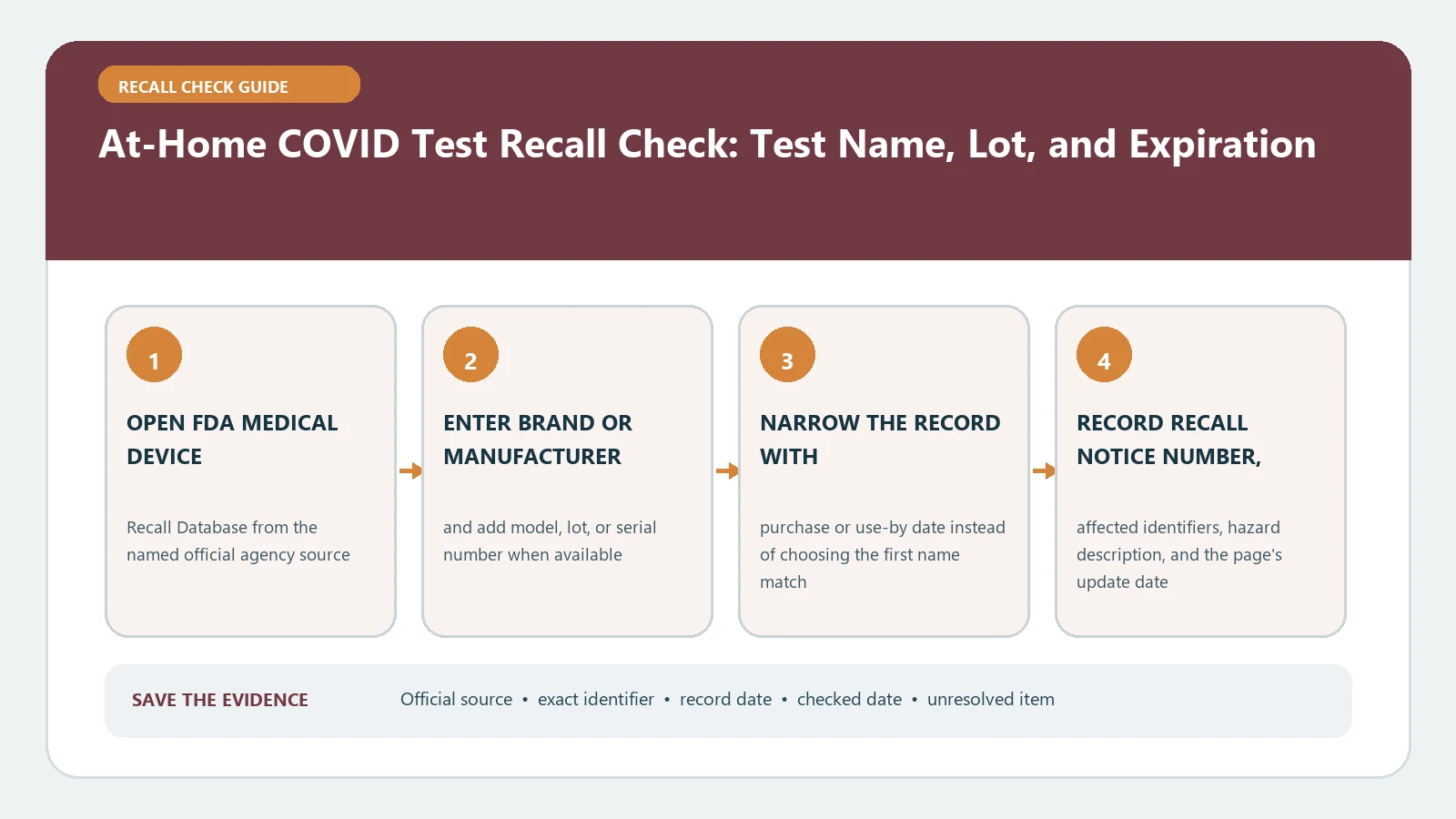
For an at-home COVID test, check recall status and expiration status separately. Match the manufacturer, exact test name, lot number, and any catalog or product code against the FDA medical-device recall record, then use the FDA test table to see whether that specific product has an authorized expiration extension. An extended date does not cancel a recall, and a recall match does not apply to every lot of the same brand unless the notice says so.
Reviewed August 26, 2026. FDA recall classifications and test expiration information can be updated. Repeat both checks on the day the kit will be used.
Keep recall evidence and date evidence in two columns
Do not open a sealed pouch just to find an identifier that is already on the outer box. Photograph the front, back, side panels, lot and expiration stamp, number of tests, and each inner-pouch label that is visible in an already opened multipack. Keep components from different kits apart.
| Question | Evidence to compare | Official destination |
|---|---|---|
| Is this lot recalled? | Test name, manufacturer, lot, product or catalog code | FDA Medical Device Recalls database and the complete notice |
| Is the printed date still current? | Exact test name and printed expiration | FDA authorized at-home test and expiration table |
| Are these components one kit? | Box lot, pouch lot, number of tests, reader requirement | Package labeling and instructions for use |
| Can the result guide care? | Test type, timing, symptoms, repeat-test direction | Current FDA instructions for the named test |
Create two final entries: recall state and usable-date state. A kit might be not found in a recall search but past its applicable date, or it might have an extended expiration yet belong to a recalled lot. Combining those questions into one safe-or-unsafe label hides the reason a kit should not be used.
Find the exact test in FDA’s current product table
Open FDA’s At-Home OTC COVID-19 Diagnostic Tests page. Search the manufacturer and full test name, including alternate retail names shown on the box. The table describes the test type, intended users, instructions, shelf life, and whether a separate extended-expiration document applies.
When an extension document exists, follow its lot-specific table. Calculate nothing from shelf life alone. The correct date is the one FDA assigns to the printed lot or expiration row, not a number of months added to the purchase date. If the test name, lot layout, or alternate brand cannot be reconciled, leave the date unresolved and contact the manufacturer.
A multipurpose reader creates another boundary. Some tests require a named reader or app, and one box may contain only consumable cartridges. Record the reader model and software version when the instructions make them part of the test system. An expiration extension for consumables does not establish that an incompatible reader configuration is acceptable.
Run a separate search for a recall or correction
Use the official FDA Medical Device Recalls database. Search the exact product name, then the recalling firm or manufacturer. The database may include firm-initiated corrections before FDA classification and explains that its create date is the classification date, not necessarily the date the company first contacted customers.
- Open the individual record and the linked company communication when available.
- Compare product description, code information, recalling firm, reason, distribution, and status.
- Require the lot or other limiting identifier when the notice names one.
- Save the recall number, record date, and exact consumer instruction used.
Recall, removal, and correction language can describe different actions. Some records concern labeling, software, reporting, or a specific lot rather than destruction of every kit. Follow the action written for consumers and do not extrapolate a professional-use or laboratory notice to a similarly named home test.
Read the record status carefully. A terminated recall means FDA considers the recalling firm’s corrective action complete under the agency process; it does not turn a previously affected kit into an acceptable test. If the physical lot is listed, follow the product-specific communication even when the database status later changes. Save both the lot decision and the record status so another person can reproduce the reasoning.
If the lot is missing or components are mixed
If pouches from several boxes were stored together, do not assign the outer-box lot to every pouch. Compare pouch markings with the instructions and manufacturer’s identification help. A receipt can establish store and purchase date but usually cannot reconstruct the production lot. An unlabeled swab, tube, or cartridge should not be paired with another kit merely because it fits.
Institutional or household stock should be checked one box at a time. Record the number of usable tests remaining, but do not count a box as one affected unit when the notice requires each pouch lot. Keep a separate row for expired, recalled, unresolved, and eligible kits. This prevents an extended date on one lot from being copied across a shelf of similar packaging.
For a broader search of device records, use the medical device recall check. The FDA recall list guide explains why an announcement page and the classified database can show different layers of the same action. Keep the kit out of use while those sources or the manufacturer cannot identify it.
A database match does not interpret a test result
Recall verification answers whether a named product or lot is subject to an official action. It does not determine whether a stored kit performed correctly, whether a negative result rules out infection, or what medical care is appropriate. Follow the current instructions for use and FDA repeat-testing direction for the exact test. Contact a health professional when symptoms, exposure, or treatment decisions require medical judgment.
If a kit is affected, preserve the package and lot photographs before carrying out the listed return, replacement, or disposal step. Track the remedy through the recall remedy guide. Close the record only when recall state, applicable expiration date, component identity, and disposition are each documented. An empty search alone is not a safety certification.
Keep a final note showing the date the FDA test table and recall database were checked, the exact product spelling used, and any manufacturer response. That dated evidence matters because the expiration table is updated regularly and a device action can be classified after customer communication begins. Recheck rather than reusing an old family inventory before the next testing need.