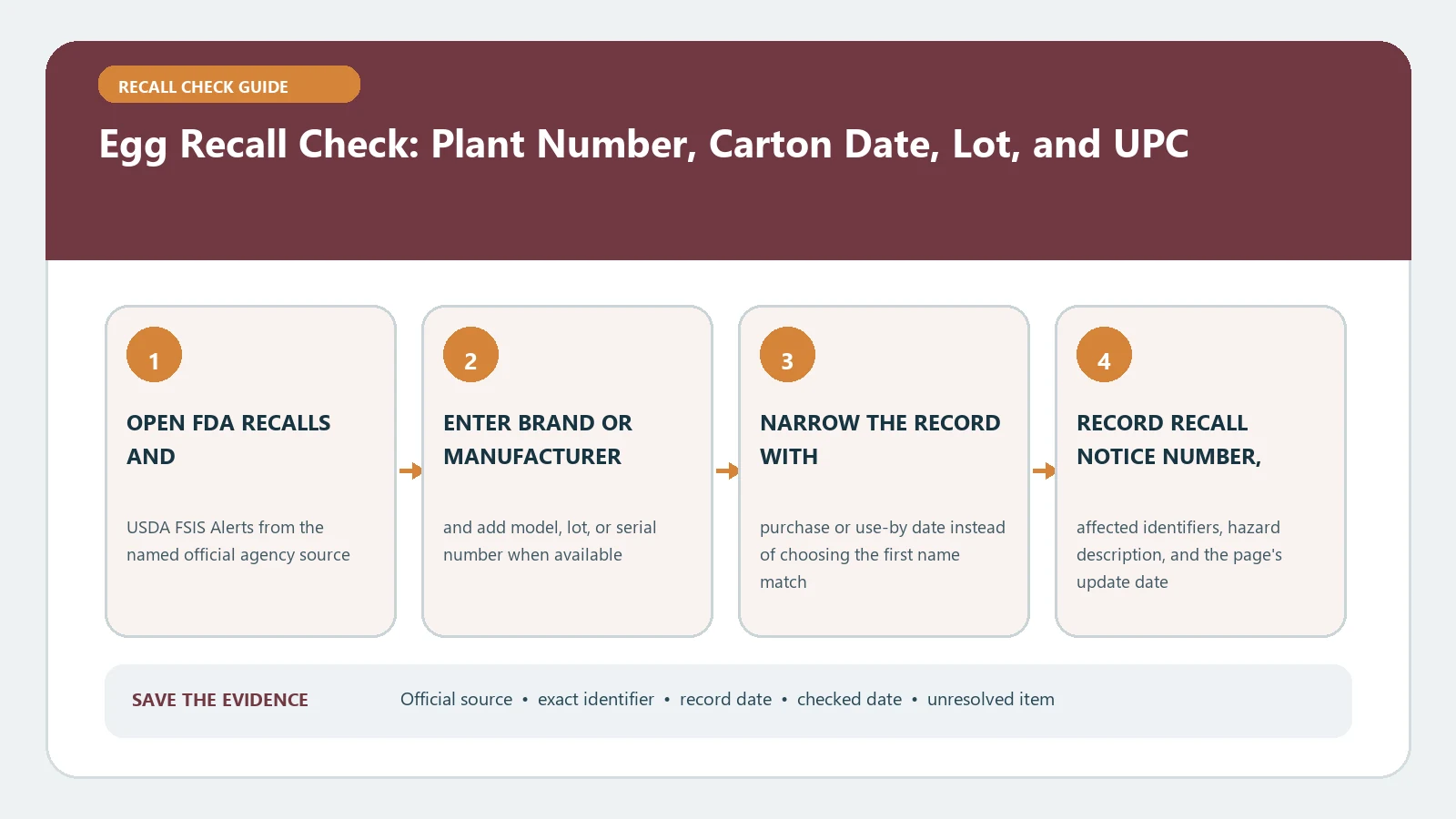
An egg carton usually does not have a consumer-searchable serial number. To check a recall, photograph the carton and compare every identifier named in the official notice: brand and product, package size, UPC, plant or identifying code, Julian or lot code, date range, and distribution area. One matching number is not a match when another required field differs. If the notice says not to eat the eggs, follow that instruction while you finish the check.
Last checked August 26, 2026. The FDA recalls and safety-alert page changes as notices are added, updated, archived, or terminated. Reopen the live notice before acting on a carton.
The “serial number” is really a set of carton codes
People often search for an egg recall serial number because a carton carries several unfamiliar strings. Those strings do different jobs. A plant or identifying code points toward a production source. A Julian date is commonly a three-digit day-of-year code. A UPC identifies a retail product and pack size, not an individual carton. A sell-by or best-by date narrows the production window. The recall notice tells you which combination controls for that event.
| Carton field | What it helps match | Why it cannot stand alone |
|---|---|---|
| Plant or identifying code | Producer or packing source | The same source can pack unaffected dates or products |
| Julian, lot, or batch code | A production window | The code must be read with the plant and notice format |
| UPC and pack size | The exact retail configuration | A UPC does not identify one physical carton |
| Sell-by or best-by date | Affected date range | A date without the product and source can match by coincidence |
| Brand and product description | The label named in the notice | Private-label eggs may share a producer with other brands |
A current FDA shell-egg notice provides a useful example of the method, not a permanent list of recalled eggs. In the Midwest Poultry Services notice published July 22, 2026, FDA displays identifying codes, a Julian-date range, product descriptions, UPCs, and best-by or sell-by dates together. The example shows why copying only one code can produce the wrong answer.
Save the carton before the evidence disappears
Do this before separating the eggs from their packaging, returning the carton, or throwing it away. A clear photo also prevents a zero, letter O, leading zero, dash, or faint date stamp from being silently changed in your notes.
- Photograph the front label, both ends, top, underside, and every ink-stamped panel.
- Write down the store, city, purchase date, package size, and whether any eggs were moved to another container.
- Keep the carton apart from other eggs until the match is resolved; do not combine cartons in one tray.
- If a code is smudged, keep the original image and ask the company contact in the official notice rather than guessing.
Match an FDA notice from broadest field to narrowest
- Open FDA Recalls, Market Withdrawals, and Safety Alerts and search the brand, producer, or product name shown on the carton.
- Open the full notice. A search-result title or retailer banner does not contain enough identifiers for a carton decision.
- Confirm that the notice covers shell eggs and read its publication date, update text, and distribution section.
- Match brand, product description, and package size before comparing the more easily mistyped codes.
- Compare the plant or identifying code and the Julian, lot, or carton-date range character by character.
- Finish with the UPC, best-by or sell-by date, states or stores, and the exact consumer instruction.
Treat every stated restriction as part of the match. If the notice lists two plant codes but only certain Julian dates, a correct plant with an outside date is not included in that notice. If the code and date fit but the package size or UPC differs, do not assume the notice applies; use the company contact named by FDA to resolve the conflict.
Use three outcomes instead of forcing a yes or no
| Outcome | Evidence | Next action |
|---|---|---|
| Matched | All required product, code, date, and distribution fields fit | Follow the remedy and handling instructions in that exact notice |
| Not matched to this notice | At least one controlling field clearly differs | Keep the result limited to this notice and check other current notices |
| Unresolved | A code is missing, illegible, or the official sources conflict | Keep the product isolated and contact the notice’s company route with photos |
“Not matched to this notice” is narrower than “safe.” FDA says its public warning page does not contain every recall, and notices can be expanded or corrected. Record the exact page, query, and checked date so a later search can be compared rather than remembered.
When the brand search finds nothing
Use the FDA Food Recalls consumer page to choose the next official route. FDA explains that public warnings are not a complete recall list and points to the Enforcement Report for FDA-regulated products. Search the producer or recalling firm when a store brand returns nothing. Try the plant code with and without punctuation, but keep each attempt in your notes. A changed query should never be disguised as the same result.
If the carton is gone, use a receipt, retailer order history, delivery photo, or loyalty-account record to recover the exact product and purchase timing. Those records may narrow the possibilities, but they usually cannot replace a required plant or lot code. Ask the recalling company whether it can identify the supplied lot from the store and date.
Shell eggs and processed egg products use different federal routes
The FDA food-recall scope page states that FDA regulates foods except meat, poultry, and processed egg products, which are regulated by USDA. A carton of whole shell eggs and a packaged liquid, frozen, or dried egg product should therefore not be forced through the same list. Check the product form and inspection mark first; then follow the FDA page’s USDA route when the item is a processed egg product.
This jurisdiction split is another reason a blank FDA brand search is not a safety clearance. It may mean the product belongs in the USDA system, the notice is listed under the recalling firm, or the event has not appeared on the public warning page.
If the carton matches, use the notice—not a generic disposal rule
FDA’s consumer recall instructions tell consumers to read and follow the product-specific notice. The remedy may direct a return, refund, or disposal method. Do not donate, resell, or give away a recalled food. If the notice describes cleaning after possible contamination, clean the refrigerator surfaces and utensils that may have contacted the product. If illness is suspected, contact a health care provider and use the reporting path linked by FDA.
Keep a copy of the notice, carton photos, return receipt, and any company case number until the remedy is complete. The result proves only that the carton did or did not match the named notice using the available identifiers. It does not certify freshness, food safety, or the absence of another recall.
Continue with the right adjacent check
If the FDA list itself is difficult to search, use the FDA food recall search workflow. After a confirmed match, compare refund, return, replacement, and disposal wording with the recall remedy check. Neither page replaces the live product notice.