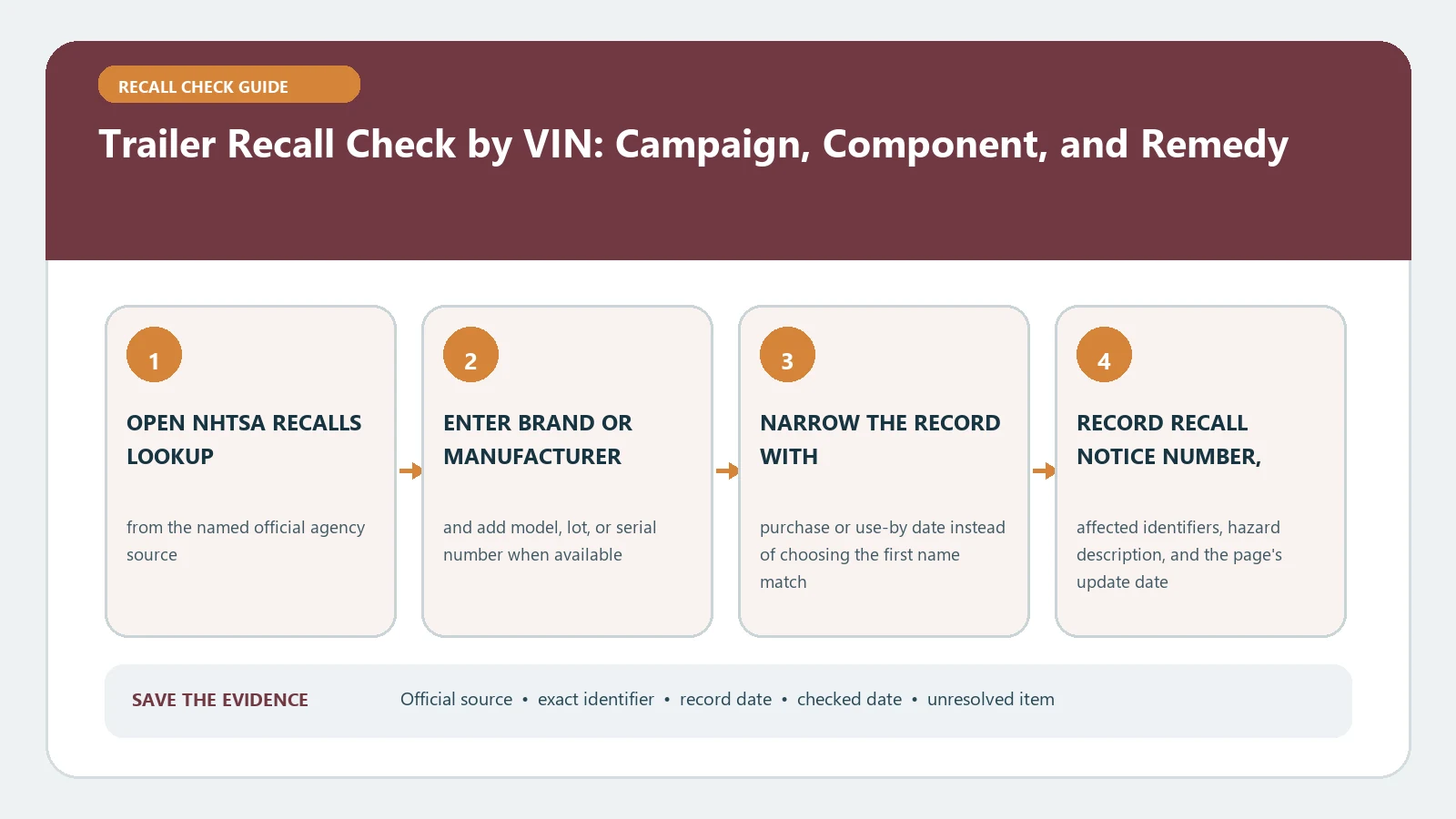
For a trailer recall check, search the trailer VIN itself, not the VIN of the tow vehicle. Copy all 17 characters from the trailer certification label or frame, confirm the decoded manufacturer and model year, and then compare the NHTSA campaign, affected component, production scope, and remedy. A recall on an axle, tire, coupler, or appliance may require a second identifier after the trailer VIN opens the right record.
The NHTSA recall, VIN-decoder, and recall-resource pages were reviewed August 26, 2026. VIN populations and remedy documents can be updated, so rerun the federal search before a long trip, sale, or repair appointment.
Photograph the trailer VIN before it is hitched
Look for the certification label near the front roadside frame, tongue, or another location specified by the manufacturer. Compare that number with the title, registration, bill of sale, and any stamped frame VIN. Photograph the whole label and a close view of the characters. Confusing the letter O with zero or dropping a leading character can produce a different manufacturer or a rejected search.
Enter the number in the NHTSA VIN Decoder as an identity cross-check. The decoded make, manufacturer, model year, trailer type, and plant information should be consistent with the trailer in front of you. A decoded VIN confirms encoded identity fields; it does not prove title ownership, current condition, or recall completion.
Treat the trailer as a set of recallable components
| Part of the rig | Evidence to record | Possible remedy owner |
|---|---|---|
| Completed trailer | Trailer VIN, make, model, model year, manufacture date | Trailer manufacturer or authorized facility |
| Axle or brake | Axle tag, serial, rating, brake model | Trailer or component manufacturer |
| Tire and wheel | TIN, size, load range, wheel identifier | Tire, wheel, or trailer firm named in the campaign |
| Coupler or hitch equipment | Brand, model, serial, capacity | Named equipment maker or installer |
| Installed appliance | Appliance model and serial | Appliance maker under its own notice |
Do not assume a trailer recall covers every installed component, or that a component recall will appear as an unrepaired campaign under the completed trailer VIN. Preserve both levels. This is especially important after an axle replacement, tire change, conversion, or secondhand appliance installation.
Run the VIN search, then open the campaign documents
Use NHTSA Check for Recalls for the trailer VIN. If an unrepaired recall appears, save the NHTSA campaign number, manufacturer campaign number, component, summary, consequence, remedy, and current manufacturer contact. Then search by year, make, and model to review general recalls and manufacturer communications that may explain the campaign or a component issue.
- Confirm that the VIN result identifies the trailer, not the tow vehicle or a prior registration record.
- Match the production dates or VIN range stated in the campaign documents.
- Identify the exact defective component and any inspection required before replacement.
- Use the owner letter to find interim precautions, remedy availability, and the responsible contact.
The NHTSA VIN recall guide covers the basic open-recall result. This trailer workflow adds the component inventory because a completed unit can contain safety equipment from several manufacturers.
Read the owner letter for logistics the summary cannot hold
The campaign summary explains the defect and remedy at a high level. The owner letter may identify when parts are expected, how long the work takes, where a mobile or remote owner should call, and what to do if the trailer was sold. Save the letter version that applies to the campaign and compare its manufacturer contact with the current NHTSA record.
For a commercial fleet, list every trailer VIN separately. A campaign population or VIN range is not evidence that each unit received an inspection. Record where each trailer is parked, whether it is in service, the component observed, the appointment or parts status, and the person responsible for follow-up. Do not close the fleet campaign from one repaired sample.
Recover a rejected VIN or missing manufacturer
Recheck the physical label, frame stamp, and title before removing spaces or changing characters. A damaged or replaced certification label should be documented with the trailer manufacturer and the state motor-vehicle agency; do not create a corrected VIN yourself. For a homebuilt, imported, very old, or low-volume trailer, the public VIN result may be incomplete. NHTSA lists omissions for some manufacturers and older or international vehicles.
If a secondhand trailer has no readable manufacturer label, collect the title record, frame photographs, dimensions, axle and coupler labels, and purchase documents. Ask the titled manufacturer or state agency how identity should be corrected or confirmed. Component searches can continue in parallel, but a tire or axle label cannot be promoted to the trailer VIN.
The NHTSA investigations and recalls resources provides routes for recalls, manufacturer communications, complaints, and data. Use those as separate evidence types. A service bulletin or complaint can help explain a symptom, but it is not automatically a safety recall or a free-remedy authorization.
Make the repair request component-specific
Give the responsible firm the trailer VIN, campaign number, component identifier, current location, and photographs. Ask whether the remedy will be performed by a trailer dealer, mobile technician, component distributor, or another authorized facility. If parts are pending, request the current interim instruction in writing instead of improvising a repair or assuming the trailer may be towed normally.
When a component manufacturer and trailer manufacturer each refer the owner to the other, send both the campaign page and the label evidence in the same request. Ask which firm filed the campaign, which network is authorized to perform the remedy, and who will document completion against the trailer VIN. Keep referral dates and names so the unresolved handoff can be escalated accurately.
The general vehicle recall guide helps interpret NHTSA IDs and dealer responses, while the recall remedy guide distinguishes an offered remedy from a completed one. Record completion for the exact VIN and component, including invoice, date, mileage if relevant, replacement-part identifier, and campaign closure. A dealer statement alone does not prove that every campaign or separately recalled component on the trailer has been resolved.
Before returning the trailer to service, compare the repair order with the original campaign one final time. The VIN, component, inspection result, corrective operation, and campaign number should belong to the same unit. Photograph any new certification or component label without covering the old evidence, and set a recheck date if the manufacturer says a later phase or additional part is still pending.