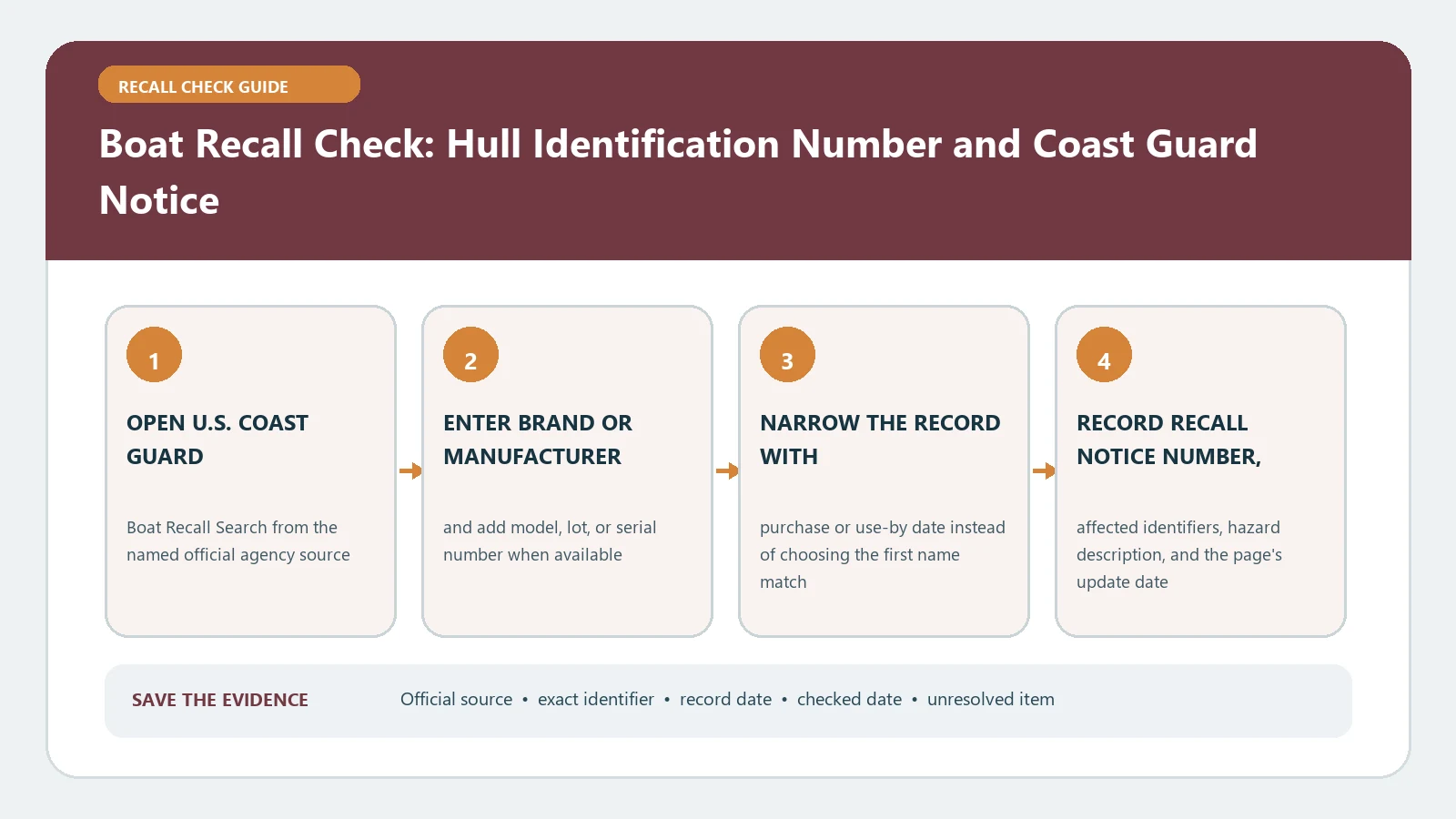
The Coast Guard boat recall search does not work like a car VIN lookup. Read the 12-character hull identification number, use its first three characters to identify the manufacturer code, note the model and model year, and search the U.S. Coast Guard recall list with those fields. Then open the case and compare any covered HIN or production range. A manufacturer result does not mean every boat from that builder is recalled.
Last checked August 26, 2026. The Coast Guard list continues to add cases and may update case details. Save the case number and recheck the live entry before purchase, repair, or transfer.
Read the HIN before opening the recall list
Photograph the primary HIN exactly as it appears on the hull and compare it with the registration or title. Do not rely on paperwork alone when the boat is available for inspection. Coast Guard materials describe the U.S. HIN as 12 characters; the first three form the Manufacturer Identification Code, while the final two identify the model year. Extra country characters on some imported boats should not be silently folded into the 12-character U.S. number.
Copy letters and numbers carefully. One wrong character can point to another manufacturer or production sequence. Preserve zeros, the letter O when it is truly present, and any visible signs of alteration. Do not sand, restamp, or reconstruct a questionable identifier merely to complete an online search.
Turn the HIN into fields the Coast Guard search accepts
| Search input | Where to get it | How it helps |
|---|---|---|
| MIC | First three HIN characters | Identifies the builder or responsible importer |
| Company | Builder plate, title, or MIC result | Finds cases when a brand name differs |
| Model | Capacity plate, builder plate, or sales record | Narrows a multi-model case |
| Model year | Final two HIN characters and documentation | Tests the covered year range |
| Recall number | Prior letter or notice | Opens the exact case directly |
The Coast Guard Manufacturers Identification search can confirm the MIC and company record. It is an identity directory, not proof that a boat is defect-free or that a particular case applies.
Open the case and test the covered production range
- Search the U.S. Coast Guard boat recall list by MIC or company, model, model year, or recall number.
- Open every plausible case and compare company, model name, model year, problem, and case-open date.
- Look for a HIN or serial range in the case details or the manufacturer’s attached communication.
- Match the full range rules, including prefixes, beginning and ending sequences, and excluded variants.
- Record affected, excluded by a specific field, or unresolved pending the recall contact’s answer.
Do not assume the newest case is the only relevant one. A used boat can remain subject to an older correction, and a model name can recur across years. Conversely, an open case for the same builder does not cover a different model or HIN range.
Manufacturer match and boat match are separate decisions
The MIC points to the builder or U.S. importer responsible for the HIN. A builder may have changed names, moved, closed, or used a trade brand that does not match the legal company in the database. Confirm the company relationship, then return to the case-specific model and production scope.
A state registration lookup, title search, or vessel documentation result serves another purpose. It may help verify identity or ownership, but it does not replace the Coast Guard defect case. Likewise, a clean recall search does not prove seaworthiness, maintenance quality, legal title, or compliance with every safety standard.
Imported boats deserve extra care because the U.S. importer may hold the MIC and recall responsibility even when a foreign builder’s name is more prominent. Compare the U.S. HIN, importer plate, and case company. If the identities conflict, preserve both sets of markings and ask the Coast Guard or responsible company to resolve them before treating the boat as outside the case.
Separate the hull case from engine and equipment actions
A boat can contain an engine, fuel system component, steering equipment, electrical equipment, trailer, and accessories with their own identities. Read what the Coast Guard case actually names. If a notice concerns a component, capture its manufacturer, model, and serial separately rather than assuming the hull HIN settles it.
Ask for completion evidence for each action: dealer work order, installed part number, dated manufacturer confirmation, or another document specified by the case. A seller’s statement that all recalls were done is not equivalent to a record tied to the case number and boat.
Inspect the work record for the HIN or component serial, not only the owner’s name. Boats change owners, marinas, and home ports, while the defect action stays attached to the physical item. If a repair record lacks the identifier, ask the dealer or manufacturer whether it can confirm completion from its campaign system.
When the HIN is altered, short, or missing
Stop the online conclusion and preserve photographs of the hull location, secondary markings, builder plate, registration, title, and purchase documents. The Coast Guard’s HIN validation and verification guidance describes methods that issuing authorities may accept, such as photographs, a tracing, physical inspection, manufacturer contact, and MIC verification. The state issuing authority controls the correction process. Do not invent the missing characters from a nearby boat.
A second HIN, a replacement plate, or characters that differ from the title require explanation, not averaging. Record where each number was found and which authority reviewed it. Until identity is resolved, both the recall conclusion and a purchase decision should remain conditional.
Create a pre-purchase recall record that survives closing
Save the HIN photographs, decoded MIC and model year, search date, case numbers reviewed, the exact range comparison, and proof of completed corrections. Use the product recall source guide when an onboard component belongs to another regulator. If a case offers repair, replacement, or another outcome, the recall remedy guide helps record what the notice promises without enlarging it.
Attach the recall record to the boat file rather than leaving it in a seller’s email account. A future owner should be able to see the HIN, case number, correction date, dealer, and installed parts without repeating the entire investigation. If the case remains unresolved at closing, state the open question and responsible contact in the purchase agreement or inspection notes.