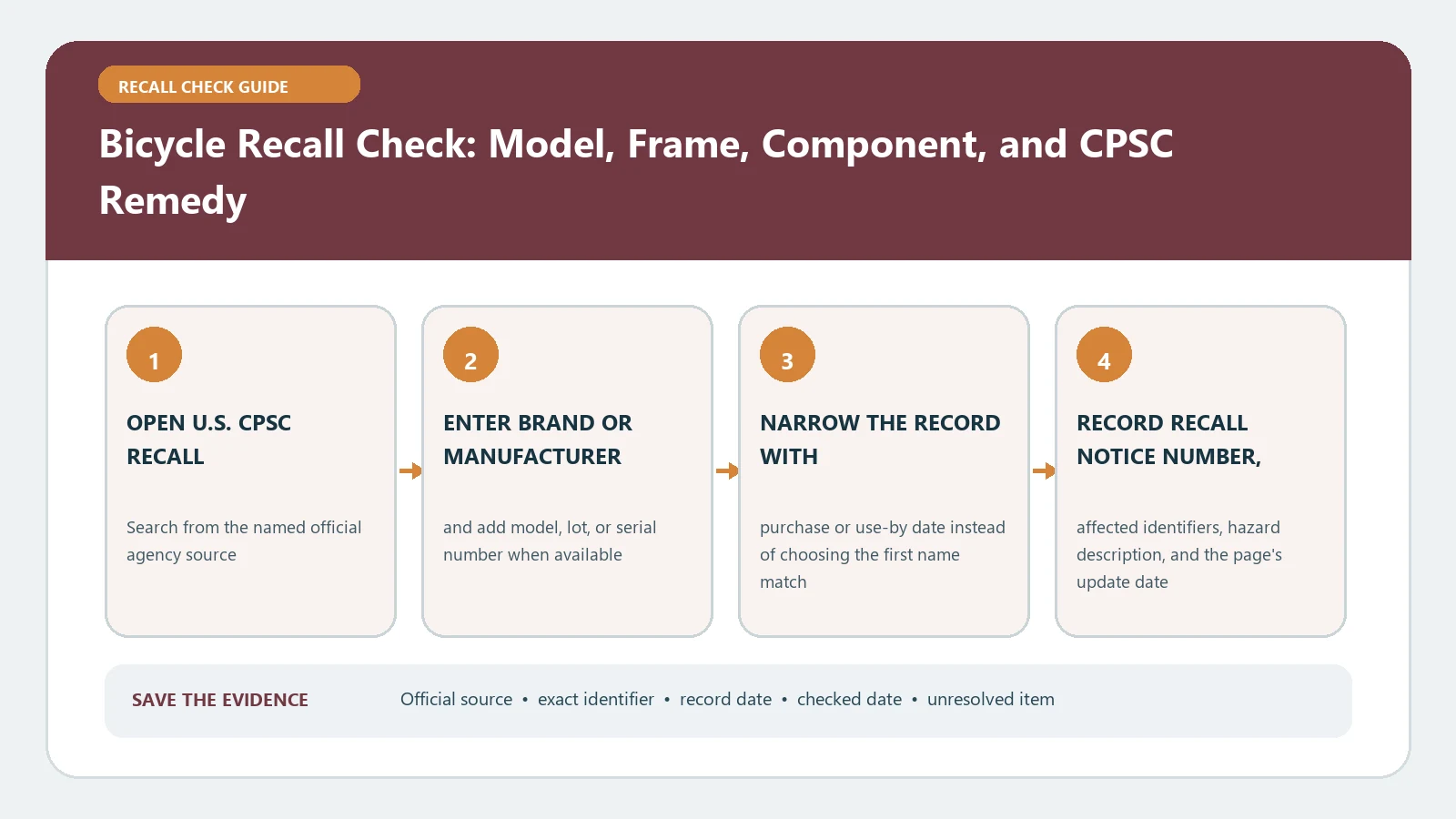
A bicycle recall check must cover both the complete bike and any named component. Record the brand, model, model year, frame serial number, frame size, and installed fork, brake, wheel, crank, battery, or accessory markings, then compare them with the full CPSC notice. Do not ride while a possible frame, steering, brake, wheel, or other crash-related match remains unresolved.
Reviewed August 26, 2026. CPSC says recall data is updated weekly and remedy availability can change daily. Reopen the notice before taking the bicycle to a dealer or ordering parts.
Build a bike record and a component record
Clean only enough dirt to read existing markings. Photograph the bicycle from both sides, then the frame serial, model decals, size, color, and the part named in any plausible notice. Common serial locations include the bottom bracket, underside of the top tube, head tube, rear dropout, or a label near the motor on an e-bike. Do not remove a component or scrape paint to find a number unless the manufacturer directs it.
| Inventory layer | Record | Why it changes the result |
|---|---|---|
| Frame | Brand, model, year, serial, size, color | Defines the bicycle or frameset population |
| Safety-critical part | Fork, stem, bar, brake, wheel, crank, pedal, seat hardware | A component recall may cross several bike models |
| Electric system | Motor, battery, charger, controller, software | An e-bike notice may cover one subsystem only |
| Ownership history | Receipt, dealer, prior owner, service invoice | Explains replacements and non-original parts |
| Current condition | Crack, looseness, noise, prior failure, no visible symptom | Supports safe handling but never overrides notice scope |
A custom build needs the same two layers. The frame brand does not identify an aftermarket fork or brake, and a component brand does not identify the frame. Record each independently before searching. Visible damage may justify stopping use even when no recall is found, but absence of damage does not exclude a serial that the notice lists.
Read the CPSC description like a mechanic
Open the CPSC product recall database. Search the exact model, then the manufacturer and bicycle or component type. The complete notice can specify model numbers, model names, serial ranges, colors, component configuration, label locations, sale dates, and photographs.
Turn each limiting detail into a yes, no, or unknown field. A recall for a bicycle equipped with a particular hydraulic brake does not cover the same frame with a different system. A model table can include dozens of builds while a serial appendix narrows the affected units. A frameset sold alone may be included even if your finished bicycle was assembled by a local shop.
- Match the product name and type: complete bicycle, frameset, or separate component.
- Confirm every model and serial rule exactly, including prefixes and endpoints.
- Use color, sale period, and photographs as supporting evidence unless the notice makes them limiting fields.
- Copy the recall number, hazard, stop-use language, and remedy into the bike record.
Parts replaced after sale create a different branch
A used bicycle may no longer match its factory specification. Compare the current component with the notice and use service invoices or old photographs to identify what was removed. If a recalled part was replaced, record the replacement model, installer, and date. Do not assume a visual change proves the authorized recall remedy was performed.
If the serial is covered by paint, missing, or rejected by the firm’s form, ask an authorized dealer to document the location and format. A purchase date or marketplace listing cannot substitute for a production serial when the notice requires one. Leave the bicycle unresolved and out of use when a crash-hazard notice cannot be ruled out.
Model year is another evidence problem. A bike bought in one calendar year may be marketed as another model year, and a color can return in several seasons. Use the frame label, dealer invoice, archived build sheet, or manufacturer response. Never derive the year from purchase date alone when the notice names a model-year range. Record uncertainty instead of forcing the bicycle into the nearest catalog photograph.
For agency routing beyond bicycles, use the product recall check guide. The Recalls.gov guide helps separate CPSC equipment from vehicle, food, and other regulated categories. This matters for a rack attached to a vehicle, a child seat, or an e-bike battery whose responsible authority may differ from the frame.
The remedy belongs to the named unit and dealer route
Follow the current notice’s instruction for stop use, dealer inspection, repair kit, replacement frame, refund, or another correction. Ask whether the whole bicycle, frame only, or component must be presented. Record the dealer, appointment, case number, installed part, and completion date. Do not perform a structural frame repair or substitute a safety-critical component outside the published program and then mark the recall complete.
A dealer’s verbal statement is useful but should be tied to the serial and recall number. If the firm is unresponsive or the remedy is unavailable, preserve every attempt and use the complaint route shown on the CPSC notice. The recall remedy guide can organize that escalation without changing the official terms.
Before leaving the shop, ask for the removed-part description, replacement-part identifier, technician or dealer record, and completion date. If the program supplies only an inspection, record the inspection outcome and whether any later recheck is required. A generic tune-up invoice cannot demonstrate completion unless it names the recall and affected component.
Report a failure separately from checking recall status
A crack, separation, brake failure, or other incident should be documented before repair when it is safe to do so. CPSC’s SaferProducts incident route accepts reports about unsafe consumer products. An incident report can help the agency evaluate a hazard, but filing one does not create a recall match or authorize a remedy.
This guide cannot inspect carbon, aluminum, steel, welds, fasteners, or hidden crash damage. It routes a physical identifier to a public record. Close the bicycle only as affected, excluded, or unresolved, and keep separate evidence for the completed correction. A no-result search is not a mechanical safety inspection.
Maintain the record with the bicycle when it is sold or transferred, without publishing personal contact information or a full serial online. A future owner should be able to identify the notice, see the authorized correction, and distinguish the replacement component. That chain is especially important for framesets and custom builds whose visible configuration changes over time.