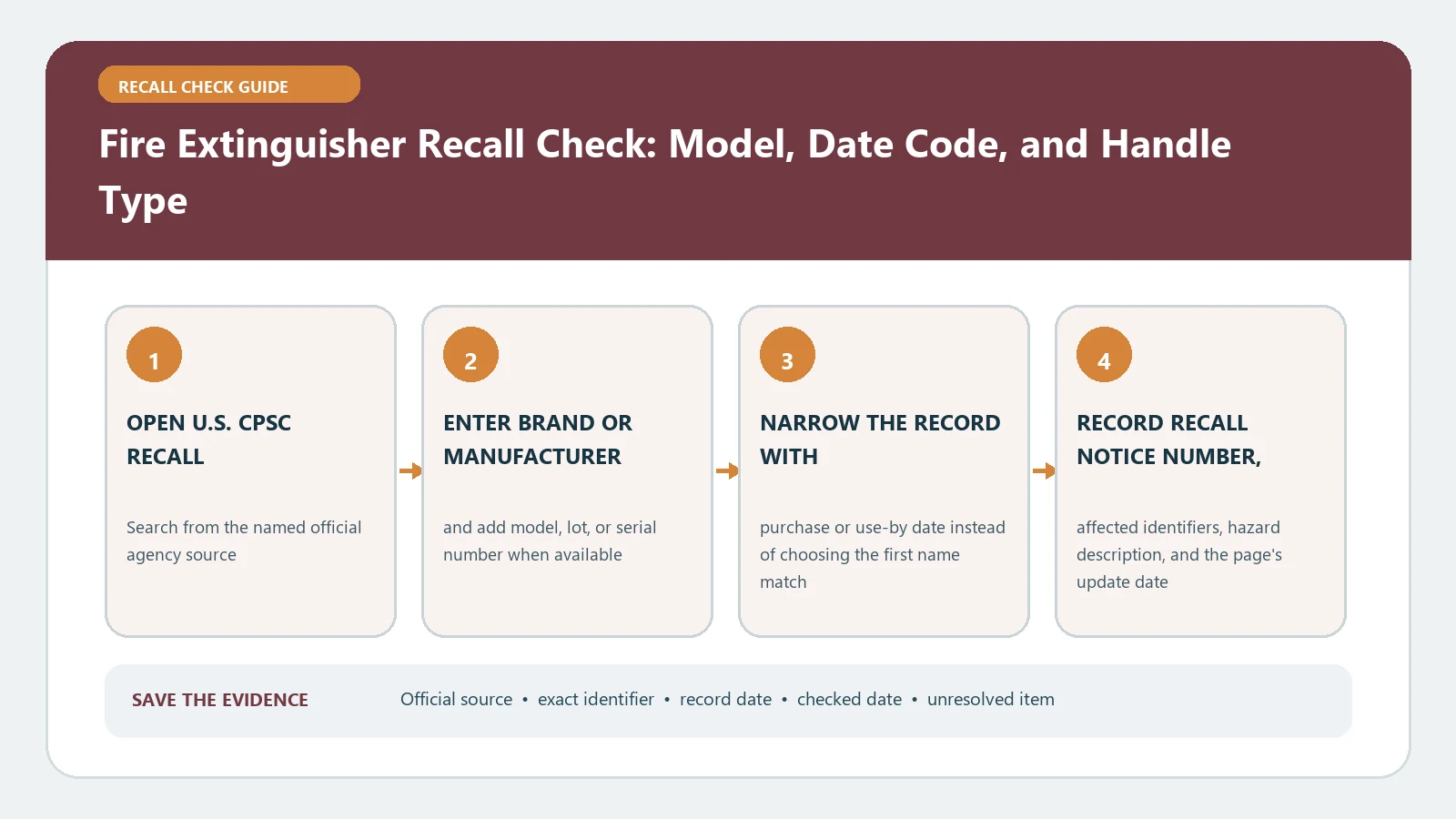
A fire-extinguisher recall match depends on the complete cylinder label, handle or activation style, and any manufacture or date-code rule in the official notice. Keep the extinguisher upright and pressurized, photograph it without testing it, and compare the fields exactly. Color, size, or the Kidde name by itself cannot decide whether a unit is included.
Reviewed August 26, 2026. Historical extinguisher campaigns can remain relevant for equipment still hanging in a home, boat, vehicle, rental, or workplace. Reopen the current CPSC record before requesting a remedy because contact paths and available remedies can change long after the original announcement.
Photograph the cylinder without discharging it
Do not squeeze the handles, pull the pin, loosen the head, or remove a hose to expose a label. Capture the front instructions, model number, serial if present, UL or rating information, manufacture code, gauge, handle material, nozzle or hose, and the bottom of the cylinder. Photograph the mounting location and any service tag separately. A service company sticker is maintenance evidence, not the manufacturer identity.
| Evidence layer | What to record | Why it matters |
|---|---|---|
| Manufacturer label | Brand, full model, serial, rating, capacity | Locates a candidate campaign and model row |
| Activation hardware | Plastic or metal handle, push button, nozzle or hose | Some campaigns divide units by operating design |
| Production evidence | Date code, manufacture date, plant or batch marks | Tests the affected manufacturing window |
| Current condition | Gauge position, corrosion, damage, missing pin or seal | Supports safe service, but does not determine recall scope |
| Federal record | CPSC number, date, hazard, consumer action, remedy | Binds the cylinder to one official campaign |
Write each character as printed. Old labels may use tiny type, and a paint scratch can turn one model into another. Take angled photographs with good light rather than rubbing or applying solvent. If the cylinder is installed in a common cabinet, number the cabinet and unit so another extinguisher is not accidentally used for the claim.
Handle type and date code are campaign rules
Search the CPSC recall database with the full model and manufacturer, then broader terms such as fire extinguisher. Open the actual record and use its description, not a generic list circulated by a retailer. One recall may cover plastic handles, another a push-button design, and another a narrow production run. Metal hardware is not automatically excluded unless the notice says so.
A manufacture code is not always a calendar date in familiar order. Copy the raw string first, then apply the decoding instructions published in that campaign. Do not infer a production year from purchase date or an inspection tag. If the notice says older units lack a date code, the absence itself may be part of the identification logic rather than missing evidence.
The large Kidde campaign shows why one-field matching fails
The official CPSC Kidde fire-extinguisher recall record covers many plastic-handle models and certain push-button units. It gives model tables, manufacturing windows, a date-code method for later units, and a separate explanation for units made before date codes were printed. That combination makes a brand-only or date-only check unreliable.
- Confirm the physical activation style matches the group described in the notice.
- Find the exact model in the appropriate table rather than a visually similar row.
- Apply the notice’s date-code or manufacture-window rule for that model group.
- Copy the current consumer action and replacement route from the live record.
Do not transfer the Kidde code method to another manufacturer or campaign. The worked example explains the method, not every fire extinguisher. Search other CPSC records when the maker, model, or hardware differs.
Recover a missing model or date code
Check the opposite side of the label, the lower cylinder, bracket, original box, purchase order, inspection inventory, and previous photographs. Ask the manufacturer or a qualified fire-equipment service company to identify the expected label location without opening or discharging the unit. Provide the rating, dimensions, handle design, gauge, hose arrangement, and purchase history as supporting evidence.
Never manufacture a date from the service tag or guess a model from cylinder color. If the label remains unresolved, document that fact and arrange an appropriate equipment evaluation or replacement decision. The CPSC product recall guide gives a wider search-recovery sequence, but it cannot turn secondary clues into a definitive model.
A damaged unit is not a search experiment
Corrosion, leakage, a missing pin, a broken handle, a detached nozzle, an abnormal gauge, impact damage, or evidence of prior discharge needs competent attention regardless of recall status. Do not test-fire a questionable extinguisher to see whether the recall hazard occurs. Do not dismantle a pressurized cylinder or place it in ordinary trash. Follow the manufacturer, local fire authority, or qualified service provider for safe handling.
Condition and recall scope must stay separate. A pristine-looking extinguisher can be affected, while a damaged unit can be unfit even when no recall matches. If a fire is occurring, evacuate and call emergency services according to the emergency plan; the recall lookup is not an emergency-response tool.
Plan the remedy without leaving the location unprotected
Save the recall number, exact model and code, claim number, requested photographs, shipping or disposal instructions, and replacement status. Alter or surrender the cylinder only when the current program directs it. For multiple units, use one line per serial or physical location so a delivered replacement cannot be credited to the wrong extinguisher.
A recall replacement may create a temporary coverage gap. Coordinate suitable interim fire protection with the property’s responsible person or fire-safety professional rather than assuming another small cylinder covers every hazard. The recall remedy guide helps distinguish registration, shipment, receipt, and completed replacement.
The lookup is not an inspection certificate
Record the result as affected, excluded, or unresolved, with the decisive model, hardware, and code evidence. A no-match search does not prove that the extinguisher will discharge, has been maintained, is correctly sized, or meets a local inspection rule. A recall match does not prove the replacement has arrived. Keep the official record and check date with the equipment log, then recheck before transferring the property or relying on an old stored unit.