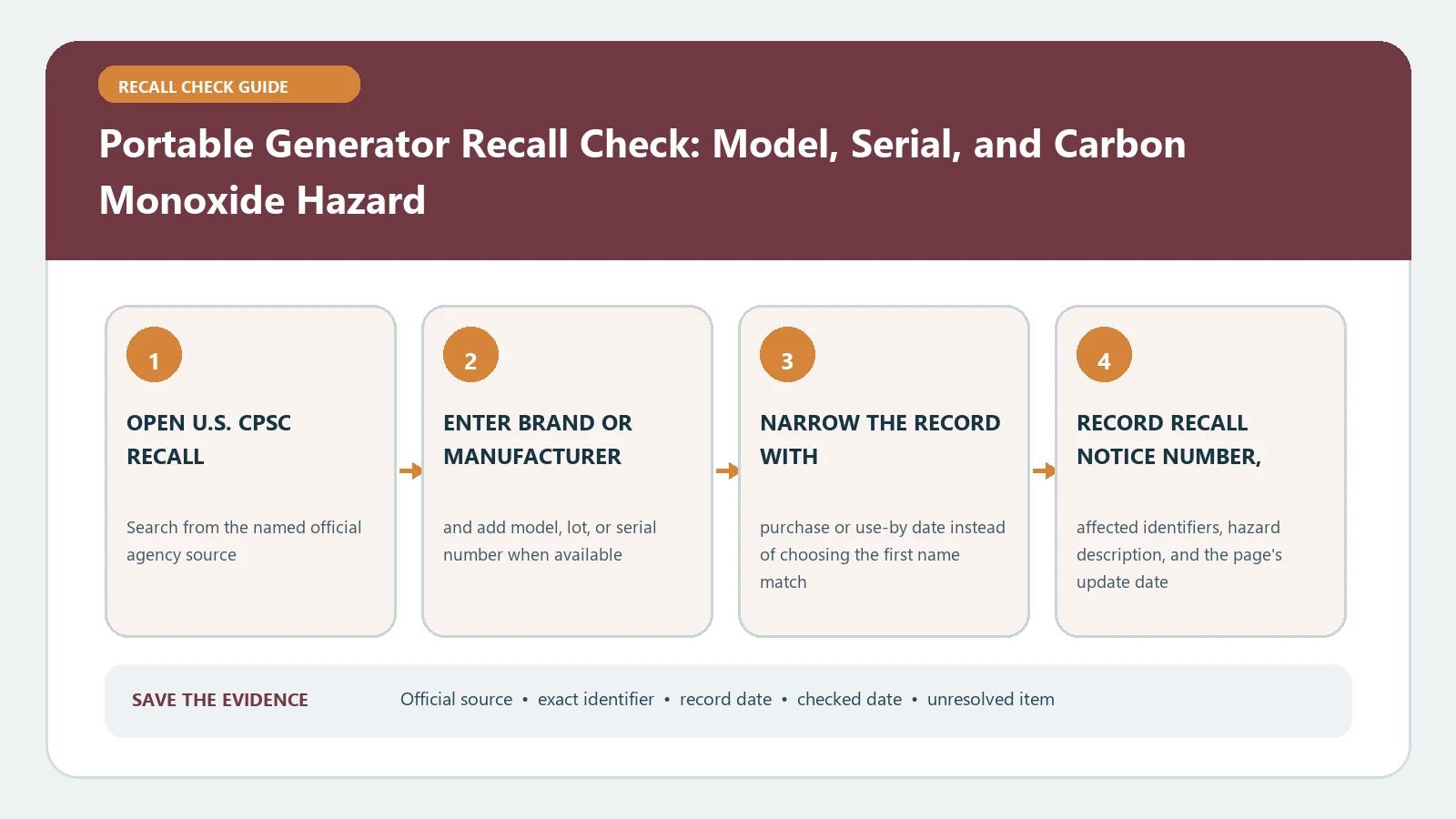
For a portable generator recall check, copy the model and serial from the generator’s own data plate and compare them with the exact ranges in the CPSC notice. Do not start or run the unit merely to identify it. Carbon monoxide, fire, fuel-leak, electrical, handle, and control campaigns can use different label fields and different remedies.
Last reviewed August 26, 2026. Recall populations, company contacts, remedy stock, and safety instructions can be revised. Reopen the current federal record before operating, transporting, servicing, selling, or disposing of a generator.
Handle an immediate hazard before reading the plate
The CPSC generator and engine-driven tool guidance warns that generator exhaust contains deadly carbon monoxide and says portable generators should be used outdoors, well away from windows, doors, vents, and other openings. It also says never to operate one in a home, garage, basement, crawlspace, or shed. Those rules apply regardless of whether a recall search finds a campaign.
If people feel sick, dizzy, weak, confused, or otherwise suspect carbon-monoxide exposure, leave for fresh air and seek emergency help as the official guidance directs. Do not re-enter or restart equipment to finish a serial photograph. Fuel odor, leaking liquid, smoke, melting wiring, fire, or severe physical damage also calls for an immediate safety response rather than an online-lookup experiment.
Photograph the whole generator identity
With the unit off, cool, and safe to approach, photograph the generator from several sides and capture the rating or data plate. Copy the manufacturer, brand, complete model, serial, date or manufacture code, fuel type, electrical rating, and any engine model shown. Add the retailer and purchase date, but keep engine and finished-generator identities separate.
| Evidence | Detail to retain | Matching purpose |
|---|---|---|
| Generator data plate | Brand, model, serial, date code, ratings | Tests the finished-unit population |
| Engine label | Engine maker, family, model, serial | Separates engine identity from generator identity |
| Physical configuration | Color, frame, handle, fuel cap, control panel, CO shutoff marking | Supports, but does not replace, code matching |
| Purchase and service file | Retailer, date, prior repair, replacement parts | Explains sales channel and later changes |
Preserve leading zeroes, letter suffixes, and hyphens. A family name printed on an advertisement may cover several models. A recalled engine does not automatically establish that the finished generator is included, and a matching frame photograph cannot substitute for a missing serial range.
For a rental or emergency inventory, add the asset number, storage site, assigned transfer switch or cord set, and current custodian. Those local fields help locate the unit but must never be entered as if they were the manufacturer’s model or serial. Photograph any replacement fuel cap, control module, wheel kit, or handle that could affect campaign identification.
Search CPSC from the narrowest identifier outward
Open CPSC Recalls and Product Safety Warnings. Try the complete generator model first, then manufacturer, brand, engine maker, retailer, and plain product terms. Open every plausible record and read its description, identifying photographs, affected codes, sale period, hazard, consumer action, remedy, and company contact in one pass.
- Confirm whether the record covers a generator, engine, accessory, or another power product.
- Find the exact model row and any serial or manufacture-date boundary.
- Apply retailer, color, fuel, handle, component, or sales-window conditions.
- Copy the current stop-use instruction and remedy without paraphrasing its scope.
- Save the CPSC notice date and the date of your own check.
The CPSC product recall walkthrough shows how to widen a federal query while preserving the decisive label. Search the manufacturer’s recall page only after you have a plausible campaign or a label-based query; use its serial checker and claim process as the notice directs.
Do not confuse a recall match with general CO protection
A campaign can concern a fuel valve, wiring, handle, tank, engine part, or carbon-monoxide control within a defined population. The broader CPSC generator-safety guidance applies to portable-generator operation even when the model is outside that campaign. An excluded serial does not authorize indoor use, and a working CO shutoff feature does not replace outdoor placement or a working household CO alarm.
Keep two findings in the file: recall status for this model and serial, and the separate operational-safety controls. A CPSC search does not mean an unlisted unit is safe, well maintained, correctly connected, or free of a future notice. It also cannot verify a certification or safety marking from appearance alone.
Recover a missing plate or empty search
Look for the carton, owner’s manual, receipt, registration, warranty claim, rental record, service invoice, or photographs taken before the plate became unreadable. Ask the finished-generator manufacturer where the serial is stamped and whether an engine number can be linked to the unit. Do not borrow a code from an identical-looking generator or estimate manufacture date from purchase year.
If CPSC returns nothing, retry model variations and both brand and manufacturer names. Search notices and warnings, not just recall rows, and check whether the item belongs to another regulator or market. An unresolved identity should remain unresolved. Do not start the generator to see whether the alleged defect appears, and do not use the absence of a database result as a condition test.
Complete the remedy without creating another hazard
Follow the consumer action and contact channel in the matched notice. Record the campaign, generator model and serial, claim number, submission date, and promised repair, replacement, refund, or disposal step. Do not drain fuel, cut wiring, ship the unit, or destroy a label unless the current written remedy requires it and the task can be performed safely.
For service, keep the work order and any replacement component identifiers. For a delayed or disputed claim, the recall remedy guide helps separate enrollment from completion. If the unit is transferred or sold after an excluded finding, give the next owner the dated search record without representing it as a permanent safety certificate.
Close one generator with one evidence row
Use affected, excluded by a named condition, remedied with proof, or unresolved as the final state. Attach the official URLs, August 26, 2026 review date, label photographs, and remedy documents. For multiple units at a household, job site, rental fleet, or emergency program, repeat the process by serial. A result for one generator never closes another unit stored beside it.