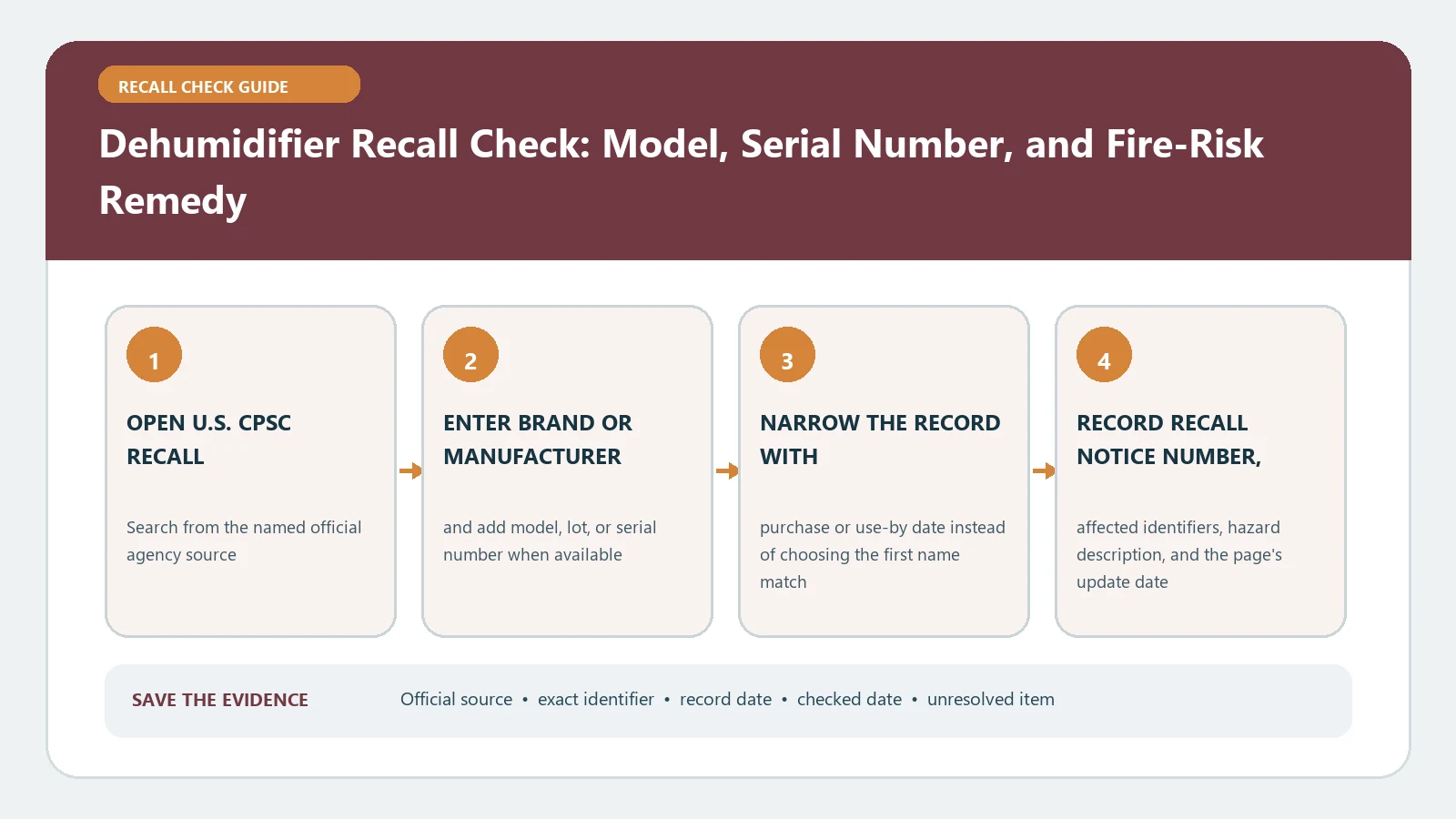
A dehumidifier recall match requires the rating-label model and every serial or date-code condition in the CPSC notice. The brand printed on the front is only a starting point because one manufacturer can supply units under many store brands. Photograph the label before moving the machine, compare the complete identifier table, and follow the notice’s current stop-use and remedy instructions for the exact unit.
The CPSC dehumidifier and general recall pages were reviewed August 26, 2026. CPSC reports weekly recall-data updates and potentially daily remedy changes, so an old screenshot is not enough for a current claim.
The rating label outranks the badge on the grille
Turn the unit off before photographing it, and move it only if that can be done without creating contact with heat, smoke, melted plastic, or damaged wiring. Common label locations include the rear, side, or area behind the collection bucket. Capture the whole label and close views of the model, serial, date code, electrical rating, pint capacity, and manufacturer name.
| Identifier layer | Exact evidence | Why it matters |
|---|---|---|
| Front identity | Brand, pint capacity, color, control layout | Finds a likely product family but rarely proves scope |
| Rating label | Full model, serial, date code, manufacturer | Tests the affected table and production population |
| Sales record | Retailer, purchase date, order, receipt | Supports distribution and remedy evidence |
| Condition record | Odor, heat, smoke, melting, prior service | Changes safe handling but not identifier scope |
| Recall record | CPSC notice date, number, hazard, remedy | Binds the unit to the correct campaign |
Do not shorten a suffix because a search form returns nothing. Two models can share a front housing while using different internal components or production runs. Record zeroes, hyphens, and letters exactly, then create a second normalized version only for search attempts.
One manufacturer campaign can cross many retail brands
The CPSC dehumidifier recall collection shows why a brand-only check fails. Its Gree warning names multiple brands and instructs owners to use model and date-code information printed on the unit. A familiar retailer badge therefore cannot identify the actual manufacturer or campaign by itself.
Search the current CPSC recall database with the complete model, then the manufacturer, brand, and dehumidifier. Open every plausible notice. An older model may appear in a recall reannouncement or expansion, while a newer campaign can cover a different set made by the same manufacturer.
Retail and manufacturer history can complicate an older unit. A warranty page may redirect to a successor company, and the model label can name an importer that no longer operates. Keep the original CPSC notice as the scope source, then use its current remedy field to learn whether a successor, administrator, or no available remedy is recorded. Do not replace the named campaign with a general brand support ticket. If several notices cover the same brand, create one comparison row per notice and record why the unit matches or fails each model and date test.
- Confirm the notice names a dehumidifier rather than another appliance.
- Find the exact model row and apply every serial or date-code limit.
- Use pint capacity, color, and sale dates as supporting or limiting fields as written.
- Copy the current consumer action and remedy contact from that notice.
Read range boundaries without rounding
A table may say begins with, between, through, or all models. Those expressions produce different tests. A serial-prefix rule can include many complete serials, while a closed range includes its endpoints but not nearby values. A manufacture or date code is not automatically the purchase date.
Mark each field yes, no, or unknown. One clear model mismatch can exclude a unit from that notice. A model match plus an unreadable serial does not justify an excluded result. Continue through other plausible campaigns before concluding that the product is not listed.
If the label is missing or the serial is rejected
Check behind the bucket, filter access, rear housing, side panel, manual, packaging, warranty registration, and retailer order. Use photographs taken before disposal or service. Ask the manufacturer to identify the expected label location and format; provide dimensions, control-panel layout, capacity, and purchase record as secondary evidence.
Do not generate a serial from a receipt or use a barcode that the notice does not recognize. If the label was removed or damaged, leave the finding unresolved and document the manufacturer’s response. The appliance recall search guide provides a broader identity-recovery route for mislabeled or secondhand appliances.
Heat, smoke, or melting changes the immediate branch
Follow the CPSC notice’s stop-use language for a matched unit. If a dehumidifier shows overheating, smoke, burning odor, melted material, or fire damage, prioritize personal safety and emergency response over collecting more identifiers. Do not energize it for a video, test it in another outlet, or ship it before the firm gives safe instructions.
Condition evidence and recall evidence remain separate. A machine can match without visible damage, and visible damage can require action even if a published recall has not been found. Preserve photographs and purchase information only when safe. An unsafe-product report may inform CPSC, but reporting does not enroll the owner in a refund program.
Bind the remedy to one machine and one campaign
Save the CPSC notice number, model, serial or date code, manufacturer case, remedy requested, submission date, and response. If the program asks for a cord-cut photograph, disposal proof, or a label image, follow the current instruction in the order given. Do not disable the unit or discard evidence before confirming what the program requires.
The refund, repair, replacement, and disposal guide helps distinguish remedy types. Completion means the named correction was actually received or performed for the identified unit, not merely that a web form was submitted.
An empty search cannot certify a dehumidifier
No database match does not prove the unit is safe, correctly wired, or free from an unannounced defect. It also does not rule out a private-label relationship or a historical notice missed by the initial query. Record affected, excluded, or unresolved, with the decisive model or serial evidence and the date checked. Recheck before resale, seasonal reuse, or moving the appliance to another household.