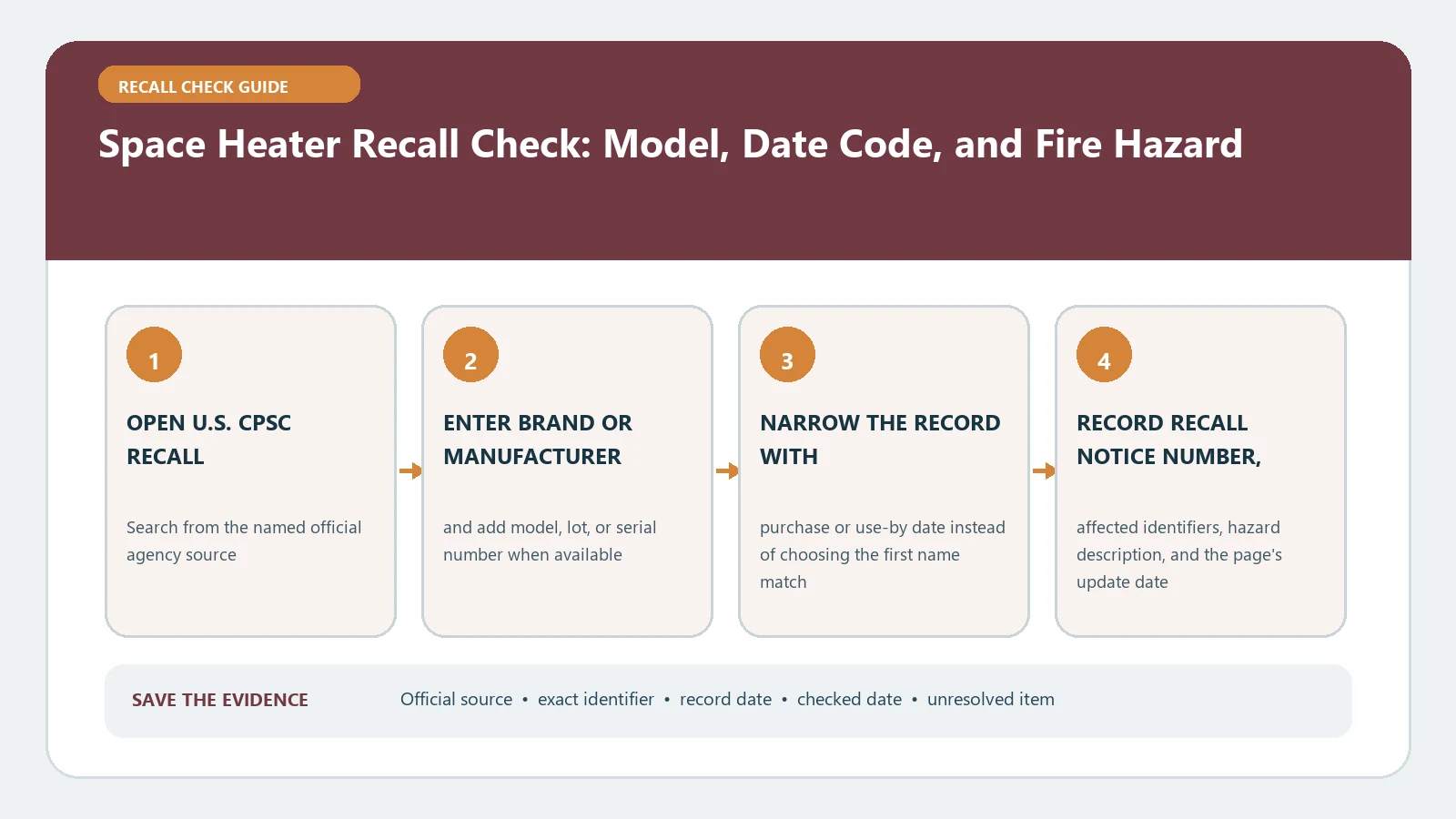
Find a space heater recall by the rating-label model, date code, serial or SN code, and product type, not by the front logo alone. Photograph the heater before moving or dismantling it, search the CPSC recall list, and compare every affected range. If the unit exactly matches, follow the notice’s stop-use and remedy instructions. Do not cut a cord, ship a heater, or attempt a repair unless that specific program directs it.
Last checked August 26, 2026. CPSC says recall data update weekly and remedy availability can change daily. Reopen the current notice before completing a refund, replacement, or disposal step.
The rating label matters more than the heater’s silhouette
Unplug and let the heater cool when it is safe to do so, then photograph the front, back, underside, cord entry, plug, rating label, and original box. Wall-mounted or hardwired units should not be removed by an unqualified person merely to find a label. Record where the label sits so a building owner or technician can inspect it safely.
| Label detail | Why CPSC notices use it | Do not substitute |
|---|---|---|
| Model or type | Defines the heater design | A marketing family name |
| Date or manufacture code | Limits the production window | The purchase date |
| Serial or SN code | Can identify individual ranges | An order number |
| Voltage and wattage | Separates electrical variants | Room size claims |
| Importer or manufacturer | Connects the legal recall party | The marketplace seller alone |
Search CPSC broadly, then narrow to the exact heater
- Open CPSC Recalls and Product Safety Warnings and search the brand, importer, model, or space heater.
- Open each plausible notice and compare product photographs only after reading the model and code description.
- Match the full date-code or serial range, including prefixes and model suffixes.
- Read the hazard, incidents, remedy, and consumer contact as separate fields.
- Save the recall number and the current remedy instructions before taking the required action.
A similar grille, color, or control panel is not enough. Manufacturers can reuse housings across models, and marketplace listings can combine variations under one product page.
Search both the brand visible to consumers and the importer named on the rating plate. CPSC notices often identify the importer or distributor as the responsible firm, and that name may not appear in the marketplace title. Save the product-page order record only as supporting evidence; the heater label remains the identity anchor.
Date-code formats change from one recall to another
There is no universal heater date-code format. One current example, the Vornado VH2 recall, identifies TYPE VH2 units with JUL24 or AUG24 on the underside rating label. That example shows how model and date work together; it does not create a rule for other brands.
Some notices use a continuous manufacture-date range, a serial prefix, or an SN code. Copy the format exactly and compare it with the examples or label images attached to the notice. Do not convert a code into a calendar date unless the recall page explains how.
Wall heaters and portable heaters may use codes in different locations. A label visible through an outlet grille can require a flashlight and safe viewing angle, while a portable unit may carry the plate underneath. Do not energize, tip, or disassemble a suspect heater solely to make a label easier to read.
Read the remedy before cutting a cord or arranging shipment
CPSC notices can offer a refund, replacement, repair, or another correction and often require proof such as label photographs, destruction images, or a registration form. Follow the named sequence. Cutting the power cord too early can erase eligibility evidence or create an electrical hazard. Mailing a heater without authorization can violate carrier restrictions or the program’s process.
Keep landlord, installer, or property-manager responsibilities separate from the consumer claim when a fixed heater belongs to a rental property. The notice may require qualified removal or installation. Record who owns the unit, who submitted the claim, and which serial was replaced so the remedy does not disappear in a maintenance ticket.
If a heater is smoking, sparking, melting, emitting a burning odor, or involved in a fire, prioritize safe evacuation and emergency response. Do not touch or photograph an energized, burning, or dangerously hot appliance just to complete a recall claim.
An incident report is evidence, not recall confirmation
SaferProducts.gov incident reporting lets consumers report an unsafe product to CPSC. A public report can help the agency investigate patterns, but it is not an official recall notice and its presence does not prove the same defect affected your unit. Submit accurate model, code, event, damage, and injury information without publishing unnecessary private data.
The reverse matters too: no public incident report does not certify a heater as safe. Recall status comes from CPSC and the responsible company; immediate product condition still deserves appropriate safety action.
If the label is scorched, painted over, or missing
Check the original box, order history, manual, building equipment schedule, prior photographs, retailer listing, and manufacturer account. Search CPSC by brand and distinctive design terms to find possible notices, then ask the recall contact what alternative evidence it accepts. Keep the decision unresolved until identity is established; selecting the closest-looking model can lead to the wrong safety instruction.
If heat or fire damaged the label, preserve the unit only when authorities say it is safe. An insurance photograph, inspection report, serial from a registration account, or retailer invoice may help the manufacturer identify it. Do not clean away damage evidence or reconnect the heater for a test.
Close the loop before replacing the heater
Retain the label photos, CPSC recall number, match worksheet, claim confirmation, required destruction or return evidence, refund or replacement record, and the replacement model. The appliance recall check covers model and serial recovery for other household equipment. For help interpreting a CPSC notice’s affected range and remedy, use the CPSC recall search guide.
For a multi-unit building or workplace, record every room and asset tag checked, not only the first matching heater. Separate affected, excluded, and unidentified units and assign each unresolved label to a follow-up owner. A refund for one device does not prove that the same model has been removed from storage rooms, vacant units, or seasonal equipment closets.