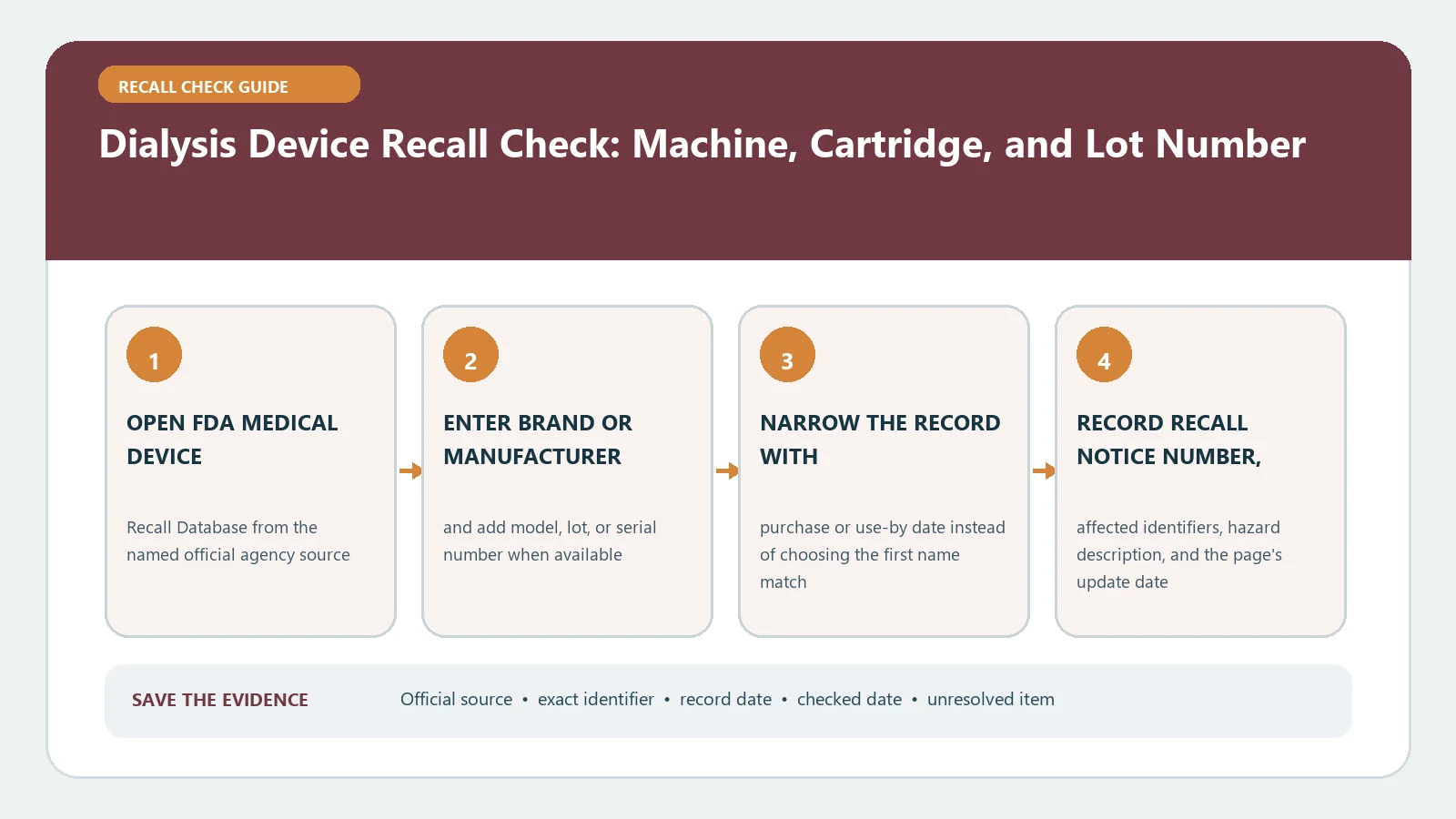
A dialysis recall check must identify the exact machine, disposable set, cartridge, catheter, software version, or lot named in the FDA action. Record each component separately, compare it with both the FDA communication and classified recall database, and take the result to the dialysis provider. Patients should not stop or alter dialysis on the basis of a headline or database match; the current notice and treating team determine the clinical response.
Reviewed August 26, 2026. FDA device communications can move from an early alert to a confirmed recall, and a firm may update correction instructions. Reopen the exact action before the next operational decision.
Split the treatment setup into independently matchable parts
Do not search dialysis as if it were one product. A facility machine may be unaffected while a bloodline, cartridge, transfer set, dialyzer, catheter kit, solution, or embedded software is recalled. Photograph labels and screens only within the provider’s privacy and infection-control rules. Do not disconnect tubing or remove sterile packaging to expose a code.
| System layer | Identifiers to preserve | Likely action owner |
|---|---|---|
| Dialysis machine | Manufacturer, model, serial, UDI or product code, runtime if specified | Facility biomedical team or home-program provider |
| Disposable circuit | Bloodline, cartridge, dialyzer, set name, catalog and lot | Clinic inventory or home-supply coordinator |
| Access component | Catheter, transfer set, connector, kit catalog and lot | Clinical team and supply chain |
| Software or settings | Version, configuration, update history, screen message | Authorized service and provider |
| Recall evidence | FDA recall number, firm letter date, correction status | Named recalling firm under provider control |
A kit can contain a recalled component made by another company, so the outer kit label and inner component lineage both matter. Likewise, a device communication may apply only to machines below a stated runtime, software release, or serial range. Use the field the notice specifies rather than substituting treatment date or clinic location.
Home inventory needs an additional custody map. Record which supplies are unopened, loaded, used, returned, or stored away from the main treatment area, and keep shipment dates and case labels with each lot. Clinic staff may trace the same component through purchasing, central stores, treatment station, and disposal logs. A carton lot does not always identify every inner package unless the recall notice says it does. When a distributor sends a field-action letter, compare its affected list with FDA rather than assuming that receipt of the letter proves every local unit is affected.
Use FDA’s communication layer and classified database for different jobs
Start with FDA’s Medical Device Recalls and Early Alerts. The page distinguishes early alerts under review from confirmed recalls and lists current dialysis-related machines, bloodlines, tubing sets, catheters, and kits when FDA considers the communication important enough for this public layer.
Then search the FDA Medical Device Recalls database. It contains classified device recalls since November 1, 2002 and supports product, firm, date, recall number, class, and reason searches. Try the exact product name, model family, recalling firm, and a distinctive component term separately.
- Open the patient or provider communication and copy its status.
- Locate the classified database entry by product and recalling firm.
- Match UDI, model, catalog, serial, lot, software, and distribution dates as applicable.
- Compare the firm’s current letter with the FDA action and provider inventory.
Correction, removal, and quarantine are not synonyms
A device recall can involve removal, correction, inspection, updated instructions, software, or a field action performed where the device is used. The word recall does not automatically mean a dialysis machine must be taken away. Conversely, correction does not mean the issue is minor. Read the hazard, affected-product table, action steps, and intended users together.
Inventory staff should distinguish product held for review, product confirmed outside scope, product awaiting correction, and product released after documented completion. A sticker or verbal reassurance is not enough unless the notice or authorized provider uses it as completion evidence. The medical device field-correction guide explains these operational differences.
If the UDI, lot, or component identity is missing
Use the provider’s equipment inventory, purchase or distribution record, package photographs, electronic maintenance log, and manufacturer field-action list. For a disposable already used, preserve the treatment date, package label image, catalog, lot, and supply shipment without retaining contaminated material outside approved procedures. A patient billing description rarely identifies the production lot.
If the database rejects a long identifier, search the model or product family and then inspect the notice manually. UDI device identifier, catalog number, model, and serial are different fields. Do not trim them until they fit an expected result. Leave the component unresolved and ask the provider or manufacturer which record links it to the affected population.
Treatment decisions stay with the dialysis team
Share the exact notice and identifiers with the nephrology or dialysis provider promptly. Do not skip treatment, change settings, substitute a cartridge, disconnect a catheter, or install software independently. FDA communications can contain instructions for health professionals that balance the recall hazard against the risk of interrupting necessary therapy.
For home dialysis, contact the program that supplied and supports the equipment even if a secondhand machine or accessory has a different ownership history. Record who reviewed the match, the interim plan, the affected component, and the next scheduled update. The broader medical device recall guide helps separate database identity from clinical action.
A report and a remedy need separate records
A problem report can describe an adverse event, malfunction, alarm, leak, contamination concern, or product-quality issue. It does not prove that the device caused an outcome and does not confirm enrollment in the recall. Keep the provider’s safety report identifier apart from the manufacturer’s correction case and the FDA recall number.
Close each component as affected, excluded, or unresolved. An affected record names the exact matching identifier and provider-directed action. An excluded record identifies the decisive mismatch. An unresolved record says which UDI, lot, software, or service fact is absent. A database entry does not certify the machine’s present condition or show that a correction was performed; completion requires provider or authorized-service evidence tied to that unit.