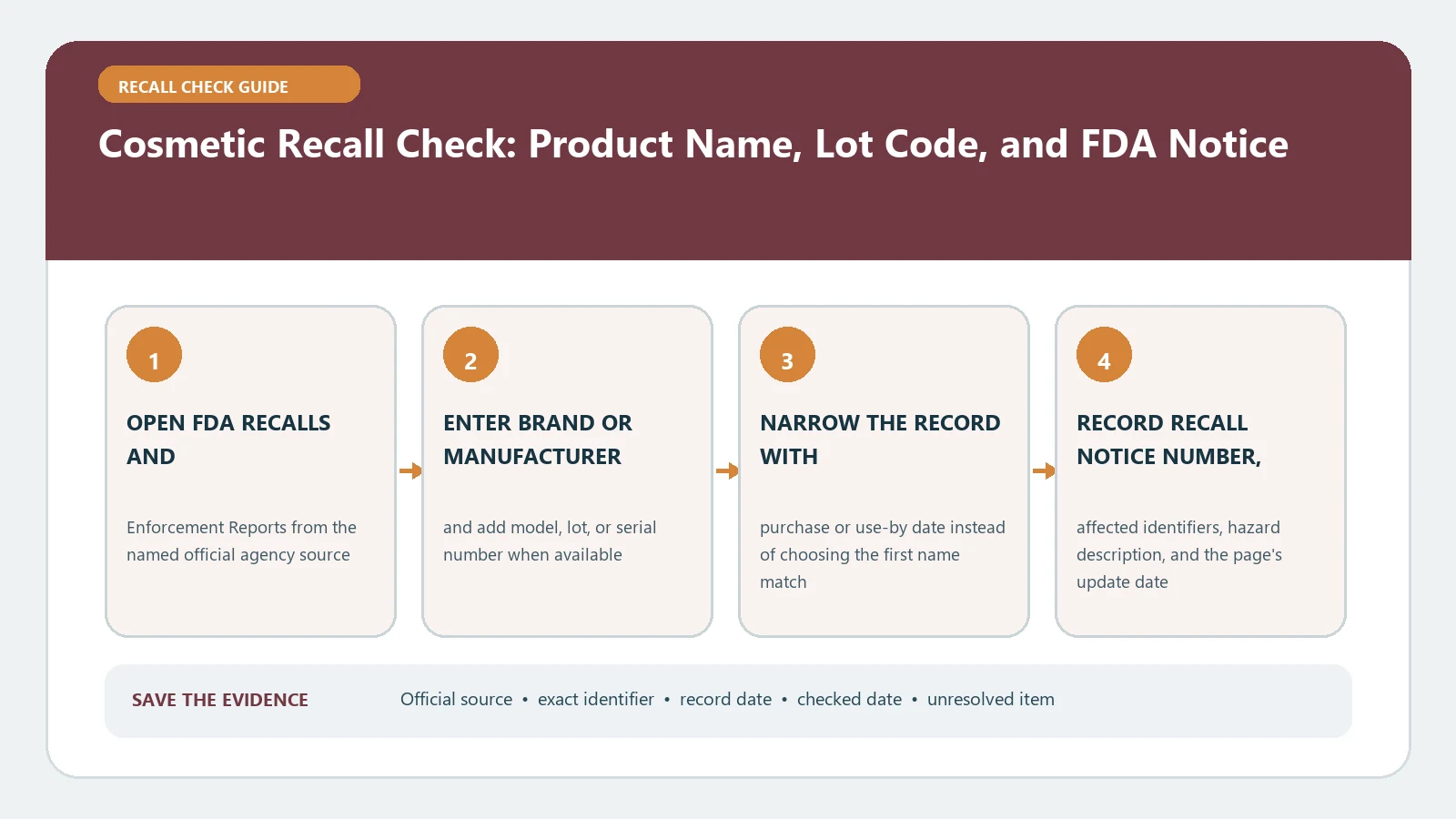
Check a cosmetic recall by matching the exact product name, shade or variant, container size, manufacturer or distributor, and any lot or batch code named in the FDA notice. A brand-wide search result is not enough, and some products marketed for skin or hair may be regulated as drugs because of their intended use. Preserve the label before returning or discarding the item.
Reviewed August 26, 2026. FDA announcements, Enforcement Reports, and complaint routes can change. Reopen the current notice before acting on a saved screenshot or retailer message.
Decide whether the label describes a cosmetic, a drug, or both
Start with the product’s intended-use claims, not the store aisle. Makeup, fragrance, moisturizers, shampoos, hair dyes, nail products, tattoo ink, and similar items can be cosmetics. A product claiming to treat or prevent disease or affect the body’s structure or function may also be a drug. Sunscreen, acne treatment, dandruff shampoo, and antiperspirant often require drug-specific searching.
Photograph every label panel, the bottom or crimp code, outer carton, applicator, seal, and retailer sticker. Do not wipe away residue or decant the product while identification is incomplete. If the product has an unexpected smell, color change, foreign material, leakage, or caused a reaction, stop using it and preserve those observations separately from the recall match.
| Field | Possible location | Decision it supports |
|---|---|---|
| Exact marketed name | Front label and outer carton | Separates similarly named lines |
| Shade, scent, or variant | Sticker, cap, or color label | Tests a recall limited to one formula |
| Net contents and package type | Principal display panel | Distinguishes retail configurations |
| Lot or batch code | Bottom, crimp, label edge, or carton | Connects the item to a production run when used |
| Responsible person | Manufacturer, packer, or distributor statement | Bridges private labels to the recalling firm |
| Purchase channel | Receipt or account history | Supports distribution scope without replacing a code |
Search the public announcement and the classified record
Begin with FDA’s Recalls, Market Withdrawals, and Safety Alerts. Search the product, brand, responsible person, and distributor. Open the complete company announcement, including product tables and photographs, and note whether it is a recall, market withdrawal, or another safety communication.
Then search the official FDA Enforcement Report by firm and product. The weekly classified record can include code information, reason, distribution pattern, recalling firm, classification, status, and recall number. A company announcement and Enforcement Report may appear at different stages, so use both to complete the product match rather than treating a missing layer as a contradiction.
For help separating FDA pages, use the FDA recall list guide. If the label indicates an OTC drug, use a drug-specific workflow rather than expanding a cosmetic notice to it. The product recall source guide can route items that belong to another regulator.
A missing lot code does not create a universal recall
FDA’s recall policy for cosmetics explains that production lot or batch numbering helps positive lot identification but is not generally required by law for cosmetics. Some recalls therefore identify products through other combinations, such as name, size, distribution dates, package photographs, or all units sold.
- Apply every field the actual notice makes limiting.
- Mark affected only when the item falls inside that full definition.
- Mark excluded only when a decisive field is outside it.
- Leave the item unresolved when the label or public record cannot support either decision.
Do not invent a lot for a salon sample, refill, tester, or product moved to an unmarked jar. Ask the salon, retailer, or distributor for the original container, supplier invoice, and responsible-person statement. A purchase date can narrow distribution but cannot prove a production run unless the recalling firm confirms the trace.
A reaction and a recall are different records
An affected-lot match determines whether the product is inside an official action. It does not diagnose a rash, burn, infection, hair loss, or another condition. Likewise, a reaction does not establish whether the product was recalled. Stop using the product, seek appropriate health care, and retain the label, photographs, use date, symptoms, and treatment information.
FDA’s cosmetic product complaint guidance provides the current consumer and health-professional reporting routes. Reporting a problem can support safety surveillance, but it does not authorize a refund or create a recall. Keep the FDA complaint reference, manufacturer case, and retailer remedy as separate files.
Private labels, salon stock, and decanted samples need a supplier trail
A salon, subscription box, hotel, retailer, or private-label brand may show a distributor while the recall names a contract manufacturer. Search every company printed on the container and ask the seller to connect its SKU to the responsible person and supplier lot. Keep an invoice or stock record with the physical label. Similar packaging or scent cannot establish that bridge.
For a sample poured into another jar, record who transferred it, the date, the original container if available, and the service or purchase tied to it. Do not copy a lot from another bottle in the salon. If no traceable source remains, the sample is unresolved even if its appearance resembles a recalled product. Ask the firm and health professional for the appropriate next action.
Imported products can add a labeler, U.S. distributor, and foreign manufacturer. Search each name and compare the market named in the notice. A recall issued in another country can be useful context but does not automatically define the U.S. lot or remedy. Record the jurisdiction and use the authority responsible for the package you possess.
Preserve the label before closing the remedy
Follow the notice’s instructions for return, disposal, replacement, or contact with the firm. Save photographs before surrendering the container when permitted, and record the notice revision date, recall number, matched fields, case number, and disposition. Do not donate or share an affected or unresolved product.
The recall remedy guide can track delayed responses. This site interprets public records; it cannot certify a cosmetic as safe, decide whether a reaction is product-related, or prove that every recall appears in one FDA list. Close the item only with an affected, excluded, or unresolved determination supported by the current official record.
A no-result search should retain the exact product spelling, responsible-person names, date checked, and sources used. Recheck after the firm answers or FDA publishes another layer. Silence in one list does not prove the product is acceptable for use, and this guide cannot replace the label, clinician, manufacturer, or agency response.