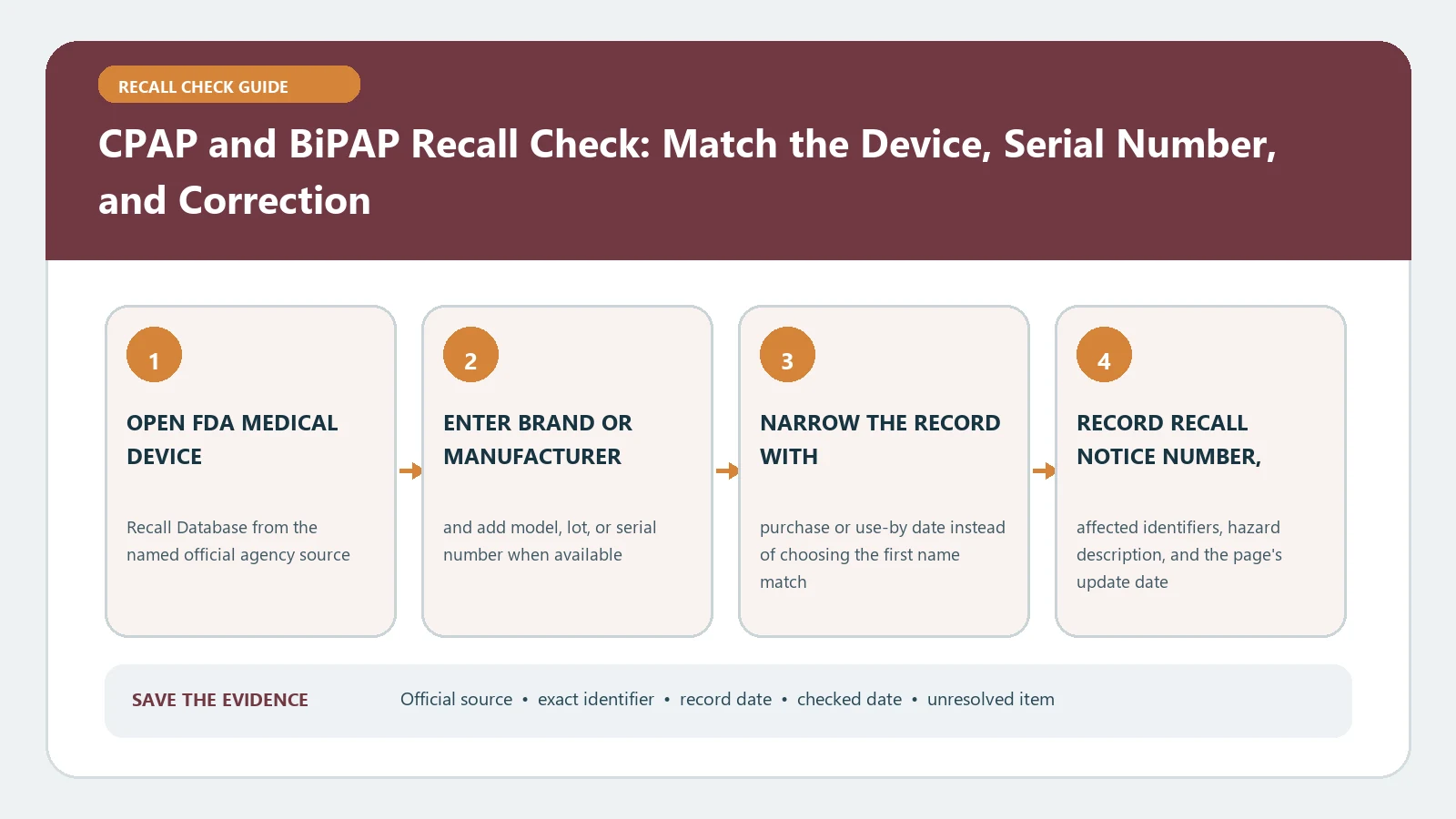
For a CPAP or BiPAP recall check, identify the manufacturer, exact device model, serial number, and any affected accessory or component, then compare them with the current FDA recall record and manufacturer correction route. Do not change prescribed breathing therapy from a brand match alone. When an official notice applies, discuss any stop, continue, or alternative-therapy decision with the treating clinician and complete the stated correction.
Create a therapy-device inventory before searching
Keep the device connected as prescribed unless an official instruction or clinician says otherwise. When it is safe to inspect, photograph the rear or bottom identification label and the screen that shows device information. Record manufacturer, model, serial number, device identifier if present, software version, power-supply model, humidifier, and modem. The mask and tubing may be replaced independently and should not be confused with the blower unit.
| Inventory field | Where to find it | Why it matters |
|---|---|---|
| Model and product name | Permanent device label | Routes to the affected family |
| Serial number | Device label or official device menu | May determine individual inclusion |
| Software or firmware | About or device-information screen | Can identify a correction version |
| Therapy role | Prescription and clinician record | Frames the risk of changing treatment |
| Accessory or component | Separate label | Prevents applying a unit recall to unrelated parts |
Use FDA records in two layers
Search the official FDA Medical Device Recalls database with the manufacturer and a distinctive model term. The database contains classified recalls since November 2002 and supports an advanced search by product, manufacturer, class, initiation date, and reason. Its create date is the date FDA classified the action, not necessarily the first day customers were notified.
Then check FDA Medical Device Recalls and Early Alerts for serious current communications and developing corrective actions. An early alert and a classified database entry have different statuses. Save both when they concern the same device, and use the newest product-specific action while preserving the FDA classification record.
Match configuration, not the words CPAP or BiPAP
Open the record and compare product name, model or catalogue number, serial range, UDI, software version, manufacture period, and affected component. A manufacturer may sell many devices under one respiratory brand. A recall can include selected ventilators and positive-airway-pressure machines while excluding later production or repaired units. A product family match is only the start of the decision.
- Confirmed affected: every required product and range field matches.
- Documented exclusion: a decisive model, serial, or version falls outside the record.
- Unresolved: the serial is unreadable, the configuration is unclear, or official sources conflict.
- Corrected: the exact action is complete and evidence is retained.
Do not label a replacement device corrected merely because its housing is new. Confirm its serial and correction status through the official manufacturer route identified by FDA. The medical device recall guide explains FDA status and identifier fields across device types.
Separate identity from the treatment decision
Identity matching answers whether the device falls inside a safety action. It does not decide whether an individual patient should immediately stop therapy. FDA’s current recommendations for recalled Philips devices state that some patients may face greater risk from stopping and should discuss benefits and risks with a health care provider.
Bring the exact model, serial result, current settings, diagnosis, nightly dependence, symptoms, and alternative-device availability to that conversation. Do not remove internal material, install an unapproved filter, alter pressure settings, or use an unapproved cleaner as a self-made remedy. For an urgent breathing problem, seek urgent medical care rather than waiting for an online recall response.
Track the correction as a chain of custody
A correction can involve registration, prioritization, repair, rework, replacement, software, updated instructions, or a refund option. Record the device serial before shipment, claim number, shipping tracking, returned-device receipt, replacement serial, and date the new or corrected unit entered use. Keep clinician instructions with the recall record but distinguish them from the manufacturer’s remedy evidence.
If the portal says a serial is not affected but the FDA model list appears to include it, save screenshots and verify that the serial was entered without confusing zero with the letter O. Confirm the country, model suffix, and whether the unit was previously remediated. Escalate through the contact route on the FDA or manufacturer notice; repeated submissions with changed identifiers can make the record harder to reconcile.
Coordinate a supplier-owned or rental device
When a durable-medical-equipment supplier owns the machine, ask it to identify the device serial, campaign, correction state, and planned replacement. Confirm which party must register the device and who will preserve prescribed settings during an exchange. Do not assume that the supplier’s inventory notice automatically reaches the patient or clinician. Keep the supplier work order with the FDA record.
If a temporary machine is issued, inventory that unit separately before use. Record its model, serial, accessories, sanitation or setup handoff, and return date. A loaner can have a different recall history and should not inherit the original machine’s affected, excluded, or corrected state.
Handle a second-hand or unidentified machine
Do not rely on a seller’s photo or listing title. Ask the manufacturer whether the permanent label can be restored or mapped. Confirm that the device is intended for the patient and can be serviced in the country where it is used. A used unit may have an unknown correction history, settings, sanitation history, or prescription status even when no open recall applies.
An empty database search means that the entered terms did not locate a record. Repeat with manufacturer, model stem, and product code, and check the product-specific FDA communication. Our ventilator recall check is a separate workflow for devices whose continuous life-support role and configuration require different handling.
Close with a dated clinical and remedy record
Save the identifiers, FDA URLs, recall or event number, database status, manufacturer result, clinician plan, correction state, and check date. Recheck when FDA updates the action, the manufacturer sends a notice, symptoms or device behaviour change, or a correction stalls. Last checked August 26, 2026. Respiratory-device recall and remedy status can change. Keep the recorded outcome tied to the exact machine and serial reviewed.