Check deli meat against the USDA FSIS notice using the establishment number, product name, package size, lot or production code, and sell-by or use-by date together. A store name or matching brand is not enough. Keep the wrapper until the comparison is complete, and follow the notice’s exact instruction to return or discard an affected package.
Last checked August 26, 2026. FSIS can expand a recall, add label images, post a public health alert, or later mark a case closed. Revisit the live notice even when you saved an earlier retailer message.
Read the wrapper as a four-part match
Deli products often share branding across several plants and production runs. Photograph the front, nutrition and ingredient panel, USDA mark of inspection, date panel, lot code, and any case label. Sliced-at-the-counter meat creates a different evidence problem: save the scale label, purchase date, store location, and product name because the original producer package may remain behind the counter.
| Package evidence | How to compare it | Common mistake |
|---|---|---|
| Establishment number | Match the EST, M, or P number exactly | Assuming the brand identifies one plant |
| Lot or production code | Preserve letters, separators, and leading zeros | Using only the sell-by date |
| Sell-by or use-by date | Check the complete date range in the notice | Reading it as the recall announcement date |
| Package size and product name | Match weight, style, and formulation | Applying a notice to every product from the firm |
The establishment number narrows the plant, not the batch
FSIS explains that the establishment number may appear inside the USDA mark of inspection or elsewhere on the package when the label points to that location. It identifies the producing establishment. It does not, by itself, show that every item from the plant is recalled. The lot, date, product description, and other code conditions still have to match.
On a clipped casing, tray, or outer case, the number may not be where a shopper expects. Do not substitute a retailer’s internal SKU for the USDA establishment number. If the notice includes label PDFs, compare the pictured code location with your package before deciding the number is absent.
Find the FSIS case before relying on a store alert
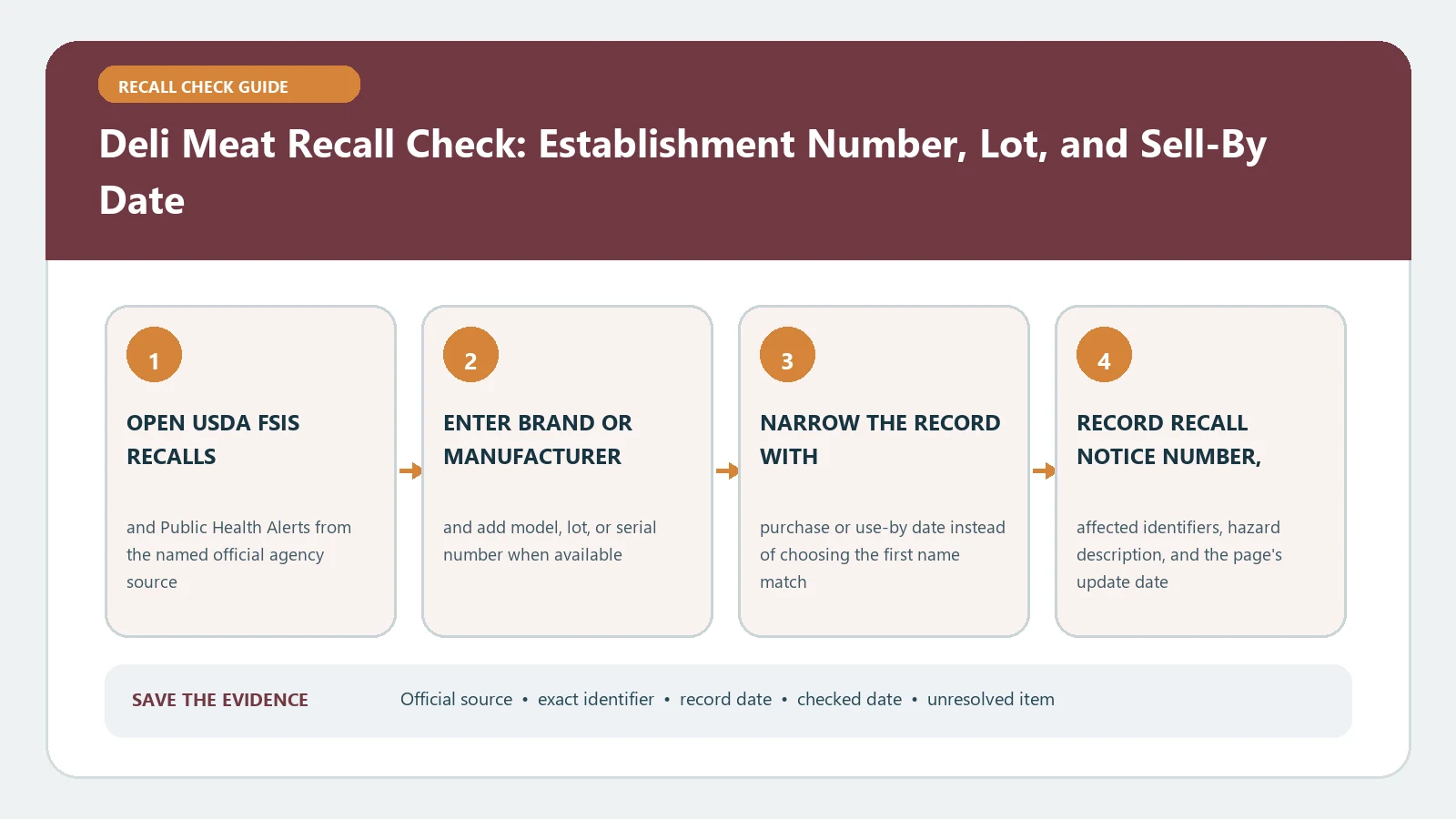
- Open the FSIS recalls and public health alerts list and search the company, product, or establishment number.
- Read the case status, announcement date, production dates, affected products, establishment number, distribution statement, hazard, and consumer action.
- Open every available label image or product list rather than relying on the summary paragraph.
- Compare all package fields and write down the one that includes or excludes the item.
- Use the company contact printed in the FSIS case when a code remains ambiguous.
A retailer notice is useful for locating affected store inventory, loyalty-card outreach, or refund handling. It may omit a plant number or production range. The FSIS case remains the better source for defining the recalled product.
Some notices link a product list that is longer than the visible webpage. Download or open the attachment and search the exact establishment number and product wording. When a case covers several brands made at one establishment, the attachment may be the only place that separates package weights and label dates. Keep the attachment with the notice because a screenshot of the summary may not preserve that scope.
Distribution and date labels can both mislead
A distribution list shows where affected product was known to have gone; it does not certify that a package outside those places is unaffected. Food can move through distributors, institutions, online orders, and household freezers. Use geography as supporting evidence after the code match, not as the only test.
Likewise, a sell-by date is an inventory label, not the date FSIS announced the recall. Match the format and range exactly. A package can remain frozen well beyond the printed retail date, which is why older notices may still matter to a household checking stored food.
Product handling and illness reporting are separate tracks
The FSIS recall explanation says notices may direct consumers not to eat an affected product and to return or discard it. Secure the package so another person or animal cannot consume it, then follow the case wording. Do not taste the meat to test it, and do not assume reheating cancels an official instruction.
If someone may be ill, contact a health professional and keep the package details, purchase history, meal date, and symptom timeline. A refund does not report an illness, and an illness report does not establish that a package belonged to the recalled lot. Preserve both records without forcing a conclusion the evidence cannot support.
Check shared refrigerators and foods prepared from the deli meat, not merely the unopened package. Write down where slices were used and whether another household member took a portion elsewhere. Follow the hazard-specific cleanup direction in the notice or public-health guidance. Do not invent a cleaning mixture or assume the ordinary food-storage routine addresses every contaminant or allergen.
When the original wrapper is missing
Search the receipt, loyalty account, delivery order, scale label, freezer inventory, and photographs. Ask the deli counter whether it can trace the item sold on that date to a producer package or establishment number. If it cannot, record the result as unresolved. A brand and purchase date may justify asking the recall contact a question, but they do not recreate a missing lot code.
For a counter-sliced purchase, note whether the case identifies a service-deli product or only factory-sealed retail packages. The same meat name can appear in both forms with different trace evidence. Ask the store to confirm the producer, establishment, and affected delivery window in writing when possible instead of treating the printed price label as a manufacturer label.
Leave a household removal record
Save the FSIS case URL, package photographs, exact matching fields, quantity found, return or disposal action, and the date every refrigerator or freezer was checked. The USDA FSIS recall check explains agency scope across meat, poultry, and processed egg products. If the notice concerns a pathogen or undeclared allergen, use the hazard-specific recall guide to separate product identification from health follow-up.