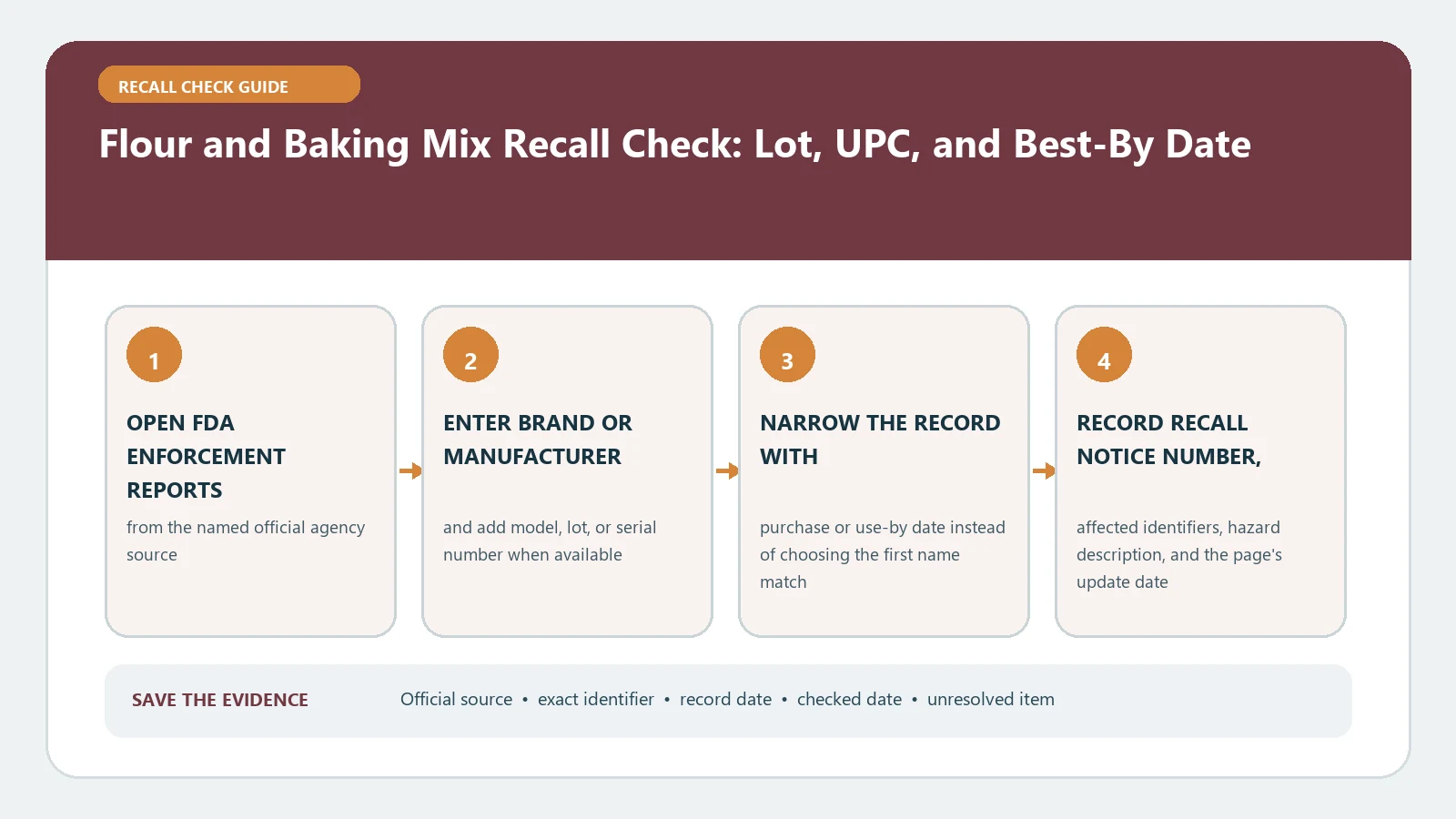
Set aside flour or baking mix until the exact product, package size, UPC, lot code, and best-by date all fit the affected-product table in the official FDA recall announcement. A shared brand or flavor is only a starting clue. Flour is often kept in secondary containers, while baking mixes may have a code on a carton flap or inner pouch, so identity recovery comes before any return or disposal decision.
Checked August 26, 2026. Company announcements can be corrected, expanded, or moved into FDA archives. Use the current notice on the day you classify the package.
Capture the dusty code without emptying the package
Close the bag or box and place it in a clean outer bag. Photograph the retail name, ingredient description, net weight, barcode digits, printed lot, and date line. On a mix, inspect both the carton and sealed inner pouch because the recall may identify one of them. Use side lighting to reveal faint ink; do not pour the contents onto a counter simply to find a stamp.
- Write the full variety, such as all-purpose flour, bread flour, cake mix, pancake mix, or another named preparation.
- Copy UPC digits from the printed package rather than from a retailer catalog.
- Keep punctuation, spaces, and leading characters in the lot or production line.
- Record whether the printed date says best by, use by, or another phrase.
- Save the purchase channel and receipt separately from the manufacturing identifiers.
A current announcement and FDA’s wider recall route answer different questions
Search FDA’s recall and safety alert list with the brand, product, and recalling company. Open the full company announcement to obtain its affected-product chart, label photographs, distribution scope, reason, and consumer instruction. FDA notes that this public list covers selected announcements and retains them for a limited period.
The agency’s food recall guidance points to the Enforcement Report when a public warning is absent and explains the identifiers consumers should compare. If an old news result has no active announcement, search the firm and product through that official route instead of assuming that no record remains.
| Search outcome | What to inspect next | Do not conclude |
|---|---|---|
| Exact product row appears | UPC, weight, lot, date, and geographic distribution | That every package under the brand is included |
| Company appears but variety does not | Corrections, expanded tables, and label attachments | That a similar mix is covered |
| Only an archived reference appears | FDA Enforcement Report and recalling-firm notice | That the event has no continuing package relevance |
| No usable record appears | Spelling, parent company, distributor, and code transcription | That the food has been cleared |
Match the retail unit before tracing an ingredient supplier
A recall may name a milling company while the pantry package carries another brand, or it may name finished baking mixes that used an affected ingredient. Read the distribution and product-table language to see which finished units are actually listed. Supplier relationships are useful search leads, not permission to add unlisted products to the recall.
Compare all stated boundaries. Package size can distinguish a consumer bag from a food-service sack. One UPC can separate a flavor or formulation. A best-by range may include only certain dates, and a lot can narrow it further. If the announcement says all lots or all dates, preserve that exact wording rather than manufacturing a narrower rule.
Make a pantry map before one bag becomes several containers
Check the main pantry, baking shelf, bulk-storage bin, garage shelves, and any container used to refill a smaller jar. Record whether each location holds an unopened package, an opened original bag, or transferred contents. This matters because one purchase can be divided among containers, and a return receipt for the empty bag does not document what happened to the remaining flour.
- Assign each package or container a temporary household label.
- Attach the photographed UPC, code, and date when the original packaging exists.
- Mark the item affected, excluded, or unresolved and state the evidence for that state.
- Follow the announcement’s handling instruction for every portion linked to an affected package.
- Save the store response and completion date beside the official notice.
Recover transferred flour when the source bag is missing
A plain canister has no lot identity. Search receipts, delivery accounts, pantry photographs, or another bag bought at the same time. Those records may establish the product and purchase window, but only manufacturer or retailer traceability can connect them to a production lot. Do not copy the lot from a newer bag or treat a best-by date remembered from memory as package evidence.
For a bakery or commercial kitchen, preserve the supplier invoice, delivery ticket, bag or pallet label, bin-fill log, production batch, and unused ingredient. Ask the distributor to trace its lot through the manufacturer’s affected table. Then identify which doughs, batters, mixes, or finished foods used that bin between refills. The invoice narrows the supply path; it does not create the lot code needed for a final product verdict.
Use the FDA food recall check when the agency route or announcement type is unclear. If the notice concerns a pathogen or allergen, the food hazard recall guide helps keep exposure questions separate from the product-code match.
Close the kitchen record, not just the refund
Follow the product-specific return, disposal, cleaning, and contact instructions in the recall. Do not donate an affected or unresolved product. If someone may have consumed it and has a health concern, retain the package evidence and speak with a health professional. The store transaction addresses the consumer remedy; it does not settle an exposure assessment.
Finish by recording what happened to the original bag, every transferred portion, and any food prepared from it that the notice specifically addresses. For a delayed refund or conflicting store response, use the refund and replacement guide. This page cannot identify a batch after its code is lost; it helps preserve and compare the evidence that FDA and the recalling firm publish.
A brand search does not prove that flour is outside a recall. FDA notes that the public company-announcement page is not a complete inventory and that older notices move beyond its current display window. Exclusion needs a documented mismatch in product, size, UPC, lot, date, or distribution, or a traceability response from the responsible firm. Keep any code-less portion unresolved while that evidence is missing.