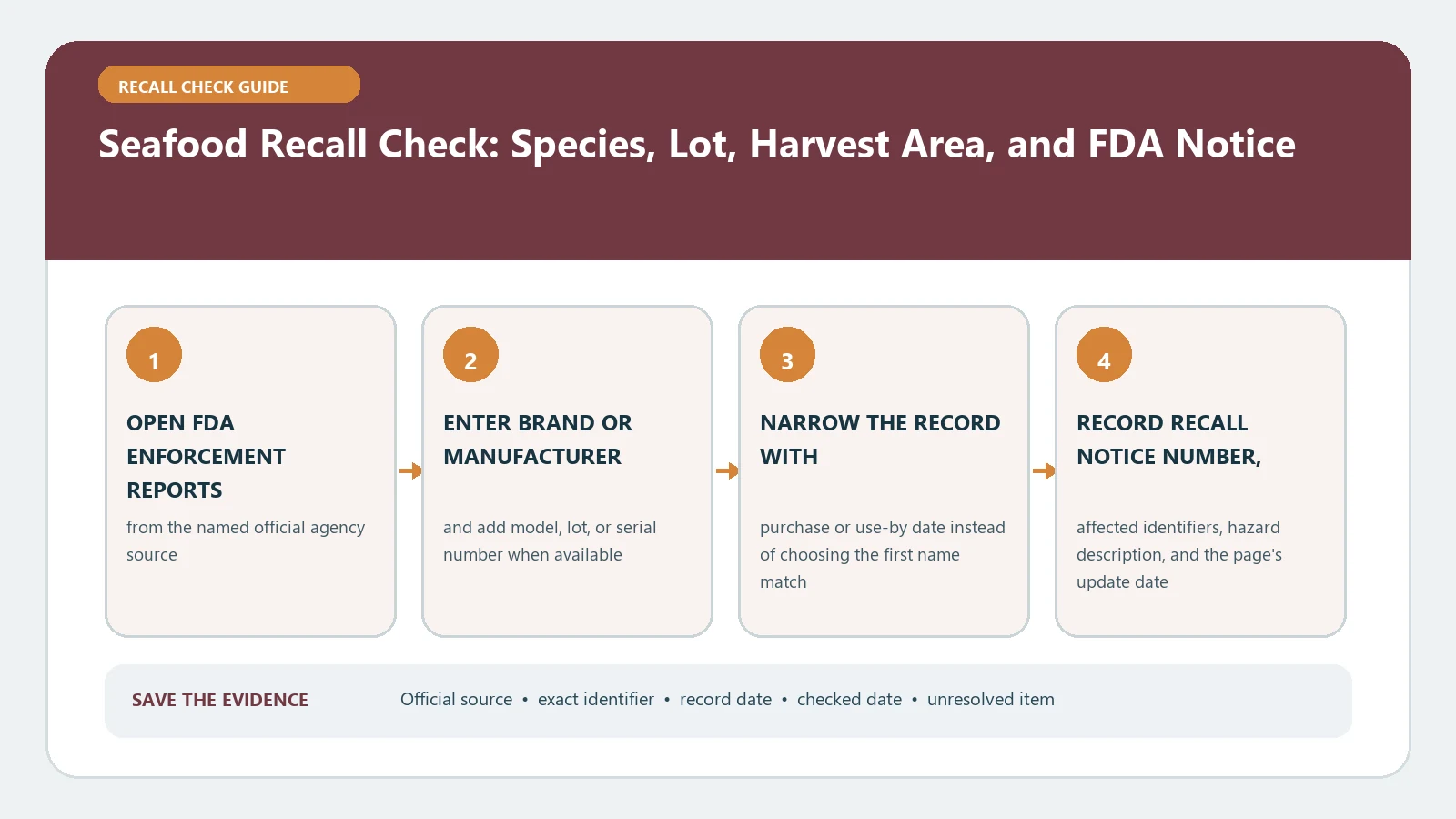
Check a seafood recall against the exact product form, species, processor, lot or date code, and the place where it was harvested or sold. Keep the package or shellfish tag, open the current FDA notice, and require every limiting field to agree. A shared species name or a nearby harvest area does not establish that one tray, can, bag, or restaurant shipment is affected.
FDA food-recall and shellfish-alert sources were reviewed August 26, 2026. Notices can expand, distribution can be clarified, and a firm may publish additional instructions, so reopen the cited record before serving, returning, or discarding seafood.
Save the package and shellfish tag before the trail disappears
Seafood identity can be lost quickly. A retailer may rewrap fillets, a restaurant may discard a case label, and shellstock can be separated from its original shipping container. Photograph every side of the consumer package and any tag, invoice, case end, menu description, or online order. Keep leftovers isolated according to the notice rather than opening or tasting them to identify the product.
| Evidence | Copy without shortening | Why it matters |
|---|---|---|
| Product | Species, common name, raw or cooked form, fresh or frozen state, package size | Separates similar seafood sold under one brand |
| Trace code | Lot, batch, use-by date, production code, UPC | Tests the affected production population |
| Shellfish source | Certified dealer number, harvest area, harvest date, ship date | Connects shellstock to a specific growing and distribution record |
| Sale | Store or restaurant, city, purchase date, receipt or order number | Checks the stated distribution path |
Preserve punctuation, leading zeroes, abbreviations, and country or state codes. A harvest date is not a sell-by date, and a certified dealer number is not a lot number. Put unknown in the evidence row instead of guessing from a photograph found online.
Choose between a company recall and a shellfish safety alert
Start with the FDA recalls, market withdrawals, and safety alerts list for company announcements involving FDA-regulated food. Search the processor, distributor, brand, species, and a distinctive lot fragment. Then check the FDA food alerts and advisories page, especially for oysters, clams, mussels, and scallops. A public advisory can direct consumers or sellers to act even when the page is not presented as an ordinary packaged-food recall.
The two surfaces answer related but different questions. A company announcement may center on brand, package, and lot. A shellfish alert may center on species, certified dealer, growing area, harvest date, and states receiving the shipment. Search both when the seafood was sold loose, served by a restaurant, or identified mainly through a shellstock tag.
A harvest area only works with its companion fields
An official FDA oyster alert illustrates the conjunction. The Future Seafoods oyster notice identified a processor and certified dealer number, species, harvest area, harvest date, distribution period, and destination states. That historical example is useful for learning how to read a notice; it is not a current list of every affected oyster.
- Confirm that the notice names the same seafood form, not merely the same species.
- Match the processor, dealer, or brand exactly, including any establishment suffix.
- Apply the lot, harvest date, area, package, and distribution limits together.
- Copy the consumer or business action from that same dated notice.
One decisive mismatch can exclude an item from that particular notice. An unreadable tag, missing case label, or uncertain purchase location leaves the result unresolved. It does not prove the seafood is safe, contaminated, or outside every other notice.
Recover a missing package or shellfish tag through the seller
For a store tray, ask the seafood counter to connect its scale label or transaction code to the original case. For a restaurant meal, provide the menu item, order date and time, location, and receipt; ask whether staff can identify the supplier, delivery date, lot, or shellstock tag. Do not demand private supplier records, but request a written affected, not affected, or unable-to-determine response tied to the official notice.
Work backward one custody step at a time. The consumer receipt can identify a store register and sale time; the store record can identify a tray batch or case; the case can identify a processor, dealer, lot, or harvest tag. Preserve what each party actually confirms. A verbal statement that the store checked everything is weaker than a response naming the notice, product row, and decisive matching or excluding field.
If the seller cannot trace the item, do not borrow a code from another package of the same species. Keep the seafood isolated according to current official guidance, record the reason identity failed, and ask the FDA or relevant state or local authority which facts are useful in a product complaint. That route documents uncertainty; it does not transform an unverified item into an affected one.
The FDA food recall guide explains package-level UPC and date matching. If the notice cites bacteria or an undeclared allergen, the hazard and allergen matching guide helps separate the hazard name from the product population. Neither page replaces the seller records needed for seafood that no longer has its original label.
If someone ate the seafood, keep exposure facts separate
Record who ate it, the amount, preparation method, meal time, and when any symptoms began. Retain the receipt and label photographs. Follow the current health instructions in the matching FDA notice and contact an appropriate health professional or local health authority when symptoms or risk factors warrant it. A recall match does not diagnose an illness, and an illness report does not prove that the named seafood caused it.
Keep exposure records apart from inventory records. One household member may have eaten a portion while unopened packages remain in another freezer; a restaurant may have served part of a case and transferred the rest to a second location. Record quantities received, served, discarded, returned, and still held. This makes the safety action auditable without turning a purchase record into a medical conclusion.
If the item is affected, use the notice-specific return, disposal, or business segregation direction. The recall remedy guide can help document whether the promised action was completed. Close the check only after every package, freezer location, restaurant batch, or downstream customer has an affected, excluded, or unresolved entry with the source URL and check date.