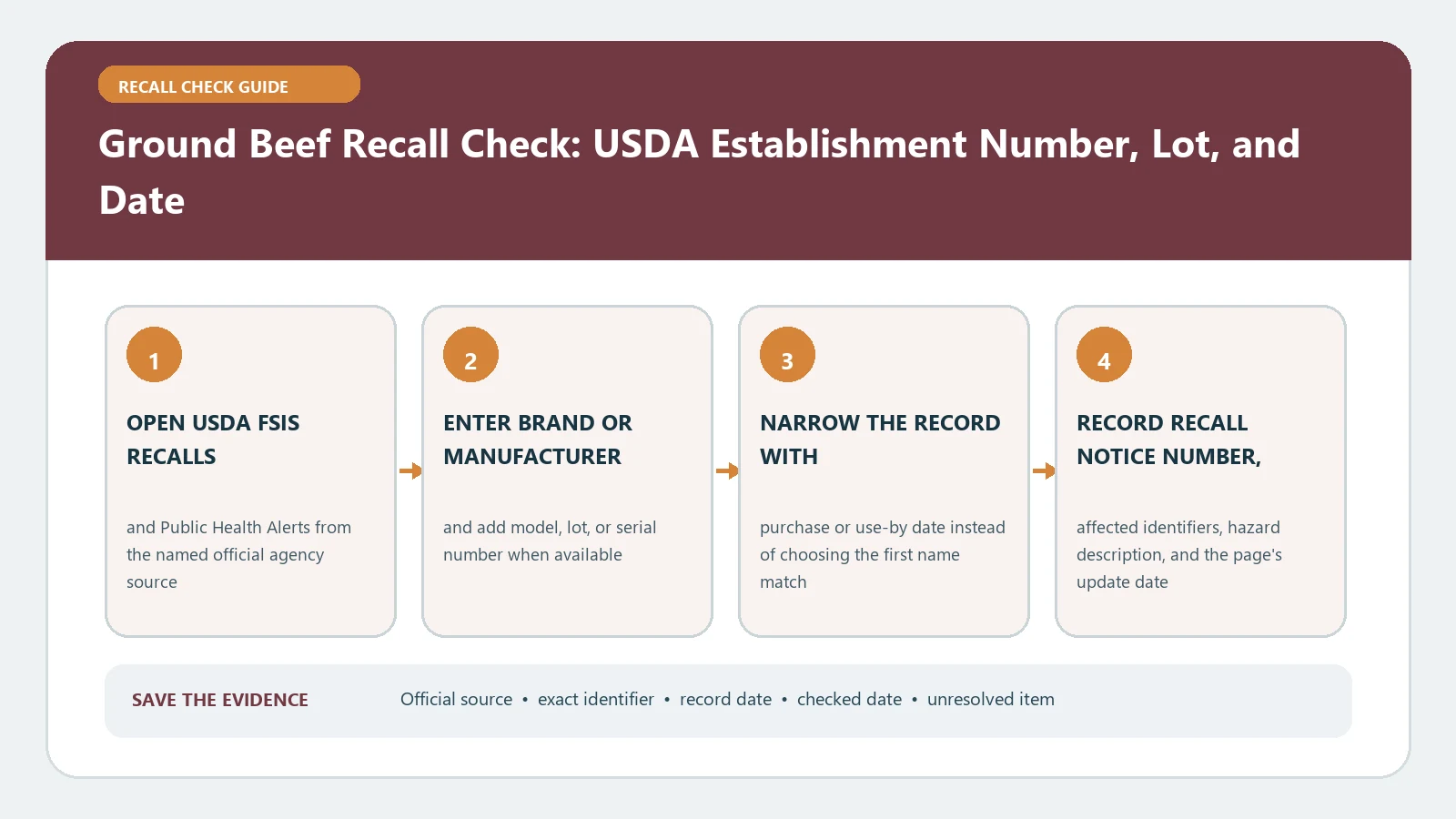
For ground beef, match the USDA establishment number inside the inspection mark together with the product name, package type, lot or production code, and date named in the FSIS recall. The establishment number identifies the producing plant, not a single batch. It narrows the search, but only the recall release and its label images can define which ground-beef packages are affected.
Source routes reviewed August 26, 2026. FSIS may update a recall release, distribution information, or effectiveness status. Reopen the current case before acting on beef stored for later use.
Read the USDA mark before searching the brand
Keep the package cold and photograph both sides without opening it. Find the USDA mark of inspection and transcribe the letters and digits following EST. The number may sit inside the round inspection legend or elsewhere on the package. A retail label can cover part of the processor’s label, so check the tray film, chub end, case sticker, and any retained box.
The FSIS page on finding a USDA establishment number explains where the identifier appears and how meat, poultry, and processed egg marks differ. Copy the full form shown on your package. Do not drop a letter prefix or assume that two plants with similar numbers are interchangeable.
| Ground-beef evidence | Role in an FSIS case | Common error |
|---|---|---|
| EST number | Connects the package to the inspected producing establishment | Treating every product from that plant as recalled |
| Product description | Separates patties, bulk chubs, trays, and other formulations | Searching only the store brand |
| Lot or production code | Tests the affected run when the release supplies one | Substituting a receipt transaction number |
| Use-by, freeze-by, or production date | Checks the case’s stated date boundary | Reading the purchase date as the package date |
| Label image and weight | Confirms the correct retail or institutional configuration | Relying on a similar photograph from social media |
Search the FSIS case list with plant and product terms
- Open FSIS Recalls and Public Health Alerts and search the establishment number without adding an unrelated retailer name.
- Search again with the processor, ground-beef description, and any case number found in a retailer notice.
- Open the complete release, not just the results row, and view every attached product-label document.
- Compare package configuration, weight, code, date, and establishment as a single affected-product definition.
- Save the release number, issue date, affected fields, distribution statement, and consumer instruction.
FSIS’s explanation of food recalls says releases provide label, lot, date, and establishment evidence when available. It also distinguishes open and closed recalls and public-health alerts. A closed administrative status does not change the identifier test for a package that remained in a freezer.
Recover identity when retail grinding changes the label
Some ground beef arrives in a processor-labeled package. Other beef is ground, repackaged, or relabeled by a store. If the recall release names an establishment and bulk product sent to retailers for further processing, the consumer tray may not display the same original label. Read the distribution and product-label attachments for instructions specific to retail packages, then contact the named store with the purchase date and receipt.
Give the meat department a narrow trace request: store location, transaction date and time, tray weight, sell-by date, price-per-pound line, and loyalty or receipt number. Ask whether that tray was ground in-store, received case-ready, or produced from a named chub or bulk lot. Request the establishment number or supplier-lot result in writing. A refund decision alone does not answer whether the tray maps to the FSIS case.
A loyalty record can establish where and when beef was bought, but it cannot generate the missing production code. Keep those facts separate. Mark the item unresolved until the retailer or recalling firm connects the transaction to the affected inventory. Do not borrow an EST number from a current package of the same brand.
Institutional or restaurant inventory needs the same separation at a larger scale. Preserve the shipping case label, purchase-order line, delivery date, remaining inner packs, and the kitchen’s thaw or grind log. Match the case establishment and production boundaries before tracing portions into meals. A distributor invoice can identify the source shipment, but it cannot establish that every package delivered under the account shared the recalled lot.
Use a package verdict that shows why it was reached
Write one line for each package. An affected entry should cite the exact FSIS case and every matched boundary. An excluded entry should name the decisive mismatch, such as a different establishment or date. An unresolved entry should state what is missing and who has been asked to clarify it. This small ledger prevents one family-sized package from being confused with several smaller trays.
The USDA FSIS recall guide covers the agency’s wider meat, poultry, and processed-egg scope. If the recall reason involves a pathogen or undeclared ingredient, continue with the food hazard matching guide after the package identity is settled.
Protect the evidence before disposal or a store return
Follow the consumer action in the FSIS release. Keep the product separated and prevent juices from contacting other food or surfaces. Photograph identifiers before surrendering the package when the notice permits. If someone may have eaten it and is concerned about symptoms, retain the case number and package record for a health professional rather than treating a refund as the end of the matter.
When one large chub was split into several freezer bags, use the original chub label as the shared source record and give every secondary bag its own disposition row. The handwritten freezer date shows household handling, not FSIS production identity. If the original label is gone, a matching purchase window may justify retailer tracing, but it does not prove inclusion or exclusion from the recall.
Close the check only when every package has a documented result and the named remedy has been completed. Save the return receipt, disposal note, or response from the establishment or retailer beside the recall release. For disagreements about refund, replacement, or another action, consult the recall remedy check. This site does not issue FSIS findings and cannot classify ground beef without the official case and package evidence.