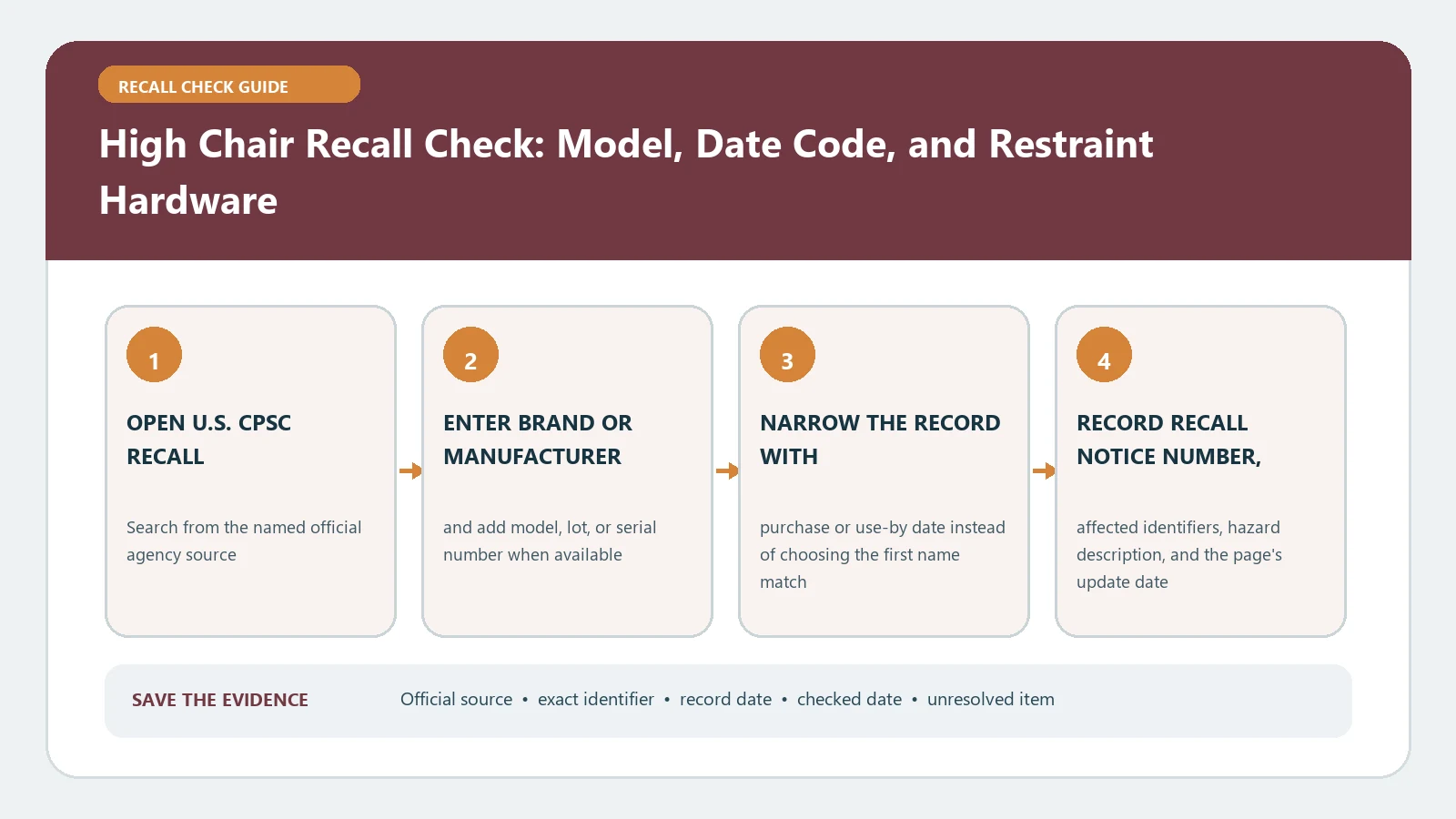
Keep a high chair out of use until its model, date or batch code, and restraint hardware have been compared with the complete CPSC notice. The same-looking chair may fall outside a campaign, while a missing belt, altered tray, or replaced seat can be the feature that matters. A brand name or marketplace photograph is not enough to clear it.
Reviewed August 26, 2026. High chairs remain in families and resale channels for years, so both current and historical federal records matter. Open the live notice before repairing, destroying, returning, donating, or reselling a chair because the remedy and evidence request belong to the exact campaign.
Pause child use before turning the chair over
Move the child to another safe place before inspecting the underside, back, or folded frame. Do not place weight in the chair to test a loose joint. Photograph the assembled chair from several angles, then the label in its normal location. Capture the model, product number, date or production batch, serial if present, manufacturer or importer, and every warning label.
Document the restraint system without modifying it: shoulder and waist straps, crotch restraint, buckle, anchors, screws, tray latches, seat attachment, leg locks, footrest, and any conversion pieces. Note missing or substitute parts. A replacement cushion can cover a date tag, and a third-party harness can hide the fact that the original attached restraint was absent.
| Evidence | Copy or photograph | Decision role |
|---|---|---|
| Tracking label | Brand, model or product number, batch, date, importer | Defines the candidate population |
| Restraint | Attachment points, buckle, waist and crotch straps, missing pieces | Tests configuration and immediate fall risk |
| Frame and tray | Locks, fasteners, hinges, tray engagement, conversion mode | Distinguishes versions and hardware conditions |
| Purchase trail | Retailer, order, seller, date, listing photographs | Supports identity and distribution scope |
| Recall record | CPSC number, affected fields, action, remedy evidence | Controls the official result |
One notice may turn on a batch and another on a date
Begin at the CPSC recall search with the full model or product number. Then try the manufacturer, importer, retailer, and high chair. Read each plausible record in full. Search terms locate candidates; the description and affected-product table decide whether the chair belongs.
The official Harppa convertible high-chair recall illustrates a narrow model-and-batch test and identifies an attached-restraint problem. By contrast, the Chicco Polly record uses model numbers and manufacture-date formats on a label under the seat. These examples show why a date code, batch, model, and hardware cannot be treated as interchangeable clues.
- Confirm that the product is the high chair named, including any convertible mode.
- Match the full model or product number without dropping suffixes.
- Apply the batch or date rule in the format explained by that notice.
- Compare the original restraint, tray, or frame configuration when specified.
- Copy the current consumer action and proof required for the remedy.
Secondhand chairs need an identity history
A resale listing may use a family name that covers several generations. Save the original listing, seller messages, purchase date, photographs, and any claimed model. Ask where the chair was bought and whether the tray, harness, seat cover, hardware, or frame has been replaced. Search every company name on the label, including importer and private-label seller.
If the label is hidden, inspect the back of the seat, underside, padding tag, footrest area, and folded frame without removing structural parts. Check the manual, carton, registration, retailer order, and older family photographs. The stroller and bassinet guide provides a related durable-child-product record trail, but visual resemblance never substitutes for a model or tracking label.
When the search returns no result
Widen the query from exact model to manufacturer, importer, retailer, and descriptive product terms. Check spelling and letter-number confusion. An empty result can mean the query is wrong, the label belongs to another market, the product appeared in a warning rather than a cooperative recall, or no public action has been found. It does not prove that the chair meets current safety requirements or is fit for reuse.
Send the label photographs and configuration notes to the named company and request written identification. If the seller has disappeared, retain the marketplace order and report a product incident or defect through the route CPSC provides. Keep incident reporting distinct from obtaining a refund, replacement, or repair. Mark the case unresolved until an authoritative record supplies the missing identity.
Also inspect whether the chair was sold under a storefront name that differs from the importer in the federal record. Compare listing images, color, conversion modes, tray shape, leg layout, and label position only as supporting characteristics. If those clues suggest a candidate but the required model or batch is unavailable, send the entire evidence set to the firm or CPSC and keep the chair out of use. Do not turn a visual resemblance into an affected finding or a visual difference into clearance.
Do not improvise the repair or destruction proof
A campaign may call for a repair kit, replacement, refund, stop-use instruction, or destruction of specified parts. Follow that notice in order. Do not cut restraints, drill the frame, discard the label, or surrender the chair before the program confirms what photographs or proof it requires. An improvised harness or hardware-store fastener can change the product without completing the official remedy.
Save the CPSC number, model and batch or date, claim reference, items submitted, promised remedy, shipment, and completion. The refund, replacement, and repair guide helps separate a filed request from a finished correction. If the chair is at a daycare, rental, grandparent’s home, or resale storage unit, close each physical location rather than only the first one found.
A recall lookup does not inspect today’s chair
Record affected when every controlling field matches, excluded when a decisive identifier differs, and unresolved when identity or configuration remains uncertain. A no-match result cannot certify the chair’s stability, restraints, assembly, maintenance, or compliance. A recall match does not prove that a child was injured or that a remedy was completed. Keep the official URLs and check date with the chair record, and recheck before reuse, transfer, or sale.