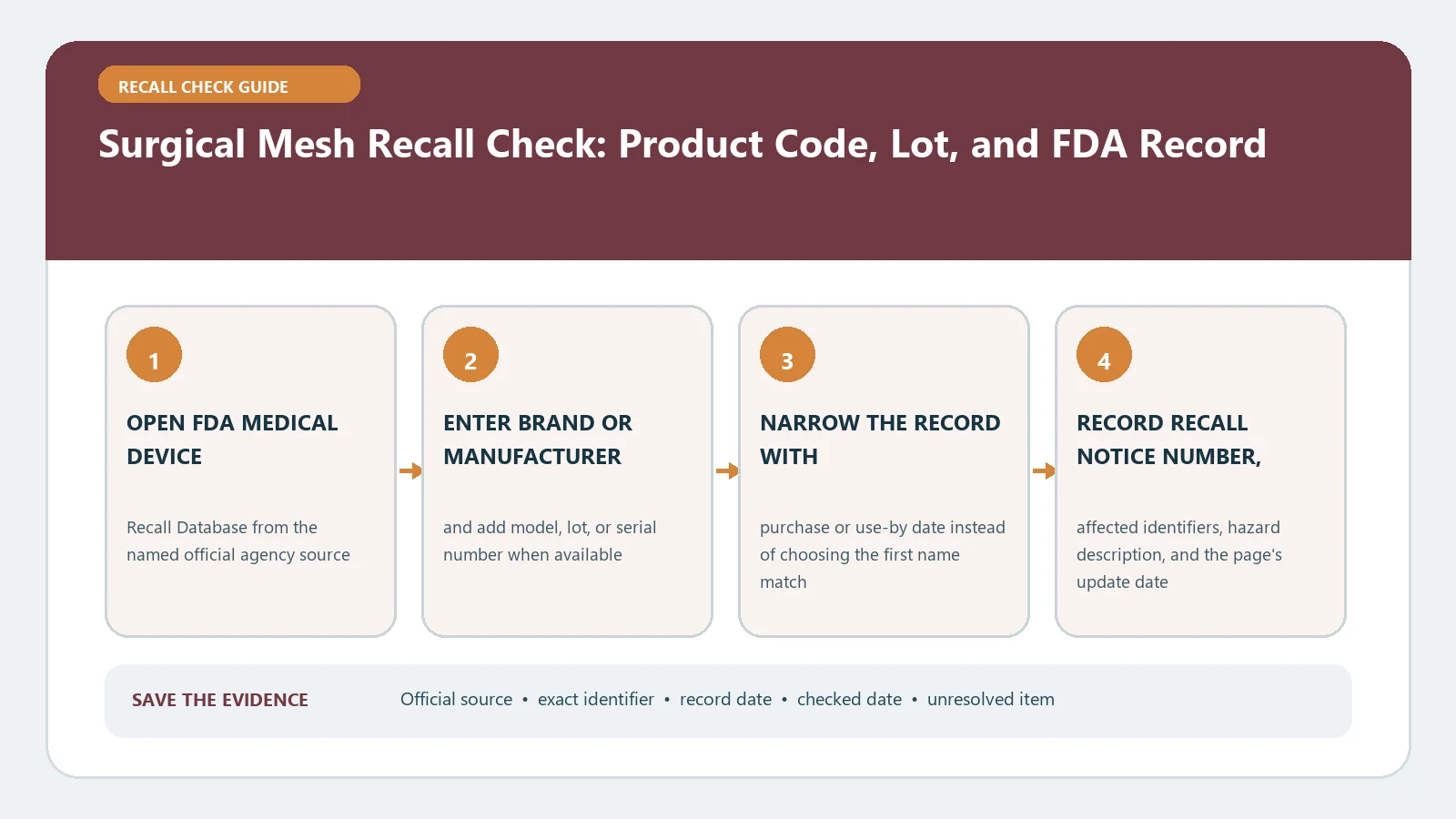
A surgical mesh recall check starts with the implant record, not a memory of the brand. Obtain the manufacturer, product name, catalog or reference number, UDI when recorded, lot number, size, and implant date. Match those fields to an FDA medical-device recall record, then let the surgeon or treating team decide whether the record changes follow-up care.
Medical-device and surgical-mesh sources were checked August 26, 2026. FDA records can be added, classified, or updated after a company begins a correction or removal, so a saved result should include the search date and be reopened when new information arrives.
Begin with the operative record and implant sticker
Ask the hospital, ambulatory center, or surgeon for the operative report and implant log. An implant sticker or supply record may identify the exact mesh more reliably than a discharge summary. The FDA advises hernia-repair patients to obtain the manufacturer, brand, UDI, and material from the physician office or facility; its surgical mesh information for patients also places treatment questions with the health care provider.
| Device detail | Where it may appear | Do not replace it with |
|---|---|---|
| Manufacturer and brand | Implant sticker, supply log, operative report | Hospital name or distributor alone |
| Catalog or reference number | Package label, implant log | A general mesh family name |
| UDI device identifier | Label barcode and readable text | Lot or serial number |
| Lot, batch, or serial | Production identifier or package record | Billing code or procedure code |
| Procedure context | Operative report | A guess based on incision location |
Create one row for each implanted component. Fixation devices, plugs, slings, mesh sheets, and later replacement material may have separate identities. Do not merge them into one product merely because they were used during the same operation.
Translate the UDI without losing the lot number
The FDA UDI Basics page distinguishes the fixed device identifier, which identifies the labeler and version or model, from production identifiers such as lot, serial, expiration, or manufacture date. AccessGUDID can help identify a device from its device identifier, but FDA explains that GUDID does not contain the production identifier. A successful UDI search therefore does not finish a lot-specific recall check.
Transcribe the readable UDI text and preserve a photograph of the barcode rather than trying to decode uncertain digits by eye. If only a catalog number appears in the medical record, ask the facility whether its inventory or billing system retains the lot. Record unavailable when the data cannot be recovered; do not manufacture a match from a similar package photograph.
Search the classified record by more than the word mesh
Use the FDA Medical Device Recalls search with the exact brand, product name, manufacturer, catalog number, or recall number. Open plausible results and compare the product description, product code, code information, recalling firm, reason, action, distribution, recall number, status, and dates. The database covers classified medical-device recalls from its stated historical start and may show a company action before or after FDA classification timing.
- Search the complete catalog number, then the brand and manufacturer if no result appears.
- Confirm that the product description is the same kind of surgical mesh and configuration.
- Compare every lot, reference, UDI, size, and date limit in the code-information field.
- Read the firm action and current status without converting them into medical advice.
The medical device recall guide provides a broader FDA-record workflow. Use this surgical mesh page when the unresolved job is linking an implanted mesh to its product and production identifiers.
Distinguish unused inventory from an implanted unit
A firm action may tell distributors or facilities to quarantine and return unused packages while giving a different instruction for devices already implanted. Read the action field and customer communication for both populations. Do not assume that a return instruction for inventory means a patient should undergo removal, or that an implant requires no follow-up because unused stock was recovered.
Ask the facility whether it received the recall communication, reconciled its remaining stock, identified implanted units, and has a patient-contact process when applicable. Record the answer and case number without requesting another patient’s information. The facility’s inventory completion does not establish what happened to the exact lot implanted in one person unless its records make that link.
Resolve a missing lot through the care facility
If the implant sticker is absent, request the itemized implant or supply log, not only a generic chart summary. Give the records office the procedure date, surgeon, facility, and the exact component you are trying to identify. A distributor invoice may establish what the facility received but not automatically which unit was implanted in one patient. Keep that distinction visible in the evidence table.
When two records disagree, send the conflicting catalog or lot values to the facility and manufacturer in writing. The hip and knee implant guide shows a related component-ledger method. It can help organize records, but a hip component and a surgical mesh remain separate FDA products with separate clinical questions.
Keep product scope and patient care as two decisions
An affected result means the available identifiers enter the population described by that recall record. An excluded result names the exact differing field. An unresolved result identifies the missing evidence and next records request. A database match does not prove the current condition of an implanted mesh, explain a symptom, or determine whether removal is appropriate.
Take the product record, recall URL, and any manufacturer communication to the surgeon or treating clinician. Do not stop follow-up, seek a procedure, or change care solely because a database entry was found or absent. If the firm calls its action a correction rather than a removal, the medical device field-correction guide explains why the action verb must be read exactly. Save the clinician response and manufacturer case number separately from the recall match.
For continuing follow-up, keep one compact component ledger: immutable product identifiers, implant date and facility, FDA recall number and status, manufacturer communication date, clinician review date, and the next requested action. Update a row rather than overwriting it so later reviewers can see when the evidence changed. This record supports communication; it is not a substitute for the medical chart.