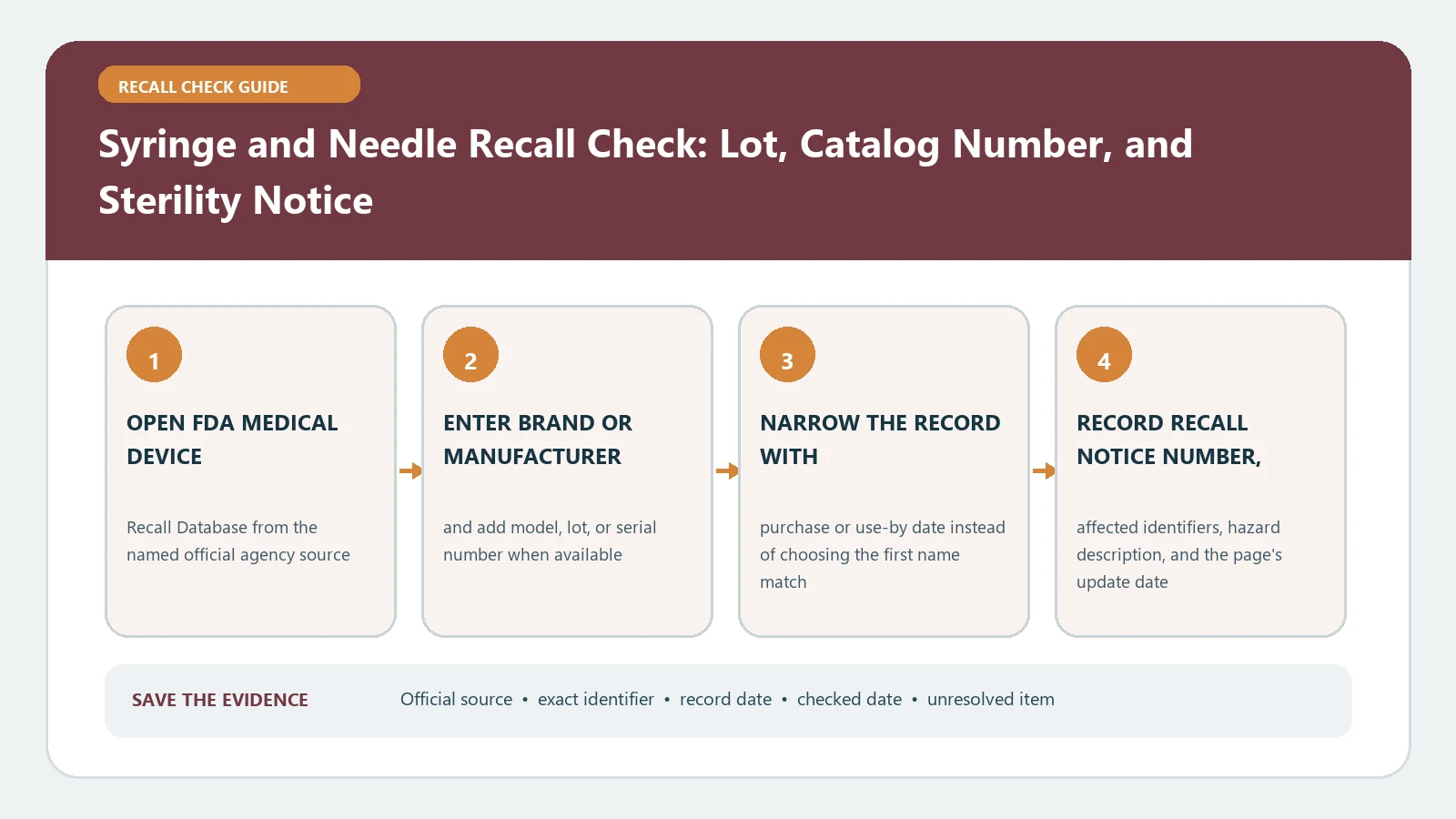
Do not match a syringe or needle recall by brand name alone. Isolate the unopened stock, photograph every label, and compare the FDA notice with the exact product description, catalog or REF number, lot, needle gauge and length, package configuration, and expiration date. If an item was already used or a patient may have been affected, preserve the package information and contact the treating professional or facility rather than trying to judge exposure from a search result.
Last checked August 26, 2026. The FDA device database can change when an action is classified or terminated, while a manufacturer may begin a correction before that classification appears. Reopen the live record and the company instructions when you make the decision.
Build one inventory row before opening the FDA search
A carton, an inner tray, and an individual sterile pouch can carry different useful identifiers. Photograph them together without opening an intact sterile barrier. Record the manufacturer, brand, product description, catalog or REF number, lot or batch, expiration date, syringe volume, needle gauge and length, and the number of units in the package. A hospital supply label or distributor sticker can help trace an order, but it does not replace the manufacturer’s identifiers printed on the device packaging.
| Field to capture | Where it may appear | What it settles |
|---|---|---|
| Catalog or REF | Carton, tray, or pouch label | Exact device configuration |
| Lot or batch | Near the expiration or barcode | Affected production range |
| Gauge, length, volume | Product description panel | Needle and syringe variant |
| UDI device identifier | UDI barcode and human-readable text | Manufacturer-submitted identity |
| Expiration date | Sterile package label | Date condition named by a notice |
The recall database and AccessGUDID answer different questions
Use the FDA Medical Device Recalls search to find classified recall records and their product descriptions, code information, reason, action, and status. Start with the product name or manufacturer, then narrow with the catalog number or another distinctive label phrase. Searching only a long serial number may miss a record because a notice may describe a lot, model family, or distribution group instead.
AccessGUDID helps resolve device identity when the label includes a UDI. It can confirm brand, company, version or model, and other submitted device attributes. It is not a recall-clearance tool. A matching GUDID record shows what the device is; the recall record determines whether a correction or removal covers it.
A lot match still needs the full product configuration
- Open the FDA result and compare the recalling firm’s name with the manufacturer or legal manufacturer on the label.
- Match the catalog or REF number before relying on a shared lot number. Different products can use similar numeric sequences.
- Read the code-information field exactly, including ranges, prefixes, suffixes, and package sizes.
- Check whether the notice covers a syringe alone, a needle alone, a fixed-needle syringe, a kit, or a component packaged with another product.
- Save the FDA recall number and the manufacturer’s customer notification before moving the stock.
Record the result as affected, excluded by a named field, or unresolved. Similar packaging, a matching color, or one overlapping word in the description does not prove that an item is covered.
Read correction language before moving or discarding stock
The FDA explains that a medical device recall can involve a correction where the device is used or a removal from the market. The agency’s medical device recall explanation also notes that a recall does not always require a return or immediate stop in every setting. The exact customer letter controls the operational step: quarantine, inspect, relabel, replace, return, destroy, or follow another correction.
At home, do not improvise a sharps shipment or put loose needles in ordinary mail. In a clinic, keep affected inventory out of circulation without erasing its chain of custody. Follow the named return authorization, destruction record, or facility protocol. A distributor’s routine return process is not automatically the recall remedy.
Sterility wording changes the immediate decision
A notice may concern compromised sterility, particulate matter, breakage, labeling, dimensions, connection failure, or another defect. Do not convert every syringe recall into a contamination claim. Read the stated reason and action together. If sterility is at issue, an intact-looking pouch does not overrule the affected lot list. If the concern is a labeling error, the physical device may still require the specific correction described by the firm.
Facilities should also distinguish stock location from product identity. The same affected lot may be divided among a central storeroom, procedure carts, emergency kits, and satellite offices. Count where units were distributed, record where each quantity was recovered, and compare that total with purchasing records. A carton removed from the main shelf does not show that every unit from the lot has been controlled.
If an affected item was used, note the date, product and lot, procedure or context, and any available facility record. A database page cannot determine whether a person was harmed. Questions about symptoms, follow-up, testing, or treatment belong with a qualified health professional and the recall contact.
If the catalog number or lot is missing
Check the outer carton, inner shelf box, sterile pouch, purchase record, distributor invoice, and inventory system. Search the FDA database with the firm name plus a distinctive product phrase, then inspect every plausible result. If the sterile barrier would have to be opened merely to hunt for a code, pause and ask the manufacturer or supplier where the identifier is located. Do not borrow a lot number from an online photograph or treat a blank search as proof of safety.
When a distributor repackaged the item, preserve both the distributor label and the original manufacturer’s trace information. Ask whether a cross-reference connects the customer item number to the recalled catalog number. Record who supplied the mapping and when it was confirmed; a verbal resemblance between two descriptions is not a reliable substitute for that trace.
Close with a unit-level disposition record
Keep the label photographs, FDA recall number, company notice, quantity isolated, action taken, return or destruction confirmation, and the person or department that closed the case. For a broader explanation of FDA device records, use the medical device recall check. When the search begins with a general FDA announcement rather than a device entry, the FDA recall list guide shows how to move from a public alert to the detailed record.