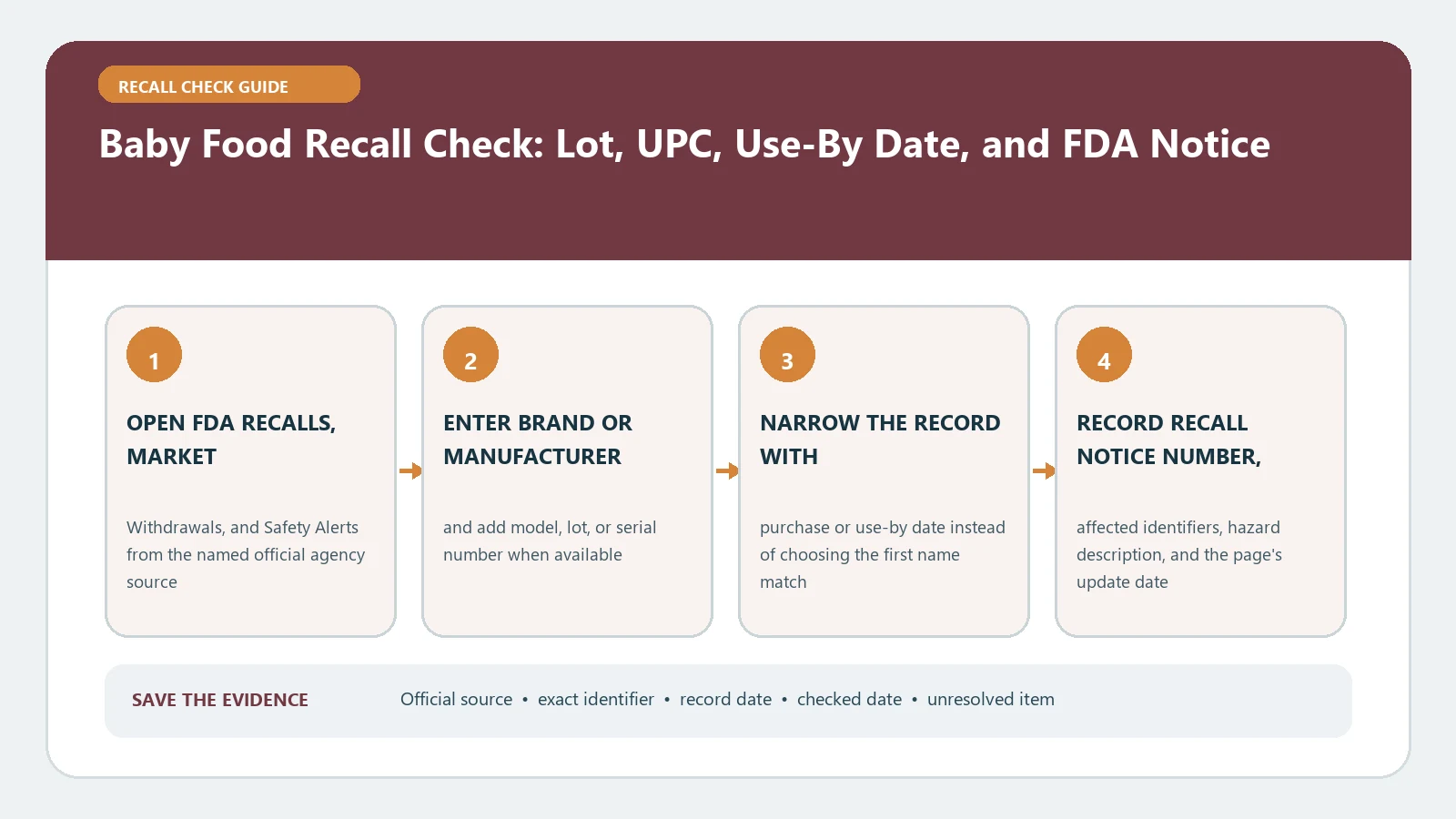
A baby-food recall applies only when the package matches the official notice’s product description and every limiting identifier, such as brand, variety, container size, UPC, lot, and use-by date. A notice about one pouch, puree, snack, or cereal does not cover every product from the brand. Set aside the package, photograph its codes, and use the current FDA record before returning or discarding it.
Reviewed August 26, 2026. FDA announcements can be revised or archived, and a classified Enforcement Report can appear on a different timeline. Recheck the complete live record before closing a package as affected or excluded.
Quarantine containers from the same purchase without mixing them
Place each unopened jar, pouch, tub, tray, or box in a separate clean bag. Do not combine containers from a multipack or discard the outer carton while identifying them. Photograph the front label, ingredient panel, barcode, stamped code, lid or seal, and any retailer sticker. Keep food that has already been transferred to another container separate from packages that still have traceable labels.
| Package field | Where to look | What it distinguishes |
|---|---|---|
| Exact food and flavor | Front panel and ingredient statement | One recipe from similar products |
| Container size and count | Net-weight line and outer carton | Single units from multipacks |
| UPC | Digits under the retail barcode | The sellable package configuration |
| Lot or production code | Lid, seal, pouch edge, bottom, or carton | The manufacturing run named in the notice |
| Use-by or best-by date | Near the lot code | The affected production window |
| Firm and distribution | Manufacturer statement and receipt | Private-label supplier and sales-channel context |
Read small characters from the photograph rather than memory. A leading zero, slash, plant prefix, or letter can change the result. Purchase date and store location are useful supporting evidence, but FDA notes that recall notices identify products through package details such as UPCs, lots, and dates. A receipt usually cannot replace a missing production code.
Use the announcement to identify the food
Search FDA’s Recalls, Market Withdrawals, and Safety Alerts by the exact product, brand, distributor, and supplier names. Open the full company announcement and its product table or photographs. FDA posts many company announcements as a public service, so the firm’s action and package identifiers must be read in the notice rather than inferred from an FDA page title.
The announcement should tell you which products are included, why the action occurred, where they were distributed, and what consumers should do. FDA’s food recall guidance lists the product name, packaging, UPC, lot or date codes, label images, and distribution as common identification fields. Require the fields the actual notice names; do not impose a generic match rule when a notice recalls all lots or uses another boundary.
When the announcement lacks a classification or later status, search the official FDA Enforcement Report by firm and product. Its code information and distribution pattern can clarify how FDA classified the action. The weekly record is a second evidence layer, not a substitute for the company’s consumer instruction. Save both URLs and note which one supplied each matched field.
Private labels may require a supplier bridge
A grocery or online brand may be produced by a supplier named more prominently in the recall. Search both the consumer-facing brand and the manufacturer or distributor statement printed near the ingredients. Compare the notice’s UPC and package photograph, then ask the retailer to connect the transaction to the supplier when the brand list is incomplete.
Multipacks create another trap. The outer carton may have one UPC while individual pouches carry separate lots or dates. Match the level named in the notice. If the action names individual pouch codes, an outer-carton match alone is incomplete. If the notice names a carton UPC and all enclosed units, do not separate an unmarked pouch and later treat it as excluded.
Code formatting can vary across containers. Preserve spaces, punctuation, prefixes, and the relationship between lot and date instead of rewriting them into a convenient number. If condensation or a curved lid makes the stamp hard to read, use angled photographs under indirect light. Do not scrape a seal or open an unused container solely to expose a code.
The infant formula recall check should be used when the product is formula rather than complementary baby food. Formula notices can involve preparation, feeding, and medical instructions that should not be generalized to puree, cereal, or snacks. For other FDA foods, the FDA food recall workflow covers the same lot-and-UPC discipline.
Read the consumer instruction for this notice only
Follow the stated stop-use, return, disposal, cleaning, and health instructions. Do not donate an affected or unresolved product. If a child may have consumed the food and the notice describes symptoms or a high-risk group, keep the package evidence and contact the child’s health professional. A refund desk cannot assess exposure, and this site cannot provide medical advice.
- Record every unit as affected, excluded, or unresolved.
- Attach the exact notice URL, publication or revision date, and matched identifiers.
- Preserve photographs before a return or disposal when the notice permits.
- Keep health follow-up separate from the refund or replacement case.
If the original package is missing, do not invent the lot
Food moved into an unmarked bowl, freezer bag, daycare container, or pantry jar cannot be assigned a lot from its appearance. Check a receipt, loyalty account, delivery invoice, pantry photograph, or another unopened unit from the purchase. Ask the retailer whether its transaction record exposes the UPC and whether the supplier can narrow the lot. If no source can do that, label the portion unresolved and ask the recalling firm for the appropriate action.
Search the refrigerator, freezer, diaper bag, caregiver’s home, and childcare supplies before closing the inventory. The recall remedy guide can track a response that spans several stores or households. An empty FDA announcement search does not certify a product as unaffected because not every recall receives the same public-warning layer and older notices may leave the current display. A defensible exclusion needs a decisive package mismatch or a traceability answer from the firm.