To check an infant formula recall, open the current FDA notice and compare the exact product name, formula type, container size, UPC, lot or batch code, and use-by date with the package in your hand. A brand match, a similar can, or a social-media photo is not enough. If the official notice says the identifiers match, stop using that container and follow the notice’s return, refund, or disposal instructions.
Keep the container until you have photographed its codes and read the full notice. Formula recalls do not all use the same boundary: one notice may include every lot currently on the market, while another may include only named batches. The wording in the current FDA notice controls the decision.
Check the current FDA alert first
Start with the FDA Recalls, Market Withdrawals, and Safety Alerts page or the FDA’s infant formula information for parents and caregivers. Open the notice itself rather than relying on a search-result snippet, retailer email, or reposted list. Check the FDA publish date and read any later update shown on the page.
Current U.S. alert checked July 23, 2026: FDA says all Nara Organics Whole Milk Organic Powdered Infant Formula lots currently on the market are included in the company’s June 13, 2026 recall. Anyone holding that product should use the dated FDA Nara recall notice for the affected products and response. This paragraph is a dated alert, not a permanent list of every formula recall.
The scope can be very different in another notice. FDA’s May 2, 2026 a2 Platinum infant formula notice, for example, identifies three specific batches. These two official notices show why the words all lots and specific batches cannot be treated as interchangeable.
Copy every identifier from the container
Put the container on a stable surface under bright light. Photograph the front, back, lid, and bottom before throwing anything away. Copy the codes exactly, preserving letters, numbers, spaces, and leading zeros. A lot code may be printed or ink-jetted on the bottom or another part of the package; use the location shown in the recall notice rather than assuming every brand prints it in the same place.
| Identifier | Where to look | Why it matters |
|---|---|---|
| Brand and full product name | Front and principal display panel | Separates the named formula from other products sold by the same company |
| Formula type or age range | Front and nutrition or preparation panel | Distinguishes powder, liquid concentrate, ready-to-feed, specialty, and age-specific products |
| Container size | Net-weight statement | A recall may apply to one package size but not another |
| UPC | Number printed below the barcode | Identifies a retail package, but does not usually identify one production lot by itself |
| Lot or batch code | Location named in the notice, often the bottom or lid | Connects the container to a production run when the recall is lot-specific |
| Use-by date | Printed date on the container | May be part of the affected range and is required on U.S. infant formula containers |
| Purchase details | Receipt, order history, or retailer account | Helps confirm distribution and supports a refund or complaint |
FDA’s food recall guidance explains that recall notices commonly provide the product name, package size and type, UPC, lot or other product codes, sell-by or use-by dates, package images, and distribution information. Match all fields that the specific notice provides; do not stop after the first matching field.
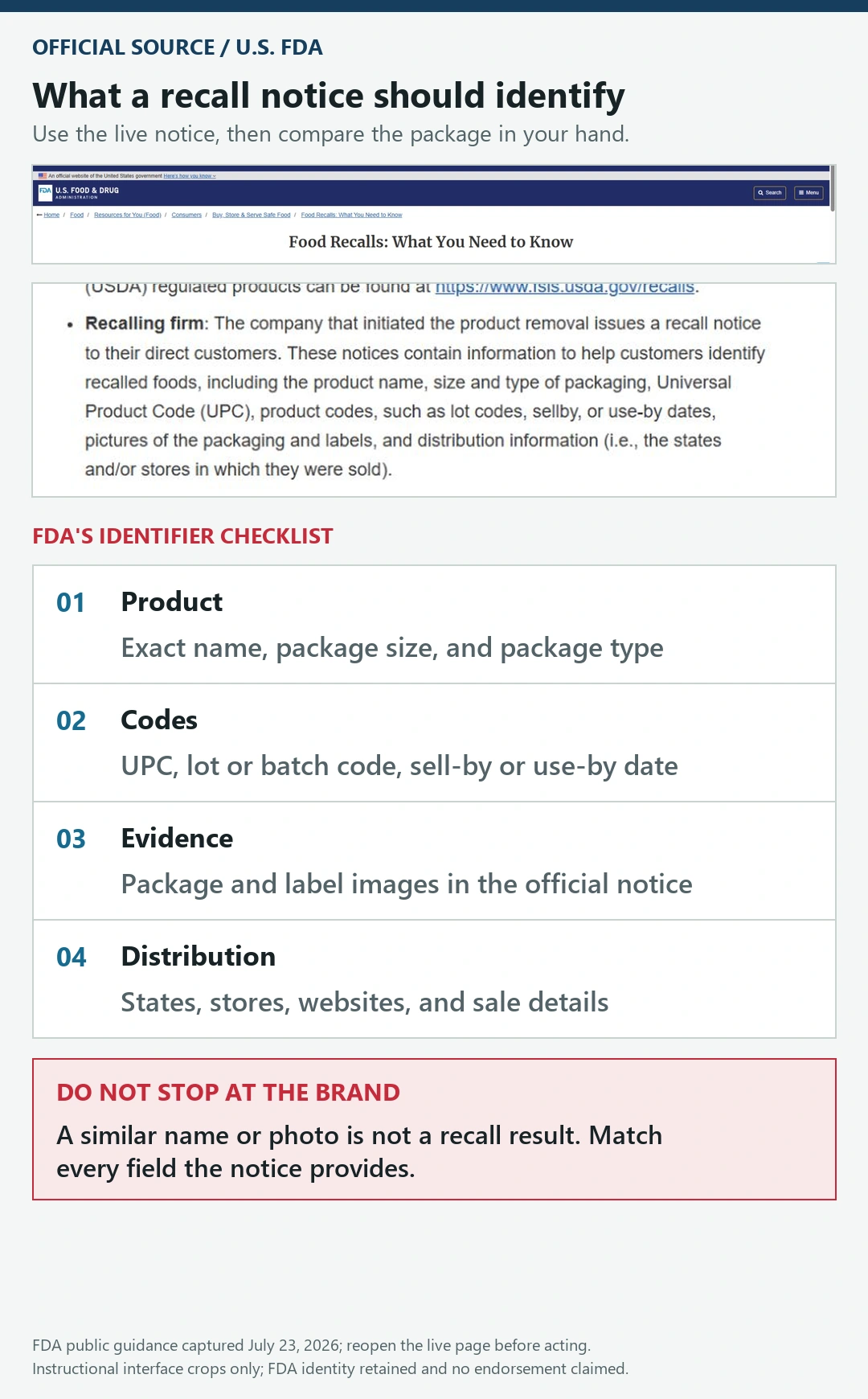
Match the package to the recall notice
- Confirm the exact product. Read the complete name, preparation type, age range, and container size. A matching brand alone is not a match.
- Read the scope sentence. Determine whether the notice says all lots, selected lots, specific batches, or a date range.
- Compare the UPC. Match every digit when a UPC is listed. Remember that the lot or batch may still decide whether one container is affected.
- Compare the lot or batch code character by character. Use a clear photo and enlarge it if a zero resembles the letter O or another character is unclear.
- Check the use-by date and package size. These can narrow the recall even when the product name and UPC match.
- Check distribution. Read the states, stores, websites, and sale dates in the notice. Distribution helps confirm context, but it should not overrule an exact identifier match without guidance from FDA or the company contact in the notice.
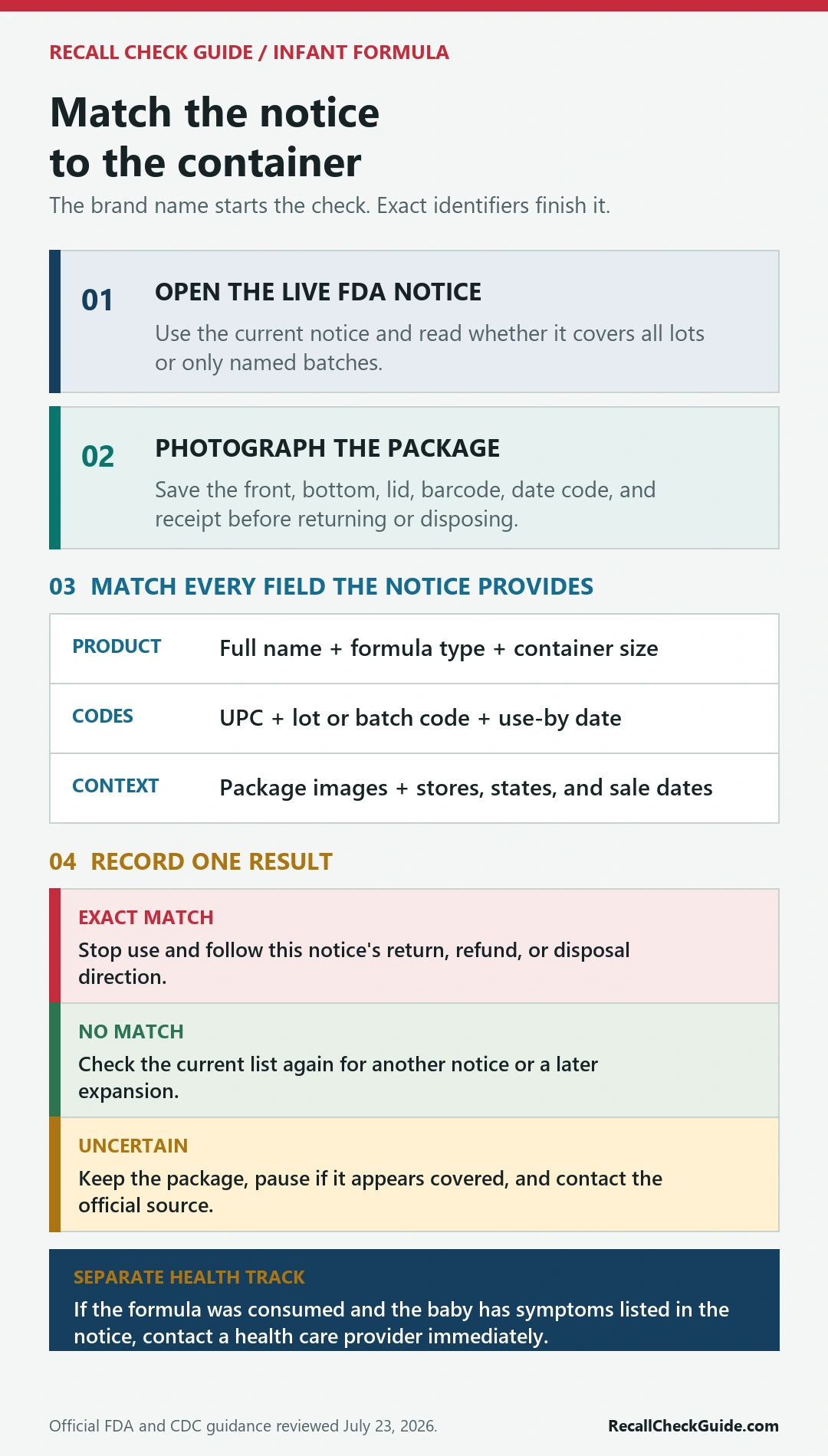
Use a simple written result: exact match, no match, or uncertain. Do not label a container safe when the code is unreadable or the notice has been updated since you saved it. For an uncertain result, keep the package, pause use if it appears to fall within an active warning, and contact the company or FDA through the contact route in the official notice.
What to do when the formula matches
Follow the product-specific action in the notice. FDA’s general food-recall guidance says recalled food is often returned to the store for a refund or disposed of according to the notice. Do not donate it, give it to another family, or feed it to a pet. Save the notice URL, package photographs, purchase record, and any refund or complaint confirmation.
- Stop using the matched container when the notice directs consumers to discontinue use.
- Do not discard the label or codes before documenting them and reading the remedy.
- Return or dispose of the product exactly as directed; contaminated-food notices may include cleanup instructions.
- Ask a pediatrician or other health care provider before substituting formula, especially for premature infants or babies using hypoallergenic, amino-acid-based, metabolic, or other medically necessary formula.
- Never dilute formula, change the water-to-formula ratio, or use a homemade recipe to stretch the supply.
The FDA’s safe formula handling guidance says not to use formula after its use-by date and to follow the label’s mixing and storage directions. FDA also advises against homemade infant formula. A recall does not make it safe to improvise a different concentration or recipe.
If your baby already consumed the formula
Read the health section of the exact recall or outbreak notice because symptoms depend on the hazard. If the notice says the product was consumed and your baby has the listed symptoms, contact a health care provider immediately. Tell the provider the product name, lot code, use-by date, when it was consumed, and what symptoms you observed. Keep the package unless a clinician or the notice tells you otherwise.
For Cronobacter, CDC says illness in infants often begins with fever plus poor feeding, excessive crying, or very low energy; some infants may have seizures. The CDC Cronobacter guidance says babies with these symptoms should be seen by a medical provider as soon as possible. Do not use a general symptom list to diagnose the cause or to rule out a different hazard named in a recall.
FDA’s current infant formula pages also provide routes for reporting an infant formula complaint or adverse event. Medical care comes first; a report does not replace evaluation or treatment.
If the container does not match
A clear mismatch across the product, size, UPC, lot or batch, and date fields means that particular notice does not identify the container. It does not prove that every possible safety issue has been ruled out. Search the current FDA list again by brand and product name, and check for a later notice or expanded recall.
Even without a recall match, do not use a damaged, leaking, swollen, rusted, or unsealed container. FDA advises checking for changes in formula color, smell, or taste and making sure case and container lot numbers and use-by dates agree. Contact the manufacturer and FDA if the package, label, seal, or formula appears abnormal.
If the code is missing or unreadable, do not guess from a product photograph. Photograph the package, retailer label, and purchase record, then use the consumer contact listed in the FDA notice or on the package. Record the date, representative, and answer so the decision can be traced later.
Match an infant formula recall by identifiers, not by brand alone
A brand can sell many unaffected products while one formula, package size, lot range, or production period is recalled. Keep the container until the official notice has been checked, and copy every identifier before contacting a seller or manufacturer. If the official notice tells consumers to stop using the product, follow that instruction first.
| Identifier | Where to look | How to compare it |
|---|---|---|
| Product name and formulation | Front label and nutrition panel | Match the complete name, not the manufacturer alone. |
| UPC or GTIN | Barcode panel | Preserve leading zeros and the package-specific code. |
| Lot or batch code | Bottom, lid, seam, label, or carton | Compare every character and any range boundaries in the notice. |
| Use-by or expiration date | Container and outer carton | Use the date format stated by the authority or manufacturer. |
| Package size and form | Net weight and powder, concentrate, or ready-to-feed label | A similar name in another size or form may be outside the notice. |
| Plant or establishment code | Near the lot or date code when present | Match only when the official notice names that identifier. |
| Notice revision and remedy | Official recall page | Reopen the current notice for expanded lots, updated dates, and instructions. |
A search that returns no match is not a general safety certificate. Check the official FDA or other responsible authority again if the notice changes, if the lot is hard to read, or if symptoms or a medical concern are involved. Consumers can also use the FDA’s Report a Problem route for FDA-regulated products. This guide helps match records; it does not diagnose illness or replace medical advice.
Related FDA recall guides
FDA and CDC sources checked July 23, 2026. Recall status can change; reopen the current official notice before acting.
For the June 2026 named action, use the Nara Organics infant formula recall guide because FDA says the scope covers all lots on the market.
Related official record checks
Use the guide that matches the exact agency, jurisdiction, tool, product, program, or record type; verify the live official source before acting.