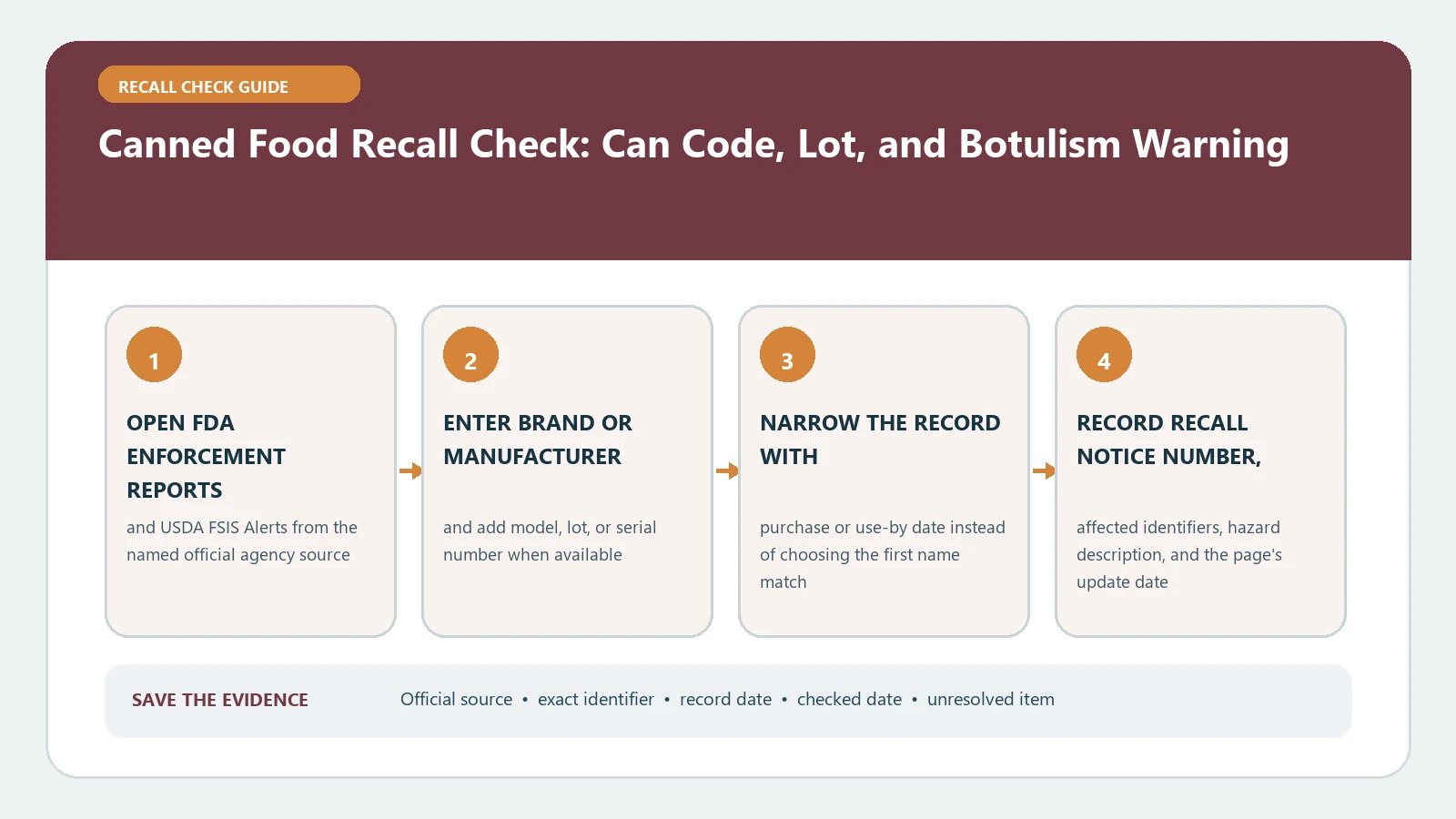
Do not open a suspect can to complete a recall check. Read the can code, UPC, date, product description, and any USDA establishment number from the outside, then compare those fields with the official FDA or FSIS notice. A botulism warning can apply to a narrow set of codes even when many cans share the same brand and label design.
Agency pages reviewed August 26, 2026. A recall may expand and a manufacturer may revise disposal or refund directions. Return to the live announcement before handling the container.
Keep the lid, seam, and stamped line intact
Set the can apart where it will not be knocked over. Photograph the top, bottom, full label, barcode, seams, and every printed or embossed line. Do not wipe a faint ink code with solvent, puncture the can, or taste the contents. CDC’s botulism prevention guidance identifies leaking, bulging, swollen, cracked, or otherwise abnormal containers as warning signs and says tasting cannot establish that food is uncontaminated.
A can code can combine plant, production line, date, and time in a format meaningful to the manufacturer. Consumers usually cannot decode it from a universal chart. The task is to transcribe the entire line and compare it with the code exactly as the notice presents it.
Route vegetable, seafood, and meat cans to the right agency
| Type of canned product | First federal recall route | Identifier likely to matter |
|---|---|---|
| Vegetables, fruit, beans, sauces, tuna, or most shelf-stable foods | FDA recall announcements and Enforcement Report | UPC, can code, lot, date, size, brand |
| Meat, poultry, or processed egg product under USDA inspection | FSIS recalls and public-health alerts | EST or P number, lot, date, can code, label |
| Mixed product with unclear oversight | Read the inspection mark and the named agency in the retailer notice | Full ingredient description and label photographs |
FDA’s food recall page explains that most foods fall under FDA while meat, poultry, and processed egg products fall under USDA. For USDA-regulated cans, FSIS recall guidance notes that an establishment number can appear on the lid or elsewhere on the exterior.
Treat the affected-product row as an exact conjunction
Open the complete announcement and locate the product table. Read across one row rather than collecting favorable details from several rows. A description, package count, UPC, can code, and best-if-used-by date may all be required. Distribution states or retailers help locate products but do not override a conflicting code.
- Match the brand and exact canned-food description.
- Compare the single-can size and multi-pack configuration separately.
- Copy the UPC from the can or wrapper, preserving all printed digits.
- Match the complete stamped can code and date, including suffixes.
- For an FSIS item, confirm the establishment number and view the attached label file.
- Save the recall number, issue date, reason, and named consumer action.
A pantry case can outlive the press headline
Canned goods can remain on shelves beyond the period when a recall dominates search results. Search FDA’s recall list and, when necessary, its Enforcement Report. Search FSIS Recalls and Public Health Alerts for USDA-regulated products. An administrative closure or an old announcement date does not alter whether the code on a stored can fits the original affected range.
If a store notice names a product but omits the can codes, follow its official agency or manufacturer link. If no full record can be found, ask the retailer for the recall number or recalling firm. A photograph shared in a neighborhood group is not a substitute for the affected-product table.
Recover a missing label from the stamped lid
A loose can with no paper label may retain its can code, embossed end mark, or USDA establishment number. Photograph those details and the can shape, then contact the manufacturer or retailer with the purchase history. Do not infer the food type from lid color or assign it to a recall because the code has a similar date. Until the company identifies it, keep the can in an unresolved category.
For a multi-pack, photograph the outer carton before separating the cans. The carton UPC and best-by line may define the retail product while each can carries a production mark. Record which inner codes came from that carton, but do not assume they are interchangeable. If the notice specifies both an outer UPC and an inner can code, both boundaries must agree on the same physical unit before it can be marked affected.
Keep home-canned food outside the commercial-recall matching ledger. It has no FDA company announcement, retail UPC, or FSIS establishment mark to compare. CDC’s botulism prevention guidance provides a separate handling route for home-canned containers and warning signs such as bulging, leaking, or spurting. Those signs are handling alerts, not a method for proving a commercially canned lot is contaminated or safe.
For FDA items, the FDA food recall check provides a broader announcement search. The USDA FSIS recall guide is the better route when an inspection legend or EST number appears.
Record the remedy without moving a damaged container unnecessarily
Follow the exact recall instruction for return, disposal, or contact. If the can is swollen, leaking, or damaged, do not carry it into a store before asking the recalling firm or local authority how it should be handled. Preserve the code from a distance if that can be done without touching leaked material. Health concerns after possible consumption belong with a medical professional and the official case details.
Create a final pantry log with one row per can or multi-pack: identifier photograph, agency, announcement, verdict, handling instruction, and completion evidence. Use the recall remedy guide if the retailer and manufacturer give different consumer responses. This guide cannot decode a proprietary can code or determine contamination; it helps compare the visible package with the agency record that controls the recall.
No result for a brand does not prove that a can is unaffected. The public FDA announcement page is not a complete list, and a meat or poultry can may belong in FSIS instead. A reliable exclusion cites the controlling agency record and the exact field that differs. When ownership or code interpretation remains uncertain, preserve the sealed container and obtain a manufacturer or agency answer before recording a final status.