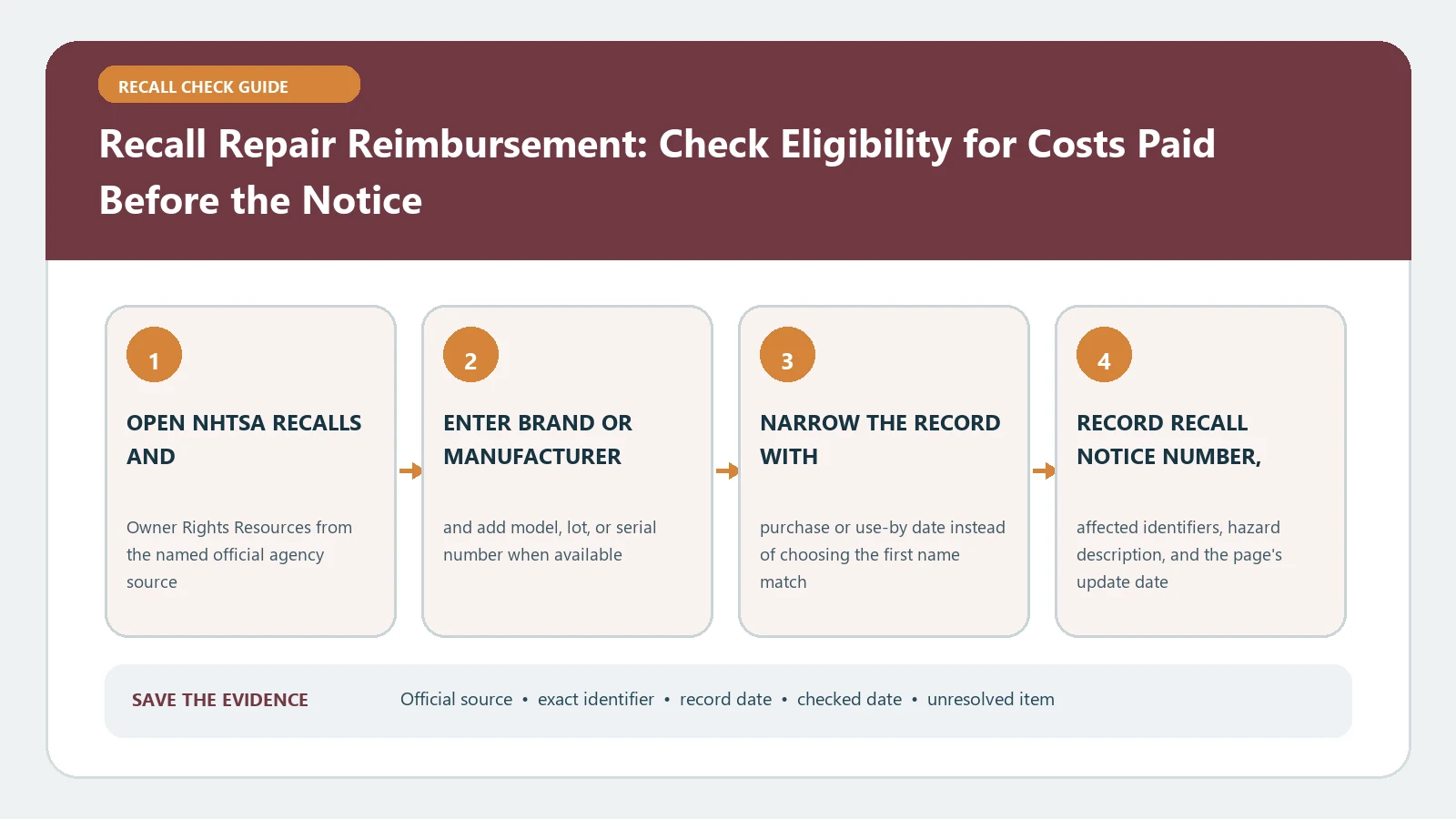
A repair paid before a vehicle recall notice may qualify for reimbursement only when the exact VIN is covered, the work addressed the same defect, and the campaign’s reimbursement rules are met. Keep the itemized invoice and proof of payment, identify the NHTSA and manufacturer campaign numbers, obtain the manufacturer plan or owner notice, and submit through the named claim route. Payment is not automatic merely because the later recall involved a nearby component.
NHTSA’s consumer recall booklet and recall page were reviewed August 26, 2026. Campaign plans and submission instructions differ, so verify the current owner notice and manufacturer terms before relying on any general explanation.
Link the earlier repair to the recalled defect
Start with the later campaign description. Copy the defective component, failure mode, remedy, NHTSA ID, manufacturer campaign number, and affected VIN result. Then read the earlier diagnosis and repair operation line by line. A receipt for brakes, wiring, or software is too broad if it does not show which part or condition was corrected.
Build a short comparison in neutral language: campaign required action, paid action, matching part or operation, and any gap. Do not rewrite the invoice or ask a shop to add work it cannot document. If the description is vague, request a copy of the repair order, technician story, parts list, diagnostic codes, or warranty submission that existed at the time.
Assemble the claim file before requesting a decision
| Claim element | Strong evidence | Common gap |
|---|---|---|
| Vehicle identity | Full VIN and ownership record for the repair date | Only make and model |
| Campaign | NHTSA ID, manufacturer number, owner notice | News article or generic recall headline |
| Repair | Itemized invoice, diagnosis, part numbers, labor operation | Credit-card total without work detail |
| Payment | Paid invoice, card record, canceled check, finance record | Unpaid estimate |
| Timing | Repair date and claim submission date | Undated screenshot |
| Claim trail | Case number, upload receipt, copies of every file | Telephone conversation with no record |
If the invoice contains unrelated maintenance, mark only the recall-related lines and retain the full original. Do not submit a cropped document that hides taxes, mileage, vehicle identity, or the relationship among parts and labor.
Find the campaign-specific reimbursement instructions
Confirm the open or historical campaign at NHTSA Check for Recalls, then obtain the owner notification letter and manufacturer reimbursement plan for that campaign. The claim address, online portal, requested documents, eligible repair period, and response process may be stated there. Use the current manufacturer route rather than sending financial records to a dealer email found in an old forum.
The official NHTSA vehicle-owner recall booklet says reimbursement is available under certain conditions for certain pre-recall remedy costs and that documentation is required. It also describes federal timing rules. That general statement does not decide one claim; the exact campaign, repair facts, manufacturer plan, and applicable rules control the outcome.
- Download or save the owner notice and reimbursement terms used for the submission.
- Submit copies in the requested format and keep the originals.
- Record the confirmation number, date, document list, and expected response path.
- Answer a document request with a dated supplement rather than replacing the original claim file.
Separate warranty history from recall reimbursement
A prior warranty denial can matter to the factual record, but it does not automatically approve or defeat reimbursement. Preserve the warranty claim, denial reason, mileage, dates, and repair invoice. Ask the manufacturer to evaluate the claim under the recall reimbursement plan, not simply reopen the earlier warranty conversation.
Similarly, roadside towing, rental cars, diagnostics, taxes, or consequential costs should not be assumed eligible because the repair itself may qualify. List each amount separately and ask which provision covers it. The recall remedy guide explains the campaign’s prospective remedy, while this page deals only with documented costs incurred before notice.
Track submission, review, approval, and payment separately
An upload confirmation proves delivery to a portal, not eligibility. A case-open email proves the file entered review, not that every document was accepted. When the manufacturer requests more information, preserve the original submission and add the new file with a clear date and description. This creates a timeline if the evidence is later questioned.
For an approval, confirm the approved amount, payment method, payee, and expected timing. Compare the amount with the itemized claim rather than treating any check as full resolution. If part of the request is denied, ask which expense and plan term produced the difference. A payment record should be attached only after funds are actually received.
Recover a missing receipt without inventing proof
Ask the repair facility for a duplicate invoice using the VIN, repair date, customer name, payment method, or work-order number. Bank or card records can support payment but rarely show the defect or part corrected. Parts receipts, inspection reports, photographs, and contemporaneous messages may help explain the file, subject to the manufacturer’s stated evidence rules.
The remedy evidence guide for a missing receipt offers recovery paths without promising acceptance. If the claim is denied, request the reason, cited plan term, missing evidence, reconsideration route, and deadline in writing. Keep a copy of every version. A denial, request for more information, approval, and actual payment are separate statuses; close the record only when the manufacturer gives a final documented decision and any approved funds are received.
When a repair shop has closed, identify any successor, records custodian, franchisor, parts supplier, insurer, or card processor that may retain contemporaneous evidence. Describe the missing source honestly in the claim. A later personal statement can explain context, but it should not be presented as an original invoice or technician diagnosis.
If the vehicle changed owners after the repair, document who owned it when the cost was incurred and who is submitting the claim. Keep sale and registration records only to the extent the plan requests them, and redact unrelated sensitive information when the approved route permits. Ask the manufacturer how a leased, fleet, or jointly owned vehicle should be handled instead of assuming the current driver is the payee.
A reimbursement file should remain narrower than a damages claim. It records a vehicle, a campaign, a pre-notification remedy cost, and the manufacturer’s decision under its plan. Medical expenses, lost time, property damage, or other disputes require their own advice and process; do not fold them into an invoice total merely to make the repair claim larger.
For the underlying campaign record, use the vehicle recall check to keep the VIN and dealer remedy status current. This guide is practical recordkeeping, not legal advice, and it does not determine reimbursement eligibility or resolve a dispute.