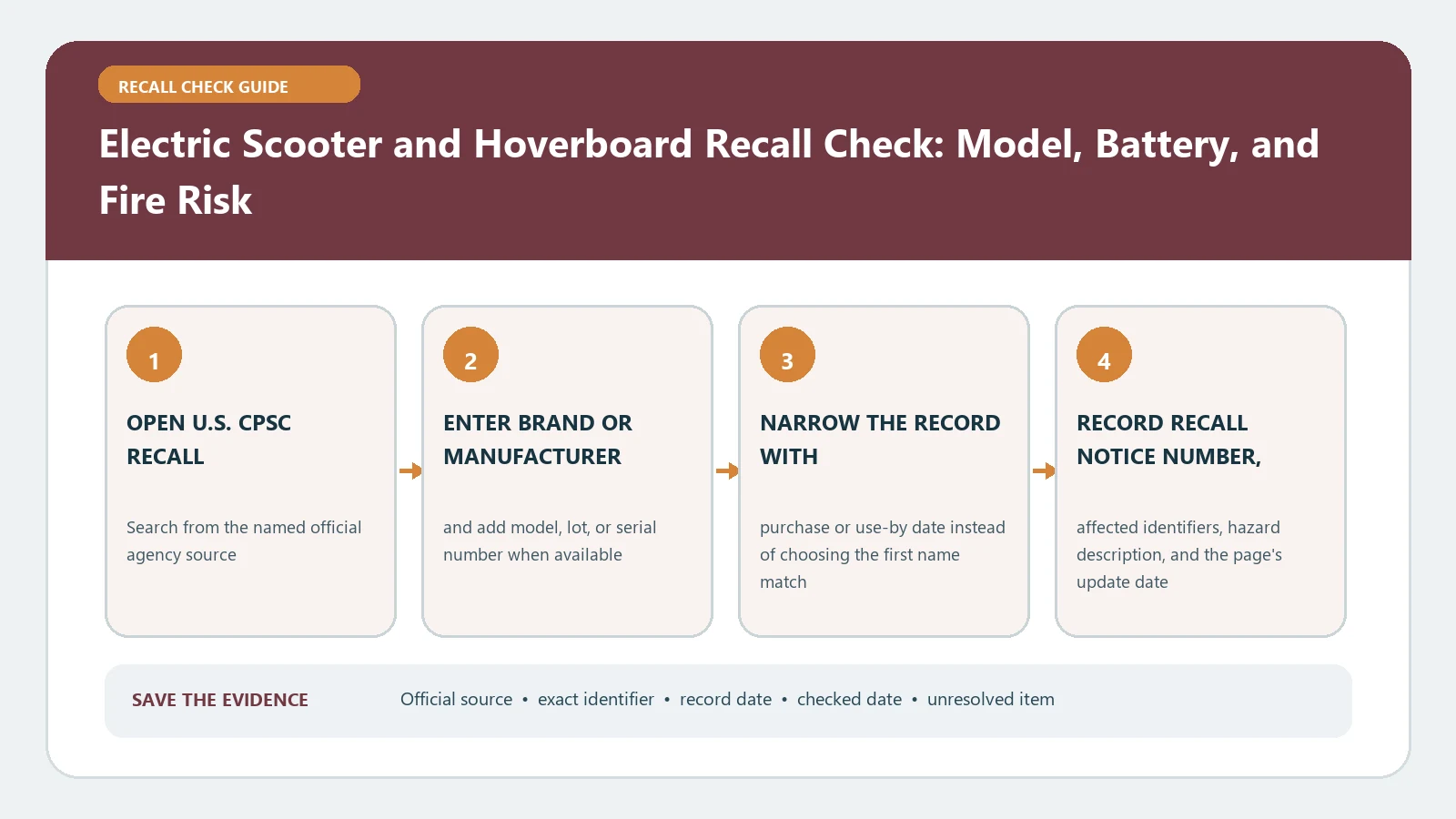
Check an electric scooter or hoverboard as a system: vehicle model and serial number, removable or built-in battery pack, charger model, and the exact product description in the CPSC notice. Some recalls cover the whole device; others identify only a battery or charger. Do not ride or recharge a possible match while you are still deciding which component the notice covers.
Current federal routes reviewed August 26, 2026. CPSC states that recall data update weekly and remedy availability can change daily, so open the live notice again before starting a claim or moving a battery.
Inventory the deck, battery, charger, and purchase record separately
Power the device down and photograph the labels without opening the battery enclosure. On a scooter, inspect the underside of the deck, stem, folding joint, battery compartment exterior, and charger brick. On a hoverboard, the model label may sit on the bottom shell while the charger carries its own electrical code. Preserve the retail box or invoice when available.
| System component | Identifier to record | Why a separate row matters |
|---|---|---|
| Scooter or hoverboard | Brand, model, serial, color, manufacture date | The chassis may define the recalled finished product |
| Battery pack | Pack model, serial, voltage, capacity, date code | A component campaign can cover only selected packs |
| Charger | Model, output rating, connector, included accessory name | The remedy may replace a charger rather than the vehicle |
| Order evidence | Retailer, seller, order date, invoice | Supports channel and purchase-window checks |
| Current condition | Heat, swelling, odor, smoke, impact, water exposure | Determines whether ordinary claim handling is inappropriate |
Search the finished device before searching loose batteries
- Open CPSC Recalls and Product Safety Warnings and search the exact brand plus model.
- Repeat with hoverboard, self-balancing scooter, electric scooter, or another term used on the label.
- Search the battery and charger model codes independently when their labels are readable.
- Open every plausible dated notice and compare its product photographs and description.
- Save the recall number and use the company contact linked by the matching CPSC page.
Do not search by marketplace listing title alone. Third-party sellers can reuse family names, merge product variations, or show a current replacement under an older order. The physical labels establish what is present now. If the vehicle was repaired or its battery replaced, record the original and replacement components as separate configurations.
Translate the CPSC description into an inclusion test
Read the notice’s Description section as a parts list. Identify whether it requires a model, serial range, date code, color, battery code, seller, or manufacture period. Compare all required fields from the same notice. Product photographs support recognition, but a photograph without the listed identifier does not finish the test.
Next read Hazard and Remedy as separate fields. Hazard explains the problem that led to the action. Remedy tells the owner whether the announced program offers refund, replacement, repair, or another response and how to contact the administrator. Never substitute the remedy from a different scooter notice because it appears easier to complete.
A swapped battery creates two possible recall histories
A used scooter may contain a replacement pack from a repair shop, marketplace seller, or previous owner. The chassis label answers the finished-device search, while the installed pack label answers the component search. Record who installed it and when, but do not assume that physical compatibility means the pack was approved for that scooter.
If the pack label is hidden behind a sealed enclosure, do not open the device merely to satisfy a search. Use the serial number and manufacturer support route to ask for the factory configuration. For a broader battery-only workflow, the e-bike battery recall check shows how to separate pack and charger identifiers, while the battery and power bank guide covers smaller consumer devices.
Treat heat, swelling, smoke, or damage as a handling exception
Do not continue an ordinary return workflow with a battery that is hot, swollen, smoking, leaking, punctured, or visibly damaged. Move people away and use the emergency or local fire-authority route appropriate to the condition. Do not place a lithium-ion device in household trash, curbside recycling, or a general retail battery box unless the matched recall and local authority expressly provide that route.
For an intact unit, follow the recall administrator’s instructions about photographs, disabling, transport, shipping, disposal, or pickup. A carrier acceptance label from an unrelated battery return does not authorize mailing this one. Save the written direction before the device leaves your control.
Recover a mismatch before using incident reporting
If the product caused an incident or appears hazardous but no recall record fits, CPSC’s SaferProducts incident-reporting route accepts consumer reports. Record the product identity, seller, event date, photographs, damage, and any medical or fire response. An incident submission is not a recall claim and does not create a refund or replacement decision.
When a claim form rejects a readable identifier, confirm that the model belongs to that exact notice, then compare letter-number characters and purchase market. Preserve the rejection screen and contact the administrator linked by CPSC. Do not alter the serial or try multiple programs until one accepts it.
Build a no-result evidence packet before escalating: full deck label, battery label, charger label, serial close-up, seller and purchase date, current CPSC notice URL, search terms used, and the exact rejection text. Ask whether the device is outside scope, the identifier format is wrong, or the remedy program is temporarily unavailable. Those are different outcomes. A blank search or rejected claim does not prove the scooter, hoverboard, or battery is unaffected, and an incident report cannot substitute for the administrator’s eligibility decision.
Close the case at component level
Your final record should say what happened to the vehicle, battery, and charger individually. Attach label photographs, the dated CPSC notice, manufacturer case number, handling instruction, and refund, repair, replacement, or disposal evidence. If the promised action stalls, use the recall remedy check without sending the device through an unapproved route.
This guide does not test a battery, authorize transport, or determine whether a device presents an immediate hazard. It helps the owner keep four identities and the exact CPSC record aligned so the official notice, rather than appearance or seller language, controls the next action.